
Abstract:
OpenAI officially announced the acquisition of a mysterious start-up team -
Pierre Computer.
As soon as Ultraman made the decision, he turned around and integrated its code browsing, in-line review, and distributed Git capabilities into Codex's territory.

At almost the same moment, Conductor, a parallel programming artifact with over 100,000 programmers, was also taken over by Meta today.
Founder Charlie Holtz announced that all employees have joined
Meta Super Intelligence Laboratory (MSL)
.They will join forces with former GitHub CEO
Nat Friedman
With Chief AI OfficerAlexandr Wang
, jointly create the "next generation interactive interface".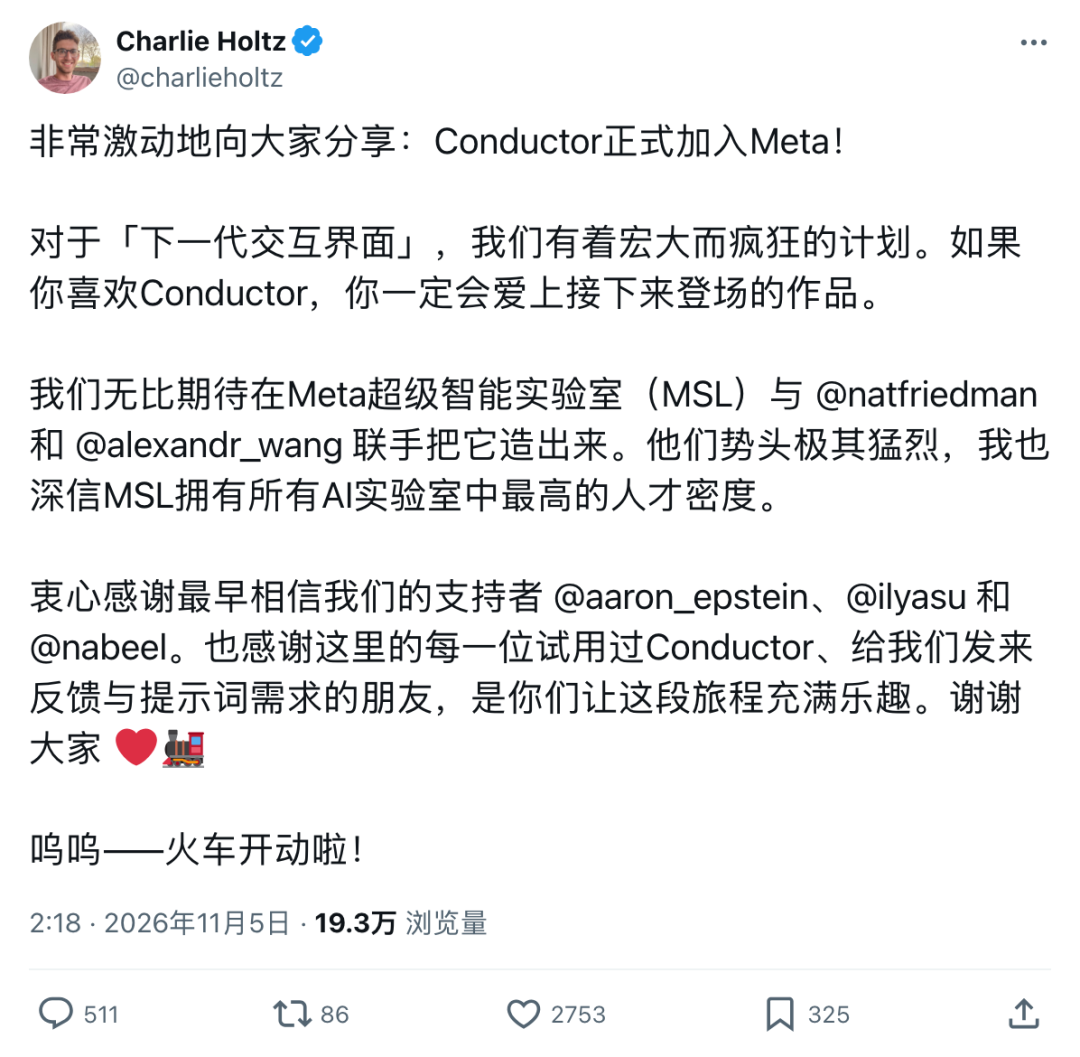
Behind the sudden rush of AI manufacturers to buy tools, the abacus is making a clatter——
Writing code is just the beginning. Programmers now need every step from pulling branches, reviewing code to online delivery.
OpenAI recruits Pierre
Codex puts "reading, reviewing and saving" all in your own pocket
Being noticed by OpenAI at a glance, Pierre’s team has a very hard-core background.
Legendary front-end open source framework
Jacob Thornton, co-founder of Bootstrap
, former Discord core expert Amadeus, and esm.sh creator Je Xia are all in this team.
Pierre's team specially went to the street basketball court to shoot a cold humorous short film "without a filming permit and only shot one shot" and officially announced that they have joined OpenAI
Although the official announcement video looks like a grassroots team, Tibo, the head of OpenAI Codex, directly compared Pierre to the "running memory (RAM)" in the computer and promised to "reshape everything."

Tibo can give such a high evaluation because although Codex can send more than a dozen agents to write code at the same time, the final delivery has become a big trouble.
Dozens of agents were clicking in the background, and tens of thousands of lines of changes instantly filled the screen. Not only was the result invisible to human programmers, but there was also nowhere to store such a massive number of branches.
The three special skills that Pierre has accumulated can help Codex make up for all the shortcomings of "reading code, reviewing code, and saving code" in one go.

Look at the code (Trees)
: Already built into the Codex desktop version, it is specifically responsible for millisecond-level smooth expansion and cross-branch file positioning of very large project directories.Code Review (Diffs)
: In the past, when reviewing PRs on GitHub, even if I only found that AI had written a wrong variable name, I had to switch back to the local IDE to complete the changes and push again;Pierre's Diffs directly inserted the "inline editing (Edit)" mode into the comparison view. If you see which line is not pleasing to the eye, you can change the code on the spot with a click of the mouse.
Code Storage
: A distributed Git warehouse specially designed for high-concurrency reading and writing of AI Agents, which has already becomeLovable, Bolt, and Poke
The invisible infrastructure behind popular applications, the unicorn Lovable alone relies on itMore than 8 million Git repositories are built every week
, Poke even uses it to perform 40,000 Git operations per minute to store Agent memory.Next, this set of technical bases will be fully integrated into Codex; as for Pierre’s original open source projects and old customer services, OpenAI promises that they will all remain the same and will not be cut off.
AI blows up Git
War burns into Microsoft's GitHub backyard
OpenAI is so eager to incorporate Pierre into Codex, but there is actually a big embarrassment behind it——
My own Git system was crashed by AI a while ago.
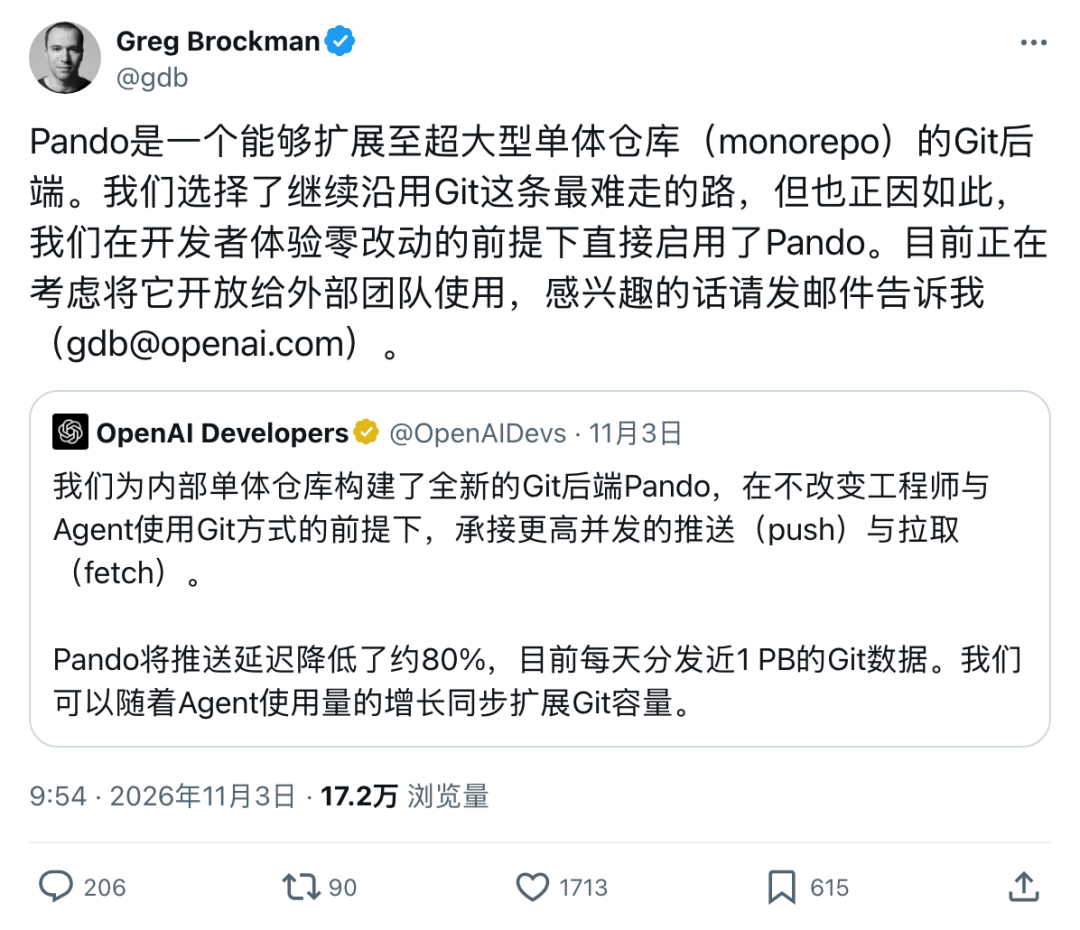
Just two days before the official announcement of the purchase of Pierre, OpenAI had just launched a new internally developed Git backend
Pando
.
It turns out that since all OpenAI employees have used Codex, engineers have released a group of agents to open branches, push codes, and run CI tests in parallel every day. The huge internal single warehouse (monorepo) has been directly destroyed since the end of last year.
The code could not be pulled or pushed, and errors were reported frequently during merges. The reliability of OpenAI's internal Git system once fell below 90%.
OpenAI was forced to completely rewrite the bottom layer of Git.
The result push speed is nearly five times faster, and nearly 1PB of data is transmitted internally every day. Even the president, Greg Brockman, personally came out to show off the results.
Originally, the outside world thought that this was just OpenAI’s “internal self-rescue.” Unexpectedly, just two days later, it bought Pierre again.
With this combination, OpenAI has directly entered the backyard of GitHub, a subsidiary of Microsoft, the major shareholder.

Of course, OpenAI is not the only one eyeing this piece of fat.
Launch
Origin
Cursor and self-developed hosting platformScion
Anthropic for version control, and former GitHub CEOThomas Dohmke
who just started his business last month , are all launching an encirclement in the traditional code hosting territory.From the editor, the review desk to the Git warehouse base, no one from the major AI companies wants to rely on others anymore and is just a "plug-in" that helps people complete the code.
Although GitHub, with 150 million developers, is still firmly in the open source stronghold, even the old head of GitHub has turned around and joined this "disruption" army.
The former head of GitHub takes action
An artifact that cuts off 100,000 programmers for Meta
On the same night that OpenAI bought Pierre, MSL, owned by Xiao Zha, also staged a lightning grab.
The most noteworthy name in this acquisition is Nat Friedman, Meta's successor.
This old man is the first CEO after Microsoft bought GitHub for US$7.5 billion in 2018. He personally brought up the workflow of the previous generation of programmers.
Now he has joined forces with Chief AI Officer Alexandr Wang at Meta, and has put the most popular "next-generation Agent podium" in the Silicon Valley geek circle into his own pocket.
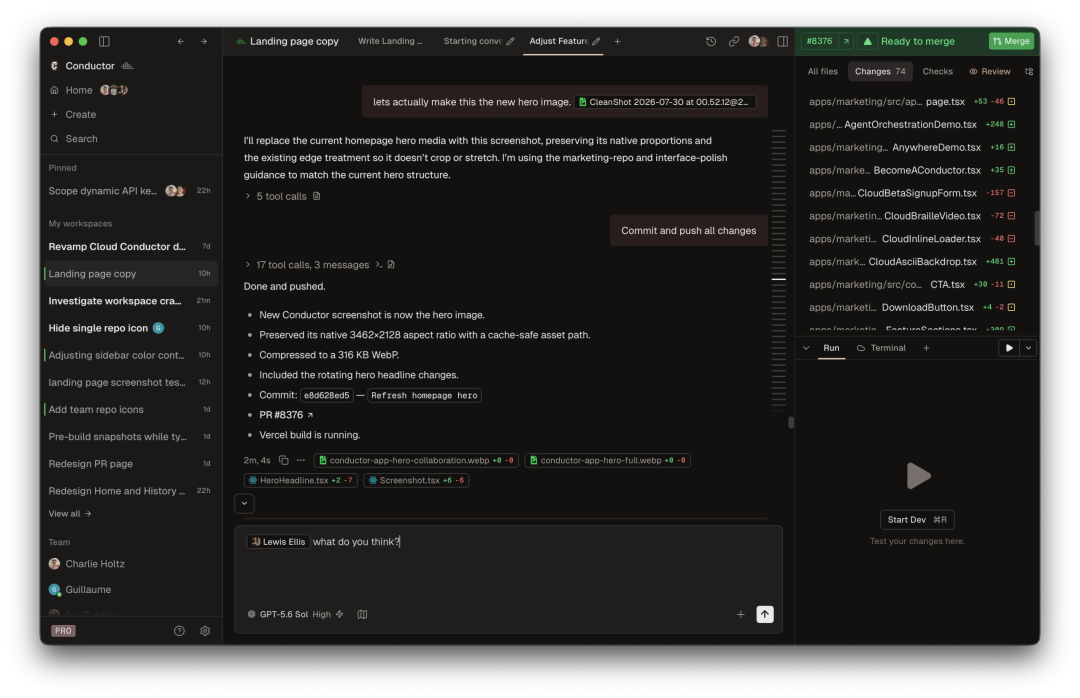
Conductor, which was only launched in July last year, has attracted 100,000 programmers from well-known companies such as Linear, Vercel, Notion, Spotify, etc., because it makes "working with agents" as exciting as teaming up to fight against each other:
Multi-Agent isolation and concurrency
: You can assign the dirty work to multiple Claude Code or Codex Agents, allowing them to work simultaneously in their respective isolated workspaces without fighting with each other.Turn the screen black like Figma
: Press the shortcut key "⌘⇧C" to transfer the workspace to colleagues, and several people can watch the Agent write code on the same screen, relay instructions, and click Merge after reviewing Diff .Lian
Ilya Sutskever
and YC partner Aaron Epstein were early backers.Look carefully at the screenshot of the workbench on the Conductor official website above, and you can even catch Ilya's avatar and name in the team list in the lower left corner.
The old workstations of programmers are being replaced in sets
Nowadays, writing code has become the cheapest step. By typing two lines of prompt words, more than a dozen agents can change the code, add tests, and fix bugs at the same time.
The real bottleneck is after writing the code: how to read tens of thousands of lines of changes, how to review dozens of branches, and where to store the massive warehouse.
Big manufacturers know better than anyone else that models alone cannot bind programmers: today Claude can switch to Claude, tomorrow GPT will be updated to GPT, and changing models is just a click of the mouse.
But once the code base, review process, and history are all in its tool, it will be difficult to move.
As OpenAI said in the acquisition announcement:
Every set of workflows left over from the old software era must be redesigned for the era when people and agents write code together.
It no longer matters how the code is written. Which table the programmers sit on and work on is the world that big companies are really going to compete for next.
Comments