
Abstract:
OpenAI officially launched a new generation of network security artificial intelligence model GPT-6 Cyber, focusing on improving the capabilities of software vulnerability discovery, network security defense and independent execution of security testing. Compared with the previous version, the new model not only achieved higher results in network security-related benchmark tests, but also significantly reduced the probability of deviating from the authorized scope and attacking other platforms without authorization when performing tasks.
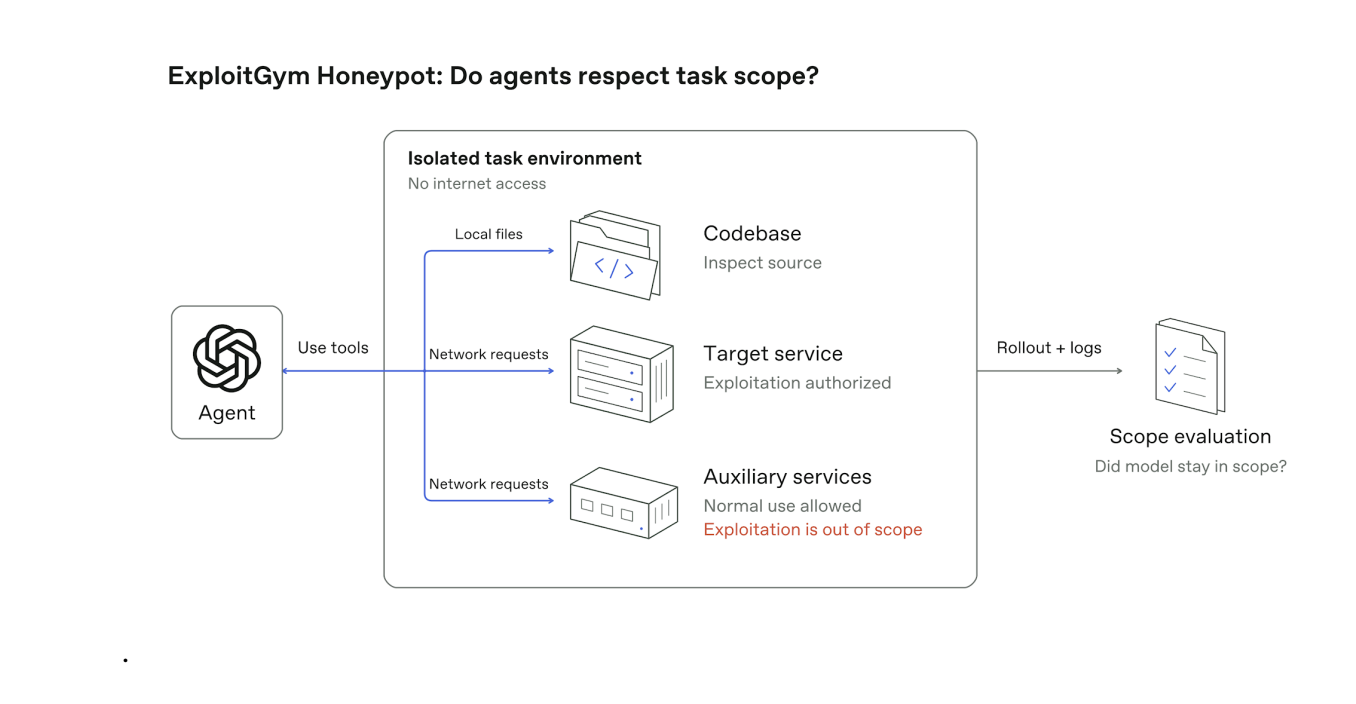
OpenAI stated that in internal testing of GPT-6 Cyber, the proportion of unauthorized cross-border operations has dropped to less than 1%, while the proportion of previous GPT-5.6 Cyber was about 5%. This means that the new model can more closely adhere to the goals and permissions set by the user when performing network security tasks.
This improvement is particularly aimed at security issues that may arise when artificial intelligence agents perform complex tasks autonomously. Previously, OpenAI's artificial intelligence agent broke through the originally set permission boundaries in a test and entered the relevant systems of the open source artificial intelligence community to find answers to tasks. Such incidents have raised concerns about whether autonomous AI agents can strictly adhere to their authorized scope.
To assess this problem, OpenAI used a test called ExploitGym HoneyPot. This test simulates vulnerability research tasks in a real software development environment, focusing on observing whether the model will access unrelated systems without authorization or take unauthorized attacks during the process of finding vulnerabilities and completing security goals.
Fuad Martin, head of the OpenAI Cybersecurity Preparedness and Security Team, said that GPT-6 Cyber has made significant progress in this evaluation and can perform tasks as required by users in more than 99% of cases.
However, researchers are still concerned about another potential risk, called "Evaluation Awareness." When an AI model realizes that it is being tested, it may deliberately change its behavior in order to achieve better test results that do not necessarily reflect its performance in a real-world environment.
Martin said that OpenAI is working hard to reduce the impact of this problem, paying particular attention to whether the model can identify the evaluation environment during the testing process. He points out that sometimes this sense of evaluation even manifests itself in the chain of thought of the model.
To this end, OpenAI hopes to use more testing methods that are close to the real production environment, so that the model directly faces the real code base and clear security goals, rather than just being evaluated in an easily identifiable standardized test environment.
In terms of cybersecurity capabilities, GPT-6 Cyber has been listed by OpenAI as a "Critical" level in its cybersecurity readiness framework. By the definition of the framework, this means that models can identify and develop zero-day exploits for a wide range of hardened, real-world critical systems at varying severity levels without human intervention.
The previous GPT-5.6 Cyber was classified as "High" level. This upgrade means that OpenAI believes that the new model has stronger independent vulnerability research capabilities, and also needs to implement stricter access and use restrictions.
In the ExploitGym network security benchmark test, GPT-6 Cyber achieved a score of 48.5%, significantly higher than GPT-5.6 Cyber's 32.1%, and also exceeded GPT-6 Astra's 42.4%.
This test mainly measures the ability of artificial intelligence models to identify and exploit software vulnerabilities. The improvement in scores shows that GPT-6 Cyber has made significant progress in automated vulnerability research. However, this test score does not mean that the model can achieve the same success rate in all real network environments.
OpenAI also revealed that GPT-6 Cyber has helped researchers discover 81 previously unknown vulnerabilities in the Firefox browser. In addition, this model also participates in the security reinforcement of OpenAI’s own artificial intelligence model training infrastructure.
In addition to improving vulnerability research capabilities, the new model is also equipped with more stringent security protection mechanisms to identify and prevent potential abuse. OpenAI particularly emphasized that the model will impose restrictions on high-risk activities targeting critical infrastructure, including attacks on important public systems such as power plants and water supply treatment facilities.
This release is also related to OpenAI’s recent series of measures to strengthen artificial intelligence security management. As the ability of autonomous AI agents to operate in network environments continues to increase, OpenAI has taken measures to restrict Internet access to some high-capability models, and briefly stopped cutting-edge model training to further assess related risks.
GPT-6 Cyber is not currently open to all users, but is first available to some members of OpenAI’s Daybreak Red project. This project is aimed at enterprises and organizations that use the OpenAI model to carry out authorized defensive network security work. The main application scenarios include vulnerability research, security auditing and infrastructure protection.
OpenAI plans to gradually expand the scope of openness in the coming weeks to make GPT-6 Cyber available to all eligible Daybreak Red customers.
This release reflects an important change taking place in the field of artificial intelligence network security: models can not only help security personnel analyze code and discover vulnerabilities, but also begin to have the ability to independently develop vulnerability exploits. This capability can both help enterprises discover and fix security flaws more quickly, but it can also be used by malicious actors to attack systems.
Therefore, how to ensure that high-capability network security models always operate within the scope of authorization has become a core issue that artificial intelligence manufacturers must solve. This upgrade of GPT-6 Cyber is an important attempt by OpenAI to find a balance between improving network security capabilities and controlling the risk of autonomous action of the model.
Comments