
Abstract:
AMD's next-generation "Medusa Point" APU recently appeared in the Geekbench test database, showing its 10-core 20-thread CPU configuration for the first time. Judging from the available information, the processor adopts a hybrid architecture design, consisting of 4 "Zen 6" cores and 6 "Zen 6c" cores, indicating that AMD will continue to use a hybrid solution of large and small cores on the new generation of mobile platforms.
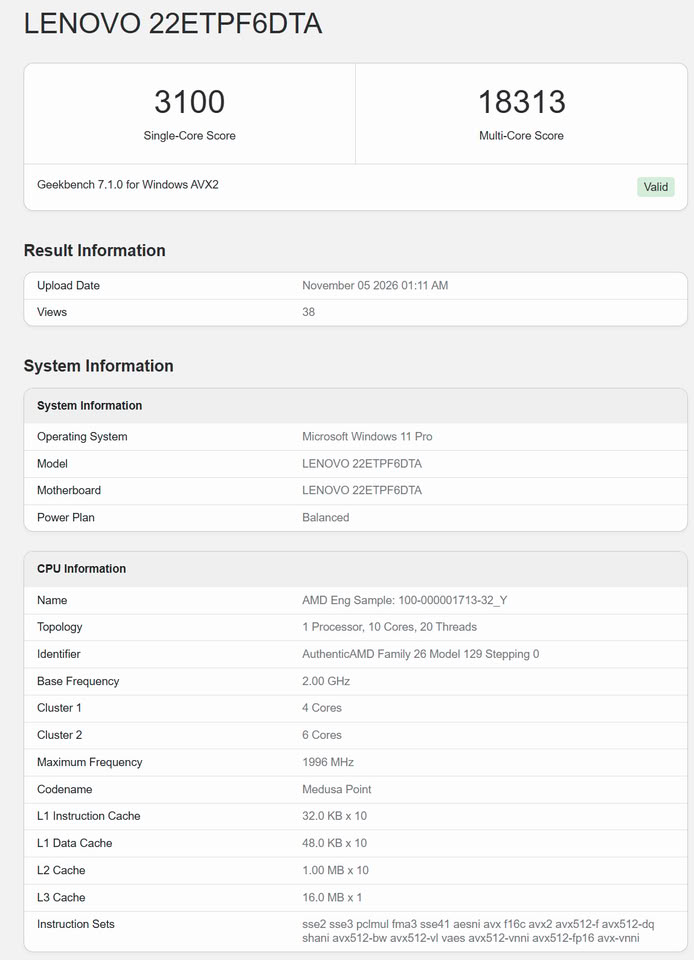
In terms of cache configuration, each core is equipped with a 32 KB first-level instruction cache, a 48 KB first-level data cache, and a 1 MB second-level cache. All cores share a 16 MB third-level cache. The test sample shows a base frequency of 2.0 GHz, while the highest frequency recorded by Geekbench is just 1996 MHz. It is generally believed in the industry that this data is likely due to frequency identification errors in early engineering samples rather than the true acceleration frequency of the final product.
From the instruction set information, the processor supports the complete AVX-512 technology, including AVX512-FP16, AVX512-VNNI and AVX-VNNI extended instructions, providing stronger support for artificial intelligence computing, high-performance computing and multimedia processing. The test platform is equipped with approximately 55.58 GB four-channel DDR5 memory, and the running speed reaches 5188 MT/s.
New clues also appeared in the graphics part. According to the news, “Medusa Point” will introduce a new graphics architecture variant called RDNA 4m. Although there is still a lack of direct comparison data with standard RDNA 4, judging from the new instruction extensions such as WMMA and SWMMAC, this GPU code-named "GFX1170" has more advanced functional support.
At this stage, it is generally believed that RDNA 4m may be an upgraded version based on RDNA 3, integrating some RDNA 4 architecture modules to enable it to support new generation graphics technologies such as FSR 4. In other words, even if it is positioned lower than a high-end independent graphics card platform, "Medusa Point" is still expected to gain more advanced graphics features and AI-related capabilities.
In terms of performance, the engineering sample exposed this time achieved a single-core score of 3100 points and a multi-core score of 18313 points in the Geekbench test. For reference, the current average single-core score of the 16-core Ryzen AI Max+ 395 is about 2742 points, and the multi-core score is about 27412 points. In comparison, "Medusa Point" leads by about 13% in single-core performance, but due to the smaller number of cores, multi-core performance lags behind 16-core products, which is also in line with expectations.
It is worth noting that the test objects this time are still early engineering samples, and their frequency seems to be limited or there are identification anomalies. Therefore, as AMD continues to improve frequency tuning, firmware optimization, and finalizes the mass production version, the final retail product is expected to have higher overall performance than the current test results.
As more and more engineering samples surface, "Medusa Point" is gradually unveiled. As an important member of AMD's next-generation APU products, its design route combining Zen 6 architecture and RDNA 4m graphics technology is expected to play a key role in the future high-performance notebook market.
Comments