
Abstract:
AMD CEO Lisa Su’s performance at the helm of the chip company has been impressive. When she joined AMD as an executive in 2012, the company was nearly bankrupt. After officially becoming CEO in 2014, Su Zifeng used his trademark humility and enthusiasm for technology to completely reshape the company and make it Nvidia's strongest rival. She has led several major deals, including the acquisition of Xilinx, and a partnership with Meta that could see the social media giant take up to 10% of AMD in the future.
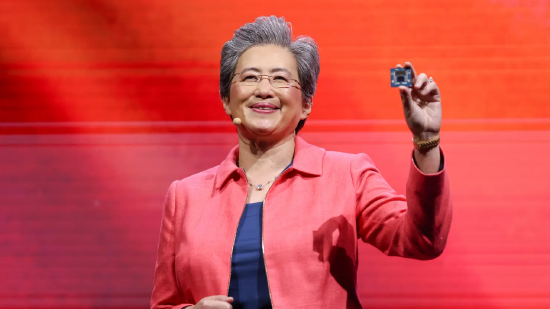
With Su Zifeng at the helm, AMD's stock price has been soaring, and this year the market finally fully recognized her achievements.
Led by the overall rise in technology stocks, AMD's stock price surged 9.9% on Monday, with its market value exceeding US$1 trillion for the first time. The stock is up 185% year to date, far outpacing rival Nvidia's 22% gain.
The chip manufacturer has received frequent good news this year, pushing its stock price higher.
Earlier this month, AMD's second-quarter results all exceeded Wall Street expectations. Non-GAAP earnings per share reached a record $1.66, while the market consensus was $1.61. Total revenue surged 50% year-on-year to a record high of $11.5 billion, which was higher than analysts' expectations of about $11.34 billion.
The growth in both revenue and profit is mainly driven by the data center segment. Thanks to strong demand for EPYC server CPUs and Instinct series AI acceleration chips, revenue in this segment more than doubled year-on-year to US$6.7 billion.
AMD predicts that server CPU revenue will increase by 80% year-on-year in the second half of 2026 and 70% year-on-year in 2027; overall data center revenue is expected to more than double in 2027, with AI graphics processors (GPUs) growing at a rate well over 100%.
AMD also released a new generation of AI chips, with the main products being the Instinct MI450 series GPU and the sixth-generation EPYC Venice CPU. Based on these new chips, AMD launched the Helios system. This integrated platform integrates GPU, CPU, network and software and is specifically used for the training and reasoning of large models, directly challenging Nvidia's AI dominance.
At the same time as the new product was released, AMD finalized two major cooperation deals. Microsoft will deploy the Helios system in its Azure artificial intelligence service in the second half of 2026.
AMD has also reached an in-depth cooperation with Anthropic to further expand its business and launch an impact on NVIDIA in the AI infrastructure market. Anthropic plans to deploy Instinct MI450 GPUs with up to 2 gigawatts of total power in Helios systems starting in the first half of 2027, in a deal that could be worth tens of billions of dollars long-term. AMD also pledged to invest up to $5 billion in Anthropic, one of the chip company's largest strategic investments ever.
The market demand for AI chips is particularly strong.
Su Zifeng said: "We are reaping the rewards of our early investment. Computing power is now a scarce resource... We are confident in the prospects of market demand."
Comments