
Abstract:
r/opensource, an open source software discussion community under Reddit, a well-known American social platform, recently launched a series of new submission rules. The most controversial of them is that it prohibits the publication of projects that use artificial intelligence, are generated by artificial intelligence, or are specifically oriented toward artificial intelligence. The community management team believes that the current stage of artificial intelligence is incompatible with the open source values upheld by the community. This decision quickly sparked controversy among users, and even prompted some developers to create new communities to accommodate projects excluded by the new regulations.
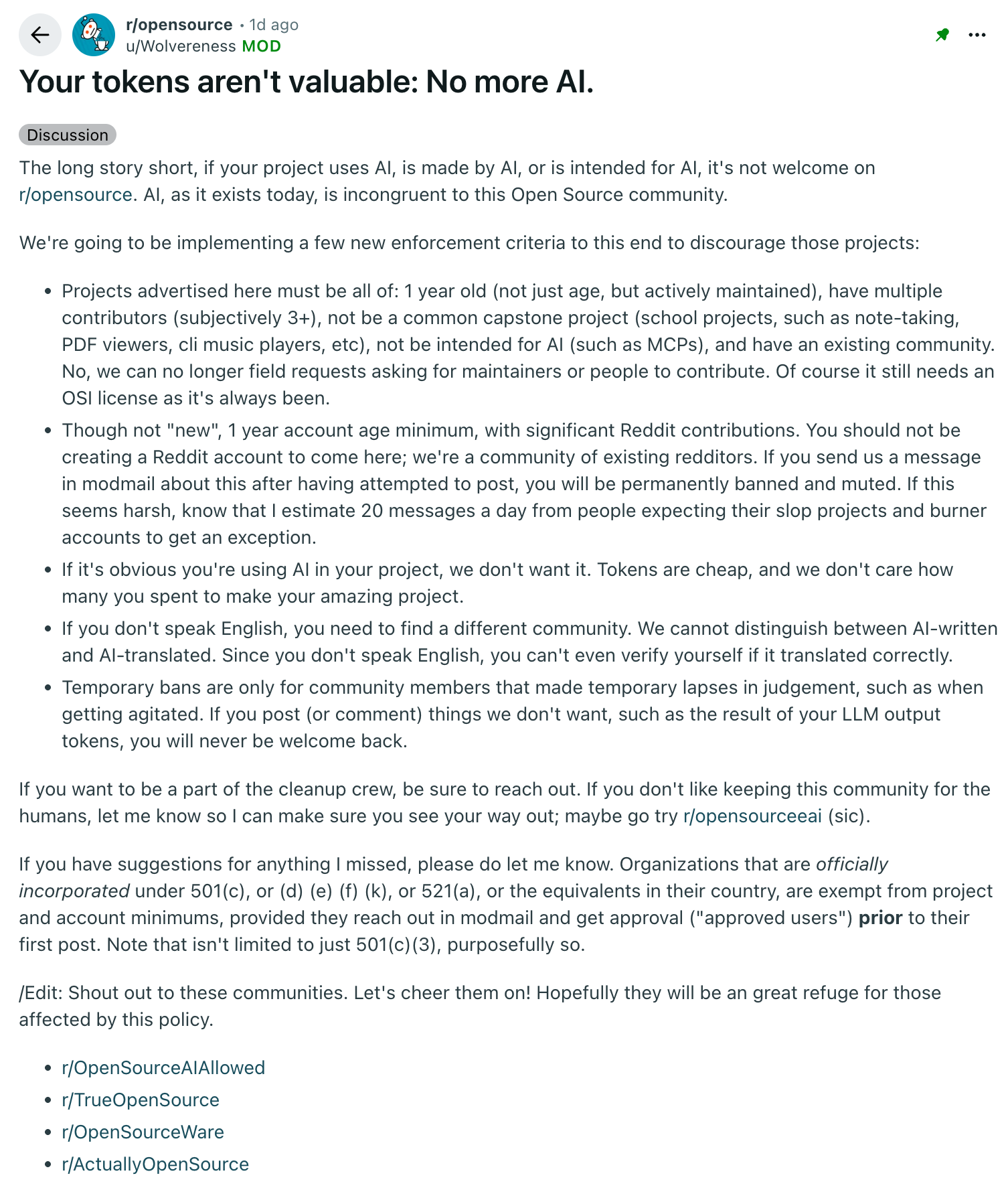
According to the rules released by the community management team on October 24, local time, if a project uses artificial intelligence, is produced by artificial intelligence, or is a product that serves artificial intelligence, it is not welcome to be released in the community. The management team believes that the current development model of artificial intelligence conflicts with the philosophy of the open source community, so it is necessary to maintain the original value orientation of the community by restricting related projects.
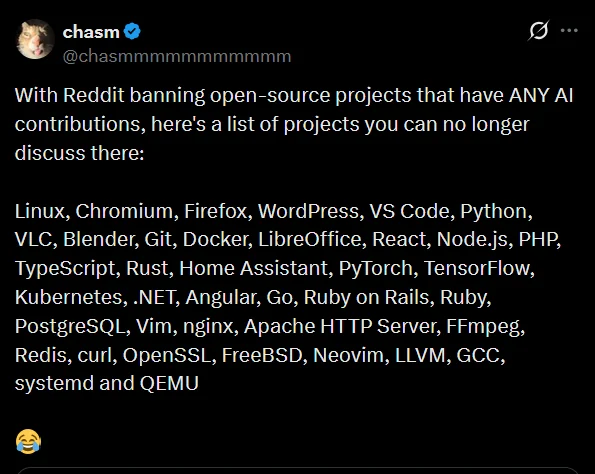
However, the new regulations do not clearly define the specific boundaries of artificial intelligence participation in project development, causing many users to question its enforceability. Modern software development has widely adopted tools such as artificial intelligence-assisted programming, code completion, and automated testing. Even if the main code of a project is written by humans, it may also contain part of the code generated by artificial intelligence. If a project is banned as long as it involves artificial intelligence, a large number of mainstream open source software may be affected.
Some users specifically pointed out that artificial intelligence-generated code now also appears in the Linux kernel. If the literal meaning of the new regulations is followed, projects that rely on these software or contain related code may theoretically be excluded from the community. Similar controversies reflect an increasingly prominent real-world problem: As artificial intelligence-assisted programming becomes more and more popular, how to distinguish the degree of artificial intelligence's participation in development, and how to judge whether a project still complies with the open source spirit, is becoming increasingly complex.
Facing doubts, community moderator Wolvereness explained in the discussion that the new regulations do not mean that all software containing artificial intelligence functions will necessarily be banned. For example, some software only comes with accessibility features such as automatic subtitles, but artificial intelligence is not its core use. Such projects may receive exceptions. Opposition persists, however, as the management team has yet to provide clear enough criteria on which AI features are acceptable and which situations would trigger a ban.
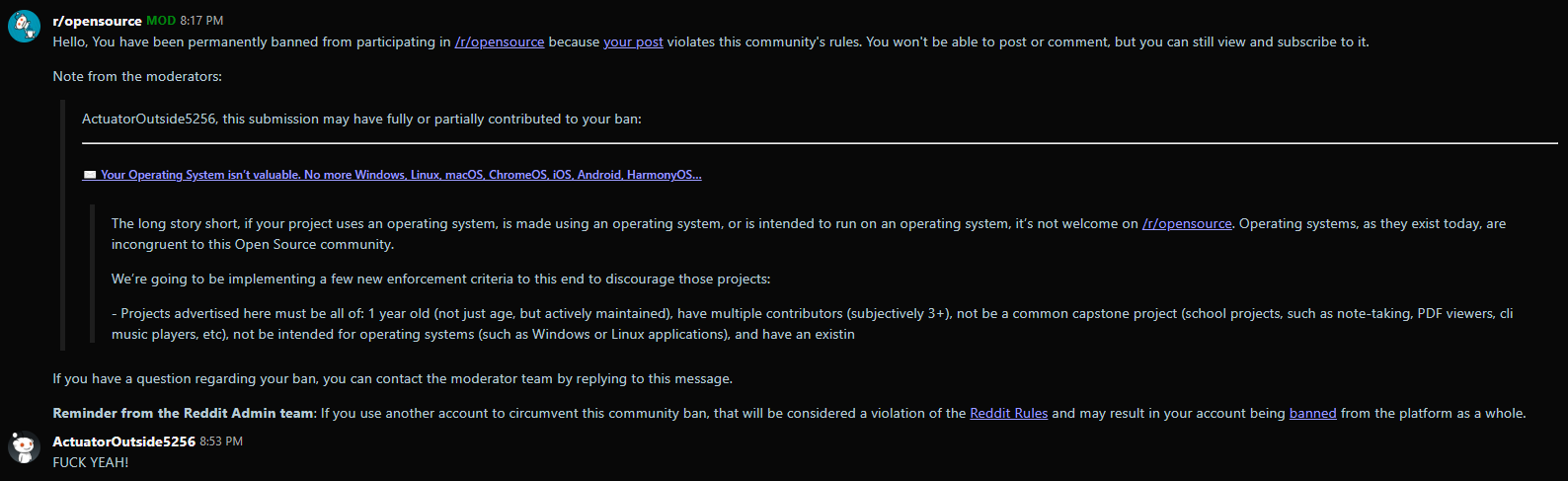
In addition to the AI ban, the community has also added other restrictions. Submitted projects must be at least one year old, still actively maintained, and have multiple contributors. This means that new projects that have just been released, software developed independently by a single person, and developers who hope to find maintainers or recruit contributors in the community may lose the opportunity to participate. The management team even made it clear that the community will no longer accept requests to find project maintainers or recruit developers in the future.
Another controversial provision involves language. The management team actually requires participants to be able to communicate in English and says users who don't speak English should look for other communities. The reason is that it is difficult for managers to distinguish between English content directly generated by artificial intelligence and English content translated by artificial intelligence; if the user himself does not understand English, he cannot confirm whether the translation is accurate.
This regulation has been criticized because it not only limits the use of artificial intelligence, but may also exclude a large number of non-English-speaking developers from the open source communication environment. Open source software originally has the characteristics of crossing national and language boundaries, and many project developers, maintainers and users come from different countries. Critics believe that language proficiency is not necessarily related to whether a project is truly open source, and that completely prohibiting non-English speaking users from participating may damage the international nature of the community.
After the new regulations were announced, some users who did not agree with these restrictions began to turn to the newly established r/trueopensource community. This new community aims to provide an alternative communication space for developers affected by the original rules and to be more open to the participation of artificial intelligence in development. The original community moderator also mentioned this new community in the discussion and expressed the hope that it can provide a place for people affected by the new policy.
The controversy comes as artificial intelligence programming tools are rapidly transforming the software development industry. Developers can use AI to generate code, analyze programs, fix bugs, and even recreate functionally similar alternatives based on the behavior of existing software. These capabilities have lowered the technical threshold for individual developers, but have also triggered ongoing debates about code quality, copyright, software security, and the definition of open source.
For developers who oppose artificial intelligence, the issue is not only who writes the code, but also the transparency, verifiability of the software, whether the development process is truly open, and whether the training data and commercial control behind the artificial intelligence model are consistent with open source concepts. Those who support artificial intelligence-assisted development believe that the core of open source should be whether users can obtain, research, modify and distribute software, rather than solely based on what tools developers use to determine whether a project can enter the community.
However, r/opensource’s new rules are not equivalent to a complete ban on artificial intelligence in the entire open source software industry or the Reddit platform. It is a contribution policy formulated by a specific community. Its impact is first reflected in the scope of discussion and user participation methods in the community. Even if a project cannot be released here, it does not mean that the project loses its open source qualifications or cannot continue to be developed and disseminated on other platforms.
This turmoil revealed a new problem faced by the open source community: when artificial intelligence gradually becomes a common tool for software development, how should traditional open source principles adapt to the new technical environment? The community can formulate rules according to its own ideas, but if the scope of restrictions is too broad, it may even exclude projects that are maintained for a long time, have open code, and allow free modification. As AI programming continues to gain popularity, debates over the definition of open source, developer rights, and community governance are expected to continue.
Comments