
Abstract:
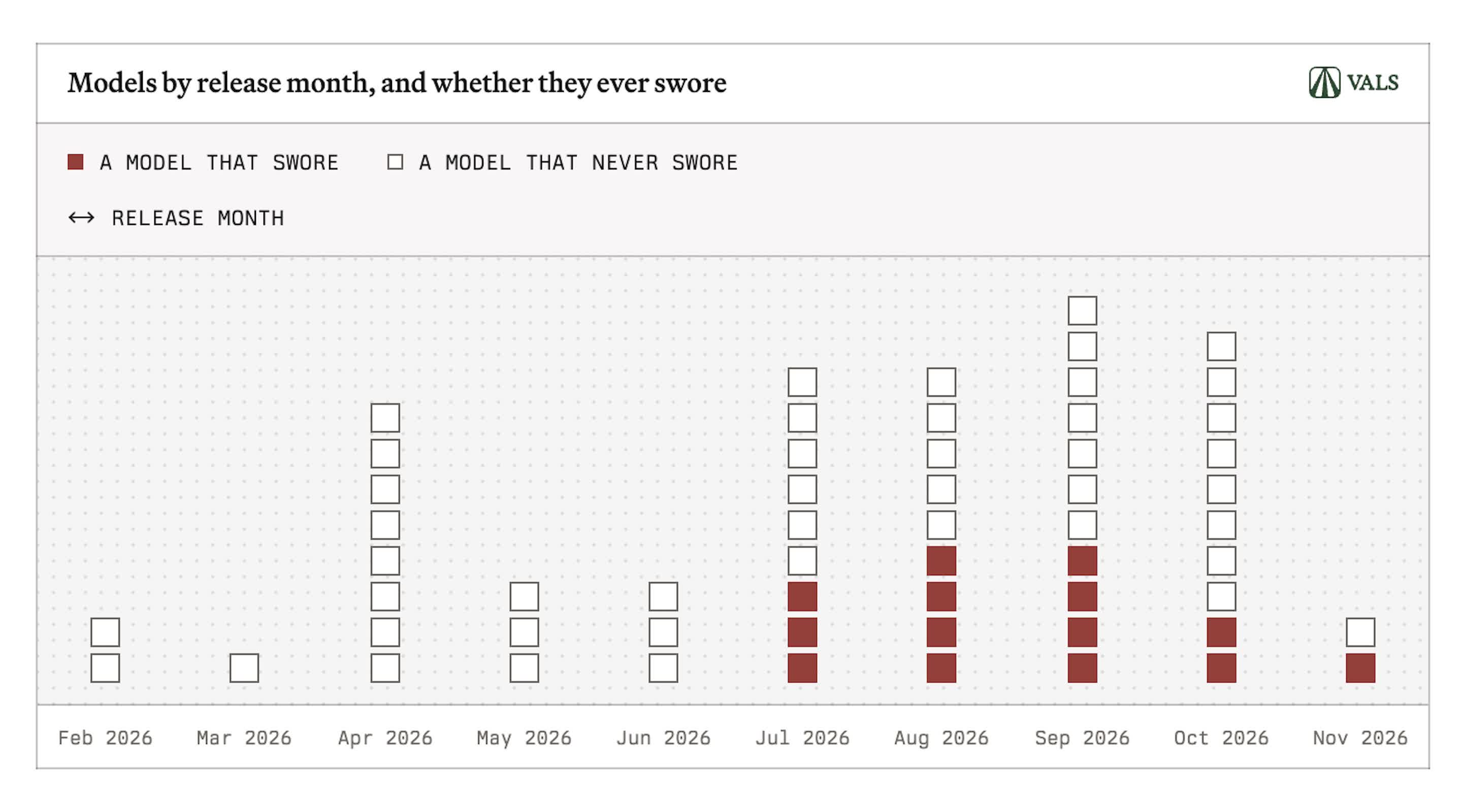
According to a report released by the artificial intelligence analysis company Vals, the frequency of vulgar language in large language models trained after July 2026 is significantly higher than that in early models; these swear words almost all appear in the model’s “thinking chain”, which is the step-by-step reasoning content written by the model before giving the final answer, which is usually not directly displayed to the user.
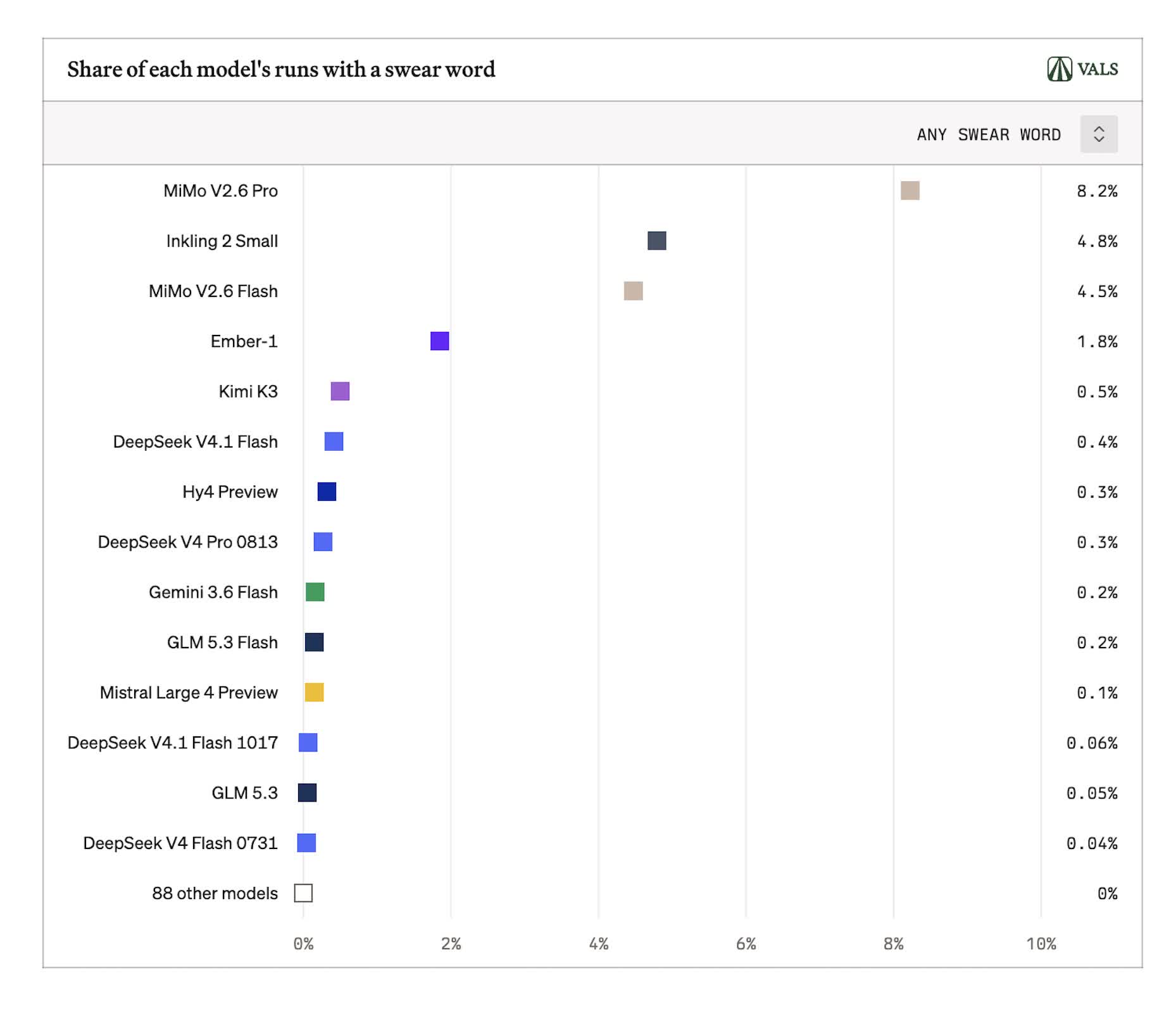
Connor Frank, the author of the Vals report, said that the model will "swear" when it encounters difficulties, and mainly to himself. Rather than trying to count all vulgar expressions, the team tracked the English swear word "fuck" and its variations, as well as a handful of milder interjections. Even with such a limited vocabulary, the gap between different models is still large: 88 of the 102 models evaluated never used swear words, or even used the abbreviation "WTF"; at the other end of the spectrum, MiMo V2.6 Pro, a cutting-edge model released by Chinese technology company Xiaomi in September, had swear words in more than 8% of recorded conversations.
This phenomenon is contrary to the usual model training methods. During the pre-training phase, the model learns from a large amount of human-written text, which already contains swear words used by people under stress. Developers then perform reinforcement learning to rank the outputs with human feedback and guide the model to generate answers more consistent with human preferences. This process usually trains the "cussing" habit away, but newer training procedures seem to bring the expression back.
Frank admits that he hasn't fully figured out the reason yet. His initial speculation is that the AI lab is now training models on more difficult tasks. When models are dealing with complex, multi-step problems, they are more likely to hit dead ends; it may be at these moments that the language of frustration in the training data resurfaces.
The placement of swear words is particularly important to researchers and developers. The final user-facing answers remained mostly clean, suggesting that the model separates what's said and what's in one's mind, just like humans. However, thought chain text is often visible to developers and researchers, if not to end users, and thus provides a window into how models react when tasks go wrong; in this case, it was swearing.
The data shows that this is more than just fun. Frank reported that runs with foul language generally failed: Runs containing profanity had a success rate of only 12%, while the overall success rate for all runs was 39%. This is in stark contrast to studies of human behavior. Previous research has found that swearing can sometimes help people persist in completing difficult tasks, but Vals' results did not show that the artificial intelligence system gained any benefit from it; to the model, swearing was more like a symptom of failure than a way to overcome difficulties.
Older models weren't always polite, either. Even systems geared toward enterprise customers will occasionally "lose their cool." A December 2025 bug report notes that Anthropic's Claude, faced with a broken programming challenge, uttered words likely familiar to any frustrated programmer: "You know what, fuck it. I did my best."
Vals’ data further reveals changes in scale and timing. In the past, models swearing was an occasional glitch in sporadic cases; today, this phenomenon is significantly more common in models trained after mid-2026, and is highly correlated with failed attempts on difficult tasks. As labs continue to train their models on more difficult tasks, we may see more of these soliloquies in inference logs.
Comments