
Abstract:
DeepSeek releases V4.1 Flash-1017 large model. At a time when the market is generally looking forward to the update of large domestic AI models, DeepSeek is the first to launch a new version. This upgrade brings significant performance improvements.
The specific performance levels and changes have been reported before. You should notice that DeepSeek has also published a Pareto curve this time, which is often called the AI killing line. V4.1 Flash-1017 is at a god-like level this time. The cost per task is only between 1/50-1/100 of large models such as Fable and Astra, and the price/performance ratio is at least forty or fifty times higher.
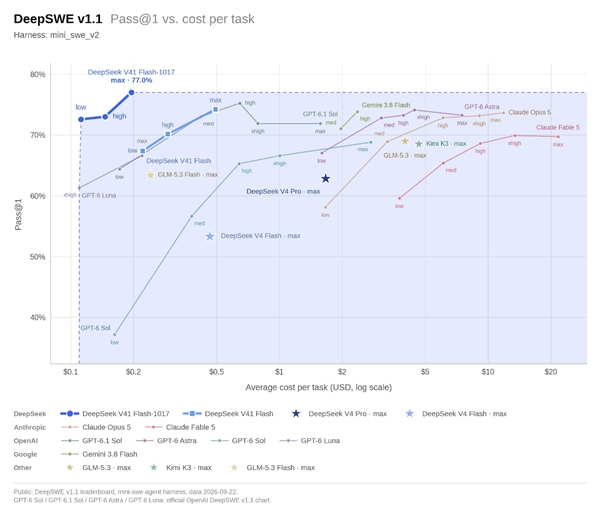
How did DeepSeek achieve such a kill line? Everyone knows that they have strong AI optimization capabilities and can do their best to reduce costs. The following picture released by vllm_project can clearly show how strong DeepSeek is in optimizing AI hardware.
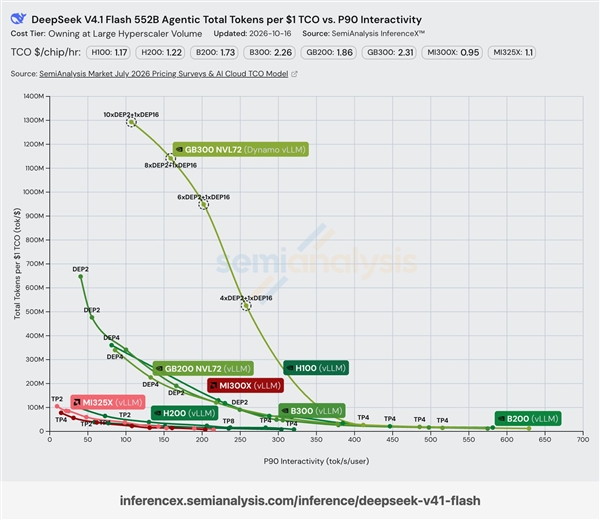
This picture compares the SemiAnalysis AgentX benchmark test. On the GB300 NVL72 and Dynamo vLLM platforms, V4.1 Flash ran a score of 1.3B Token for 1 US dollar, and the P90 interaction speed exceeded 100 tok/s/user.
1 US dollar is 1.3 billion Tokens, so 1M Token only costs US$0.00077, which is much cheaper than the input price of V4.1 Flash of US$0.15.
Of course, these two prices cannot actually be converted so simply. The Tco cost of 1 USD and 1.3 billion Tokens is on the computing power side, and API pricing has to take into account more complex situations. However, DeepSeek's ultra-low cost gives them an unrivaled advantage in this regard.
Because DeepSeek V4.1 Flash has an unbelievable cost advantage, major platforms dare to offer ultra-low charges. The usage of OpenCode and CommandCode’s 10-dollar package has recently reached 80-120 USD. OpenCode has been free and open in the past two days. Now the usage of V4.1 Flash on the aggregate routing platform is at the level of 100 billion Tokens, and one company can match the usage of six or seven friends.
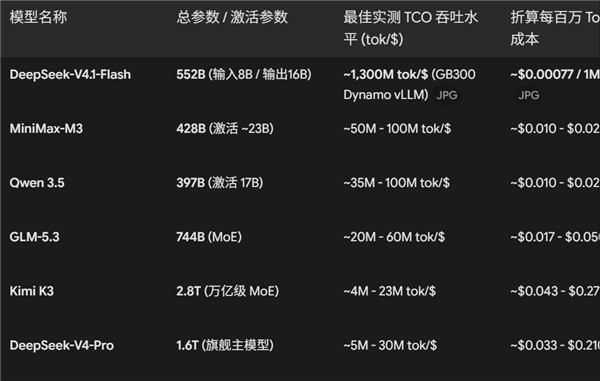
Let AI compare the TCO costs of multiple open source large models. The output of other large models with one trillion parameters is at most 1/10 of V4.1 Flash. If it is a large model with 1.5-3 trillion parameters, the cost difference can reach more than 40-50 times, which is completely incomparable.
It should also be noted that the TCO cost is still that of V4.1 Flash-0910, not the 1017 version released today. Although the API pricing of the latter has not changed, it has greatly optimized Token efficiency and reduced Token consumption. The degree varies in different tasks. In terms of somatosensory, the consumption has been reduced by at least half, which means that the TCO cost can be greatly reduced again.
Comments