
Abstract:
The Trump administration plans to issue new fuel efficiency rules on Monday that would relax the more stringent standards put in place under Biden. Trump packaged this policy adjustment announced in December last year as a means to boost the U.S. domestic auto industry and reduce consumer costs. As he announced the plan, he was flanked by a number of automotive executives.
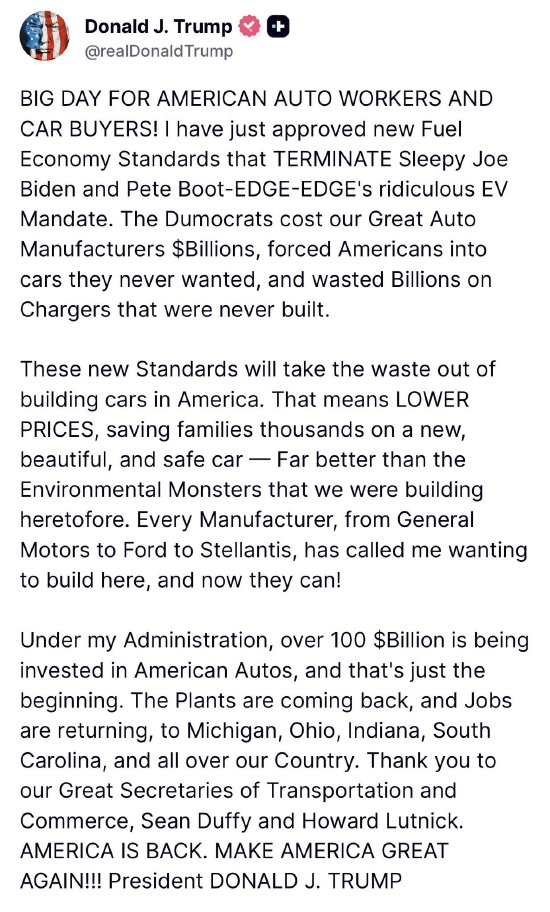
Trump posted on social media on Saturday: "These new standards will eliminate waste from the process of manufacturing cars in the United States. This means lower prices, allowing families to save thousands of dollars when buying a new, beautiful and safe car - far better than those 'environmental monsters' we have been producing until now."
Trump, who is struggling in the polls ahead of the November midterm elections, has come under fire for failing to do more to address concerns about rising consumer prices, especially persistently high oil prices.
Transportation Secretary Sean Duffy responded to the president's remarks on social media on Saturday: "A big victory for American autoworkers is coming on Monday." A U.S. official confirmed that new corporate average fuel economy standards will be released on Monday.
Trump has been critical of Biden-era rules that are part of a series of policies aimed at spurring the production and purchase of electric vehicles. If the final rule released on Monday is consistent with last year's initial proposal, fuel economy requirements for 2031 models will drop to 34.5 mpg from about 50 mpg.
The lowered standards would be a major win for the auto and oil industries. Previously, these industries complained that Biden-era requirements exceeded the limits of existing technology and actually hindered the sales of traditional fuel vehicles in favor of electric vehicles.
However, the policy change comes at a time when diesel prices have reached record highs and gasoline prices have reached their highest levels in September, a rise driven by both the war in Iran and the conflict between Russia and Ukraine. High fuel prices are having a ripple effect on the broader U.S. economy.
Trump administration officials are exploring a range of options aimed at curbing soaring fuel prices, driven in part by political considerations as rising costs of living undermine Republicans' chances of retaining control of Congress after November's midterm elections. A ban on diesel exports has been floated as an option, but energy experts say such a move would only provide short-term relief and could ultimately drive up costs.
Atid Kimelman, an attorney with the environmental nonprofit Natural Resources Defense Council (NRDC), said: "At a time when Americans are struggling to pay more than $4 a gallon for gasoline, the Trump administration will force them to pay more to fill up the tank. Oil companies will reap huge profits from repealing fuel economy standards, while the rest of us will be forced to spend more of our hard-earned wages to fill the tank."
Comments