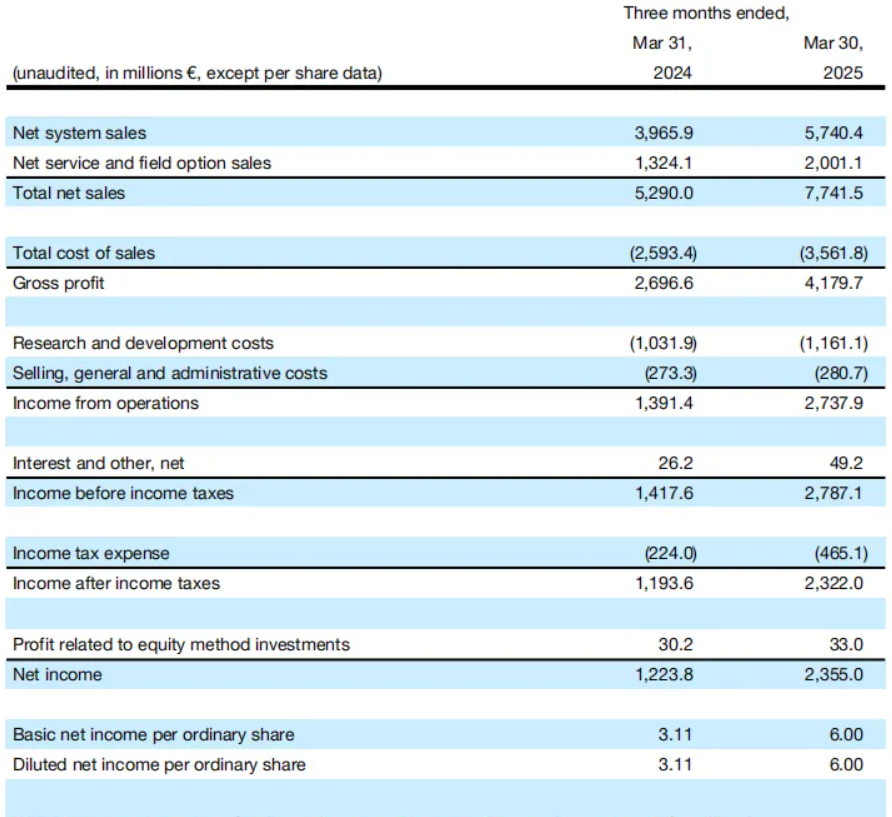
ASML announced its financial report for the first quarter of 2025, showing significant year-on-year growth in revenue and profits. The official also responded for the first time to the impact of U.S. tariff policies on its business. According to the financial report,ASML's revenue in the first quarter was 7.74 billion euros, a year-on-year increase of 46%, of which installed after-sales service revenue was 2 billion euros; gross profit margin was 54%, an increase of 3 percentage points year-on-year; net profit was 2.36 billion euros, a year-on-year increase of 92%.
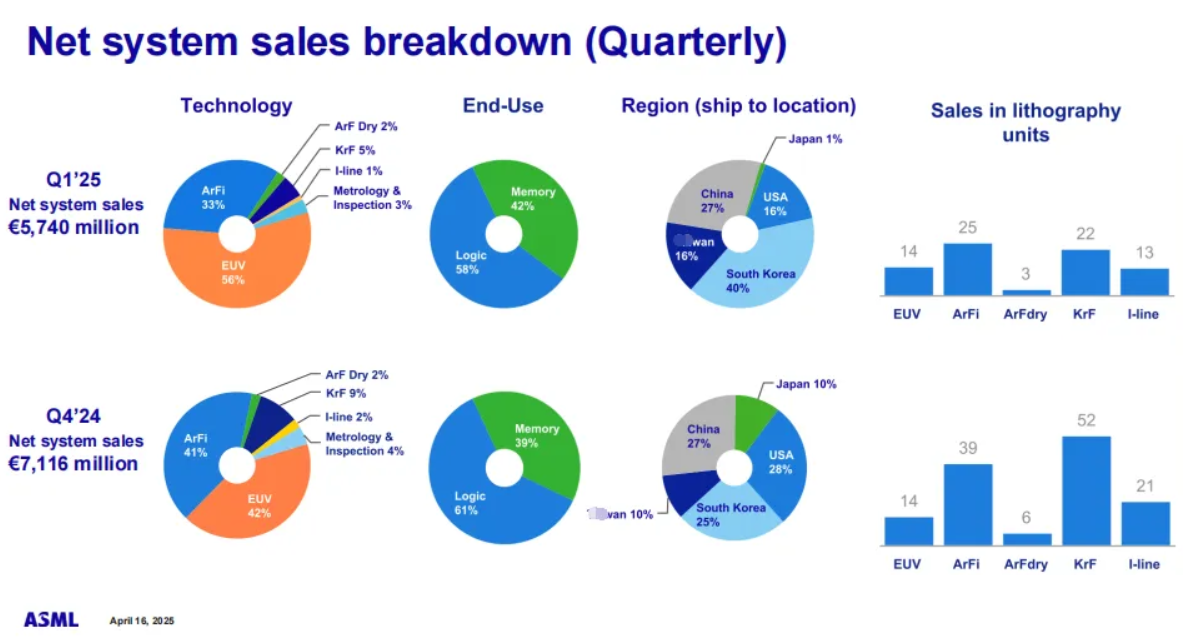
In the quarter, ASML EUV lithography machines sold a total of 14 units, which was the same as the previous quarter, including 5 High-NA EUV lithography machines. It currently has three customers, apparently Intel, TSMC, and Samsung.
From a regional perspective, thanks to the drive of Samsung and SK Hynix, South Korea contributed 40% of ASML’s lithography machine sales, an increase of 15 percentage points month-on-month.
The share of the U.S. region dropped sharply from 28% to 16%, possibly due to concerns about the instability of Trump’s policies.
Mainland China still accounts for 27%, Taiwan increased from 10% to 16%, and the total increased from 37% to 43%.
Regarding the impact of the Trump administration’s tariff policy, ASML Chief Financial Officer Dai Houjie said that it can be roughly divided into four categories:
One is to impose tariffs on complete systems shipped to the United States;
Second, tariffs are levied on parts and tools used in on-site operations in the United States;
Third, there are already manufacturing links in the United States, but materials imported to the United States and further manufactured in the United States will also be subject to tariffs;
Fourth, other countries impose tariffs on goods shipped from the United States (if applicable).
Dai Houjie said that ASML is actively collaborating with the entire semiconductor ecosystem to better understand how tariffs will be implemented and strive to minimize the impact.
"Our goal is to keep the impact of tariffs on our performance as minimal as possible," he said.