The National Aeronautics and Space Administration (NASA) confirmed that a meteor exploded over the northeastern United States on the afternoon of May 30 (Saturday), producing a strong sonic boom that was heard in Boston and New England and caused houses to shake. The incident occurred at around 2:06 pm local time, and the explosion location was over the north of Cape Cod Bay.
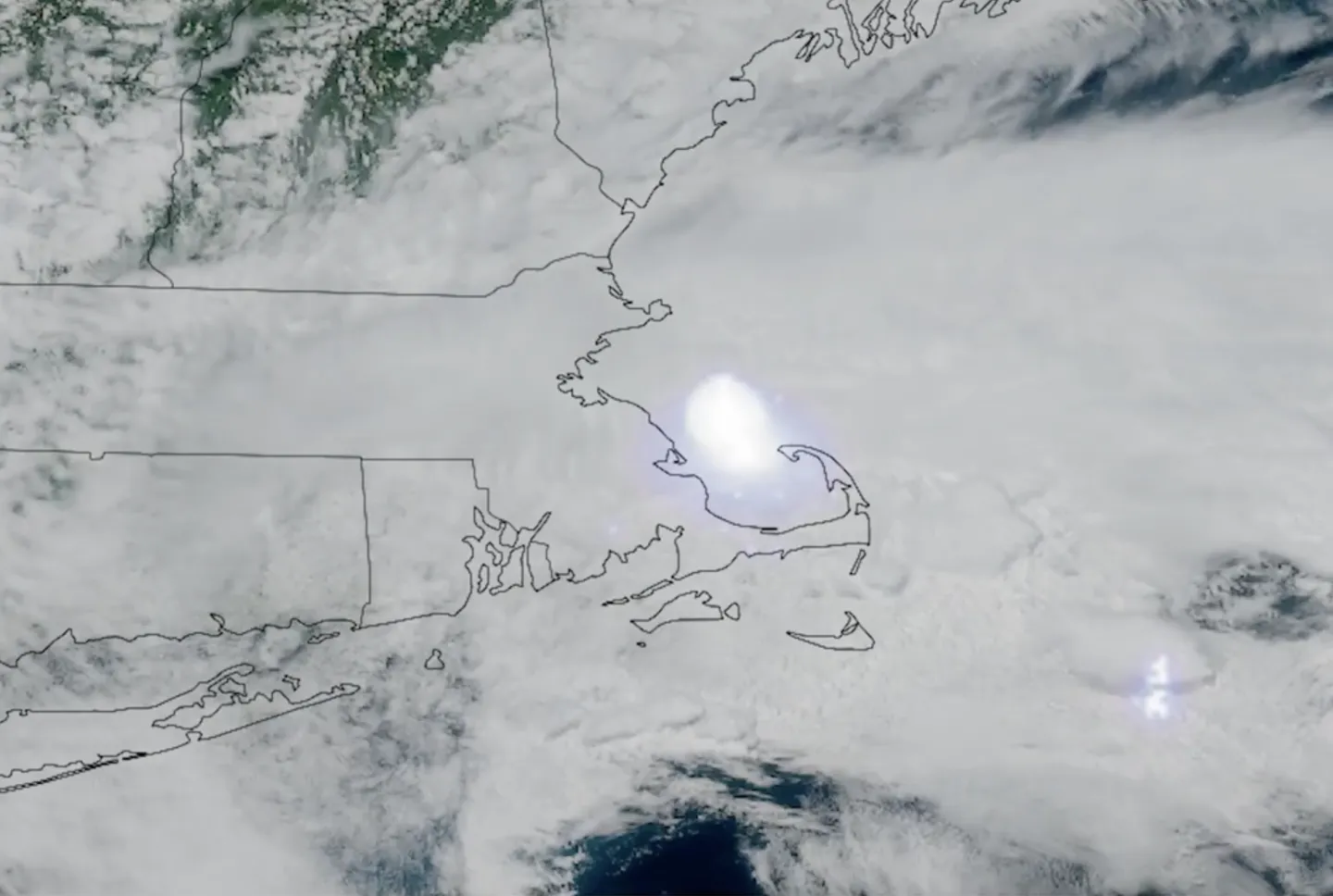
According to reports, the meteor emitted a bright fireball as it streaked across the sky over the northeastern United States. The process was filmed by many people on their mobile phones and uploaded to social media platforms, including Instagram and TikTok. The latest generation of the United States' GOES-19 weather satellite also recorded the flash produced by the explosion at an altitude of about 40 miles (about 64 kilometers). Relevant agencies subsequently released satellite animation images showing the optical changes in the area within about 30 minutes.
At the time of the incident, residents in many places in New England reported hearing loud explosions and feeling their houses shake, and an earthquake was briefly suspected. The United States Geological Survey (USGS) later released information denying the existence of local seismic activity and clearly identified the phenomenon as a "widespread perceptible sonic boom suspected of being produced by a bolide." NASA later issued a statement on the social platform X, describing the incident as "a bright fireball accompanied by a loud noise."
According to NASA's analysis, the meteor entered the atmosphere at a speed of about 75,000 miles per hour (about 120,000 kilometers per hour) and disintegrated at an altitude of about 40 miles above northeastern Massachusetts and southeastern New Hampshire. NASA estimates that the energy released at the moment of its disintegration is equivalent to about 300 tons of TNT explosives. This energy level is considered to be enough to explain the huge sonic booms and vibrations widely heard in New England.
Videos circulating on social media showed that looking up into the sky from Rome, New York and other places, one could see a bright trail and fireball phenomenon. Some reports described the size of the bolide witnessed on the ground as being about three feet. Another meteorological and satellite monitoring agency pointed out through released materials that the strong flash signal produced by the bolide before and after the explosion was clearly captured by the Lightning Imager (GLM) of the GOES-19 satellite. Relevant data showed that this event was highly concentrated in time and space.
After the incident, some residents worried that it might be related to the fall of man-made spacecraft or space debris. NASA deputy press director Jennifer Dooren issued a statement through Agence France-Presse (AFP), saying that the fireball event did not originate from any currently active meteor shower, but it can be confirmed that it was a natural celestial body and not a space debris re-entry event caused by the re-entry of a spacecraft or satellite into the atmosphere. She emphasized that all current evidence points to meteors of natural origin disintegrating in the atmosphere, rather than man-made objects falling out of control.
Currently, relevant scientific institutions are further analyzing the meteor trajectory, incident angle and energy release process to assess its possible impact on the ground and the need for improvement of future warning mechanisms. Although the incident triggered panic and discussion on a large scale, available information shows that the explosion occurred at high altitude and caused no known direct damage or casualties on the ground.