As the new round of trade war launched by US President Trump gradually heats up, key countries and companies in the global clothing and footwear supply chain are facing unprecedented challenges. Among them, apparel manufacturers in Asian countries are the first to bear the brunt and may be hit hard by high tariffs and supply chain shifts, while American consumers will pay more costs.
Currently, the United States has imposed tariffs of up to 145% on Chinese goods, and China, as one of the largest apparel suppliers to the United States, is bearing the brunt. Although some tariffs were suspended on April 9, it is expected that they may be restarted after the suspension period ends in early July. At the same time, the United States also generally imposes a 10% tariff on clothing and footwear imports from other countries. The additional tariff, known as the "reciprocal tax rate," has been preset to impose higher tax rates on 60 major surplus countries, including Vietnam, Bangladesh, Cambodia, etc. These countries are key links in the global apparel industry chain.
Countries such as Vietnam, Bangladesh and Cambodia have always been the manufacturing bases of choice for international apparel giants due to their low labor costs. For example, about 90% of Bangladesh’s exports to the United States are ready-made garments, and the United States is its largest customer. According to the proposed reciprocal tax rate, the United States will impose an additional 37% tariff on Bangladeshi goods. Cambodia faces a tax rate as high as 49%, while Vietnam is 46%. This will not only affect the export revenue of these countries, but may also force clothing brands to find alternative supply locations or directly pass the costs on to American consumers.
According to the American Apparel and Footwear Association, 97% of clothing and footwear in the United States relies on imports, and almost all new clothes and shoes sold in the United States will be affected by tariffs. In 2024, the United States will import approximately US$108 billion in clothing from around the world, more than half of which comes from China, Vietnam and Bangladesh. Seven of the top ten supplier countries are from Asia.
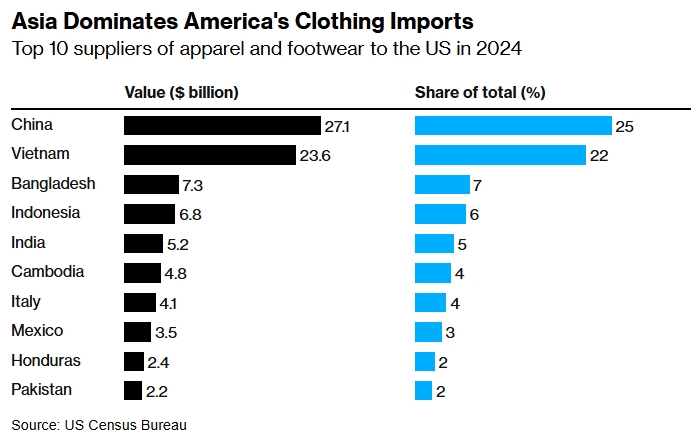
Trump's first round of tariff wars forced many companies to move some production out of China as early as 2018 to circumvent tariff barriers. This trend has also driven the development of garment manufacturing in places such as Vietnam, Bangladesh and Cambodia. According to the Cambodia Textile and Garment Association, more than half of the country's garment factories will be owned by China by 2024.
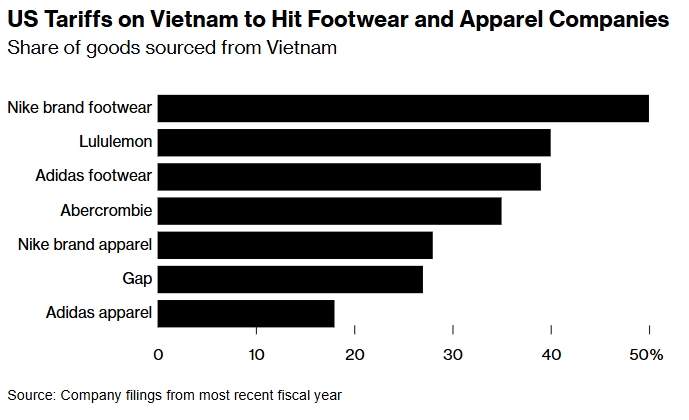
For major international brands, tariffs will directly affect their cost structure. About 50% of Nike (NKE.US)'s footwear products and 28% of clothing in 2024 will come from Vietnam; 38% of Adidas (ADDYY.US)'s shoes will be produced in Vietnam, and 23% of its clothing will come from Cambodia; 40% of Lululemon's (LULU.US) products will be produced in Vietnam, 17% from Cambodia, and 7% from Bangladesh; up to 90% of ONON's (ONON.US) shoes will come from Vietnam. When these brands face high tariffs, they have to consider raising prices or rearranging their supply chains.
And consumers will actually feel the pressure of rising prices. A study by the Yale University Budget Laboratory shows that if tariffs remain in place for a long time, American consumers will see shoe prices rise by 87% and clothing by 65% in the next three years; even in the long term, prices are expected to remain 29% and 25% higher respectively. In addition, the United States also plans to cancel the "duty-free package" exemption policy from China on May 2, that is, direct mail packages with a single value of no more than $800 are exempt from tariffs.