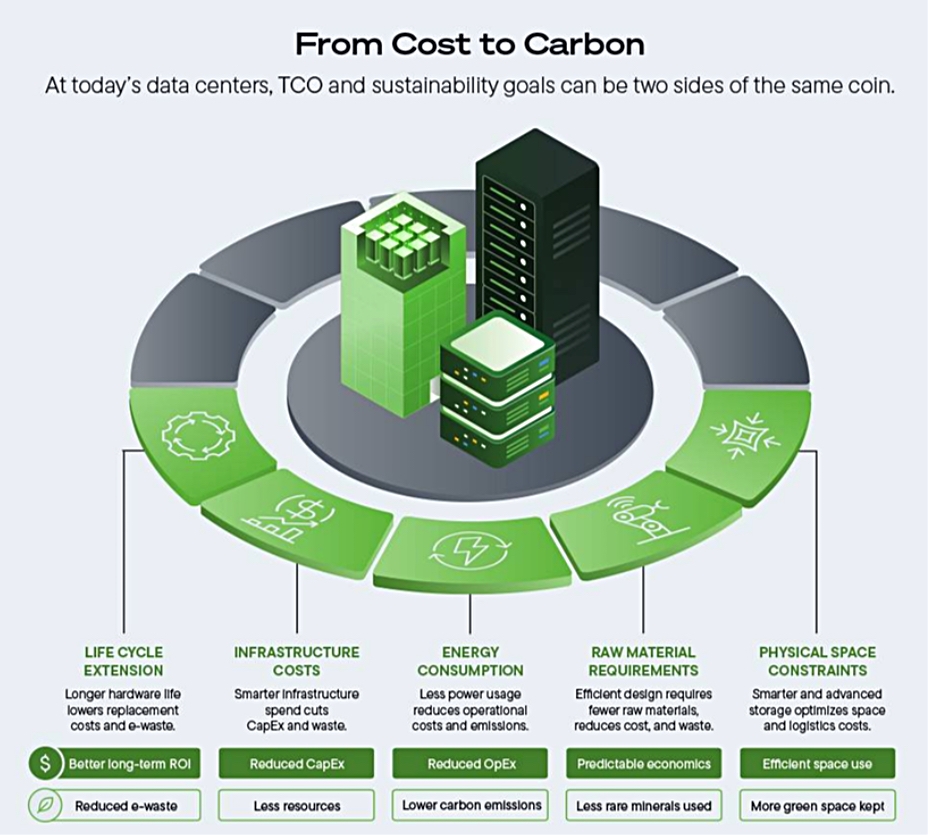
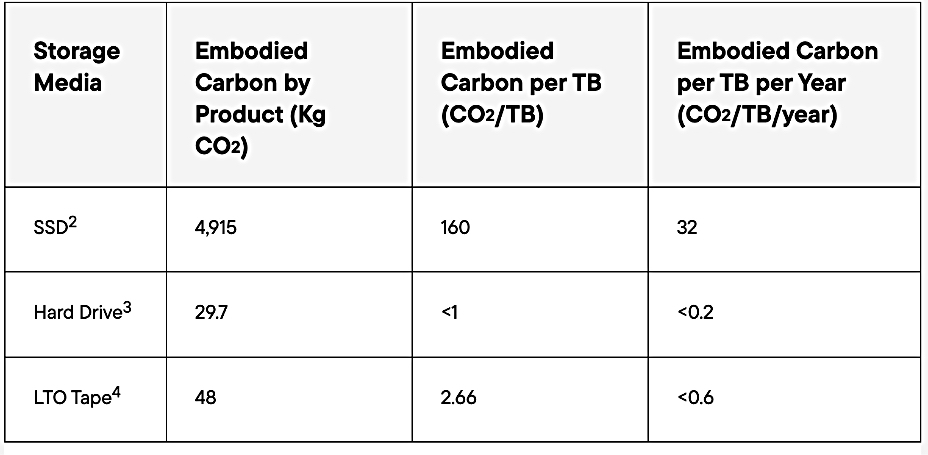
Although mechanical hard drives will not be completely replaced by SSDs, their status is no longer what it used to be. As the big brother of mechanical hard drives, Seagate recently issued a report trying to prove that mechanical hard drives still have extremely high value, such as in terms of environmental protection. The report compares three types of media: mechanical hard disks, SSDs, and tapes, and includes three indicators: five-year life cycle carbon dioxide emissions, average carbon dioxide emissions per TB capacity, and average annual carbon dioxide emissions per TB.
SSD is accused of being the worst: for a piece of 32TB capacity, the total carbon dioxide emissions can reach 4915 kilograms, an average of 160 kilograms per TB, and an average of 32 kilograms per TB per year.
Tapes were next, but much better, with total emissions of 48kg for an 18TB capacity, an average of 2.66kg per TB, and an average of no more than 0.6kg per TB per year.
Mechanical hard drives are naturally the best. The total emission of a 32TB capacity is only 29.7 kilograms, which is less than 1 kilogram per TB on average, and even less than 0.2 kilograms per TB per year on average.
Doesn’t it feel a bit like a grandma selling melons...
Of course,Mechanical hard drives still have extremely high value, especially in cold data storage. They can store data stably for a long time and are more cost-effective.
In fact, according to IDC statistics, about 60% of data today is cold and does not require frequent access.