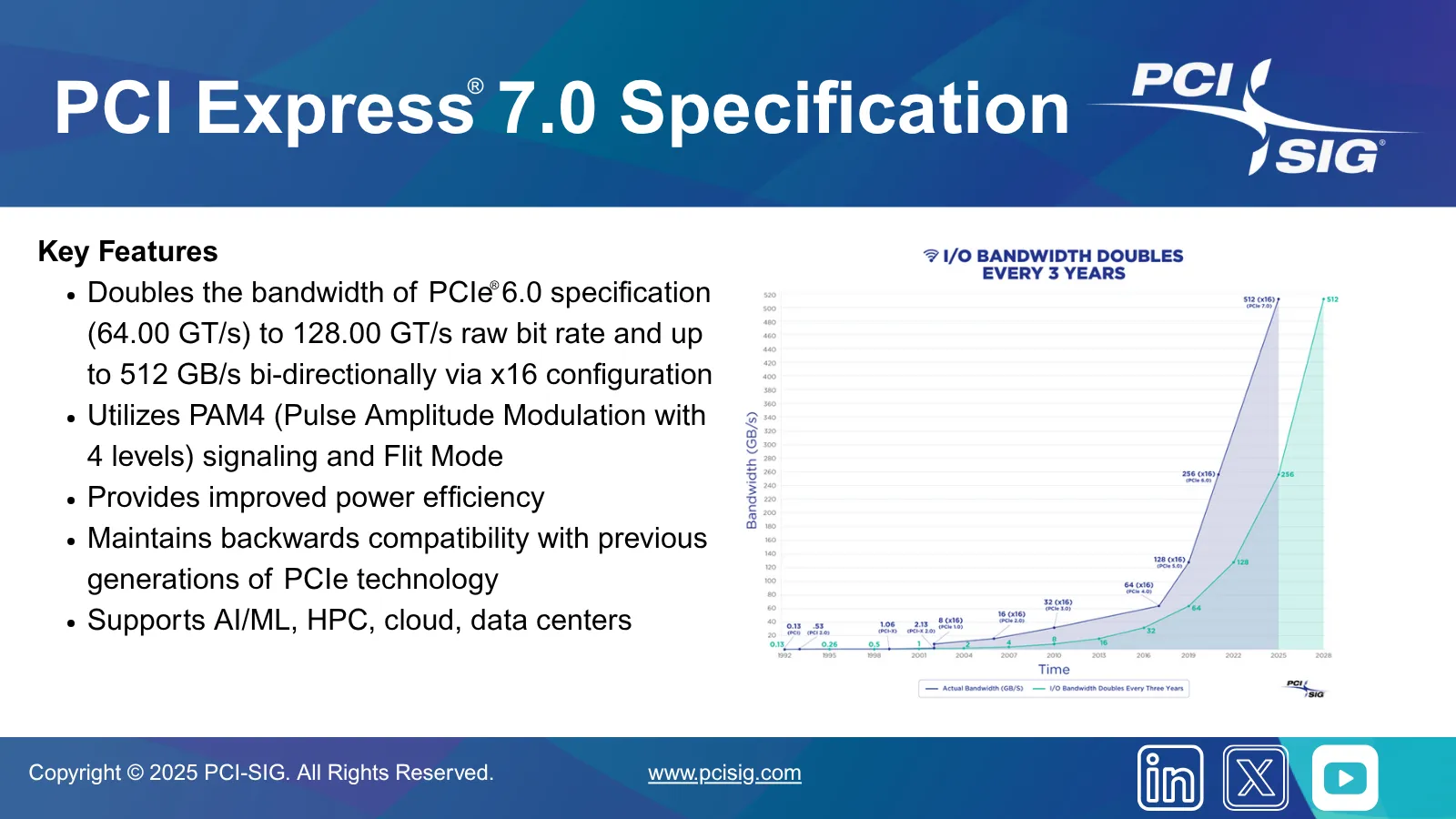
The PCIe 7.0 specification is now released, and many of us are still waiting for PCIe 6.0 to be implemented in consumer products. The PCI Special Interest Group (PCI-SIG) announced Wednesday that PCIe 7.0 is now available to members of its organization with theoretical maximum bandwidth speeds of 512GB/s (bidirectional) over x16 connections.
PCI-SIG President Al Yanes said in the announcement: "PCIe technology has been the choice for high-bandwidth, low-latency IO interconnects for more than two decades. We are pleased to announce the release of the PCIe 7.0 specification, which continues our long tradition of doubling IO bandwidth every three years. As AI applications continue to rapidly expand, next-generation PCIe technology will meet the bandwidth needs of data-intensive markets where AI is deployed, including hyperscale data centers, high-performance computing (HPC), automotive, and military/aerospace.”
You may have noticed that consumer computing devices are not covered in the announcement - the specification is currently targeting data-driven applications such as cloud computing and quantum computing data centers, and it will be some time before it even reaches those markets.
PCI-SIG says PCIe 7.0 will be backwards compatible with previous PCI Express versions, but makes no mention of any immediate plans to bring it to everyday desktop SSDs or GPUs. This is not surprising considering that the PCIe 5.0 specification, introduced in 2019, only started trickling into consumer hardware two years ago and is still quite rare.
Meanwhile, PCI-SIG said that exploration of PCIe 8.0 is "already underway." If all goes well, PCIe 6.0 will make its consumer debut in 2028 when the next-generation specifications are finalized.