New research shows that the super-Earth exoplanet 55 Cancri e (also known as 55 Cnc e), about 41 light-years from Earth, may have a hydrogen-rich atmosphere tightly coupled with its molten interior. This result comes from the latest observational data from the James Webb Space Telescope (JWST). The relevant paper was submitted to "Nature Astronomy" in June 2026, providing important clues for the scientific community to understand the formation and evolution of "lava planets", an emerging class of exoplanets.
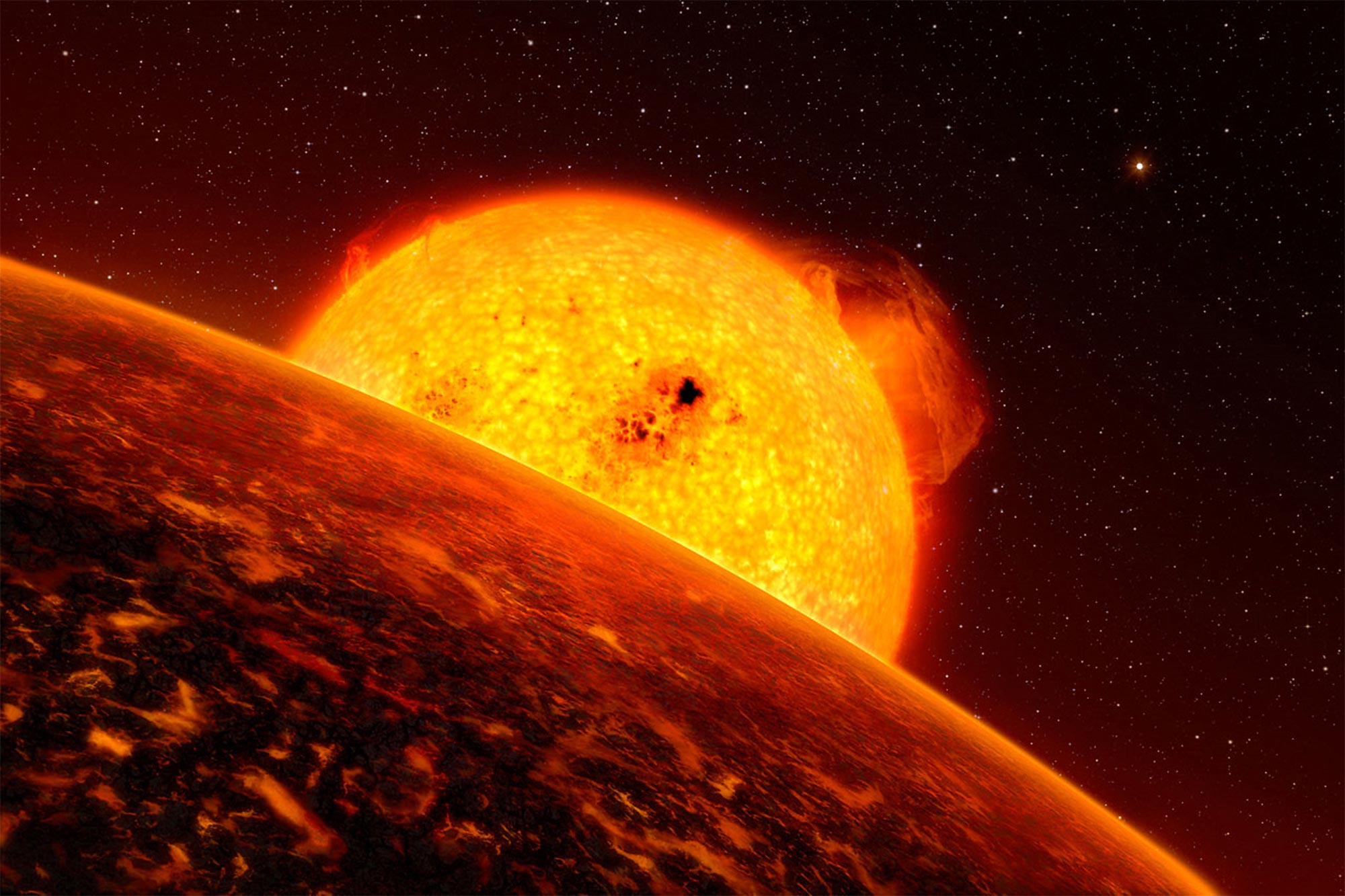
55 Cancri e is a super-Earth planet with a radius of about 1.88 times that of Earth and a mass of about 8 times that of Earth, orbiting a sun-like star. The planet is tidally locked to its parent star, completing one revolution in only about 0.7 days, and its orbit is extremely tight, much closer to Mercury's 88-day orbital period around the sun. Scientists generally believe that such an orbital distance is enough for the planet's surface to be "baked" by high temperatures, forming a large lava ocean on the sunlit side.
The research team used JWST to observe five "secondary eclipses" of 55 Cancri e, which is the process in which the planet moves from in front of the star to behind the star and temporarily disappears from the observation line of sight. By analyzing the changes in brightness and spectrum before and after the planet, the researchers compared the data with existing exoplanet formation and evolution models. Such models predict that the atmosphere of a molten planet should contain a higher proportion of carbon monoxide (CO) and carbon dioxide (CO₂).
The latest observations indicate that the atmospheric composition of 55 Cancri e is likely to be dominated by large amounts of carbon monoxide, supplemented by less carbon dioxide, and quite abundant hydrogen. The researchers also found that the differences between the five eclipsing events may be related to volcanic outgassing processes, or from clouds formed by outgassing. These clouds can cool the surface for a short period of time and are later dispersed by new outgassing, presenting a dynamically changing atmospheric structure.
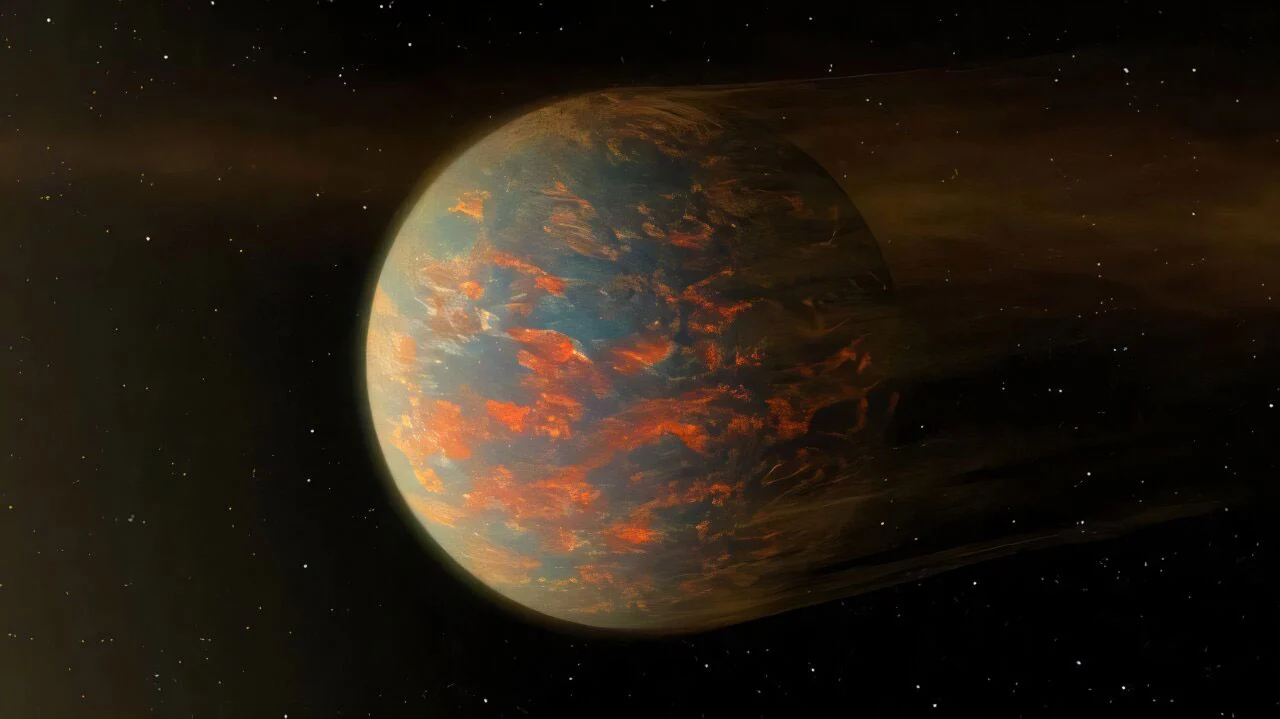
The paper points out: "The secondary atmosphere of a rocky planet is determined by its internal composition and the subsequent outgassing process, so the atmospheric composition is directly related to the redox state inside it." 55 Cancri e's atmosphere is biased towards the hydrogen-rich model and shows an obvious temperature inversion structure, which means that its internal oxygen fugacity is relatively low, which is more consistent with the scenario of the atmosphere formed by outgassing from a "reduced molten magma ocean". Simply put, hydrogen is more dominant than oxygen in the planet's internal chemical environment, thus shaping the characteristics of its hydrogen-rich atmosphere.
The so-called "lava planets" refer to exoplanets with large areas of molten magma on their surfaces. This type of celestial body has gradually become a research hotspot in the past ten years. 55 Cancri e was confirmed in 2004. Since then, similar planets have been discovered including K2-141 b, L 98-59 d, TOI-561 b, HD 63433 d, and CoRoT-7 b. Their orbital periods are approximately 6.7 hours, 7.5 days, 10.5 hours, 4.2 days, and 20.4 hours respectively. Like 55 Cancri e, these lava planets are tidally locked to their parent stars and orbit very close to each other, resulting in extremely high surface temperatures. Among them, L 98-59 d is likely to have its entire surface covered by a molten ocean like Jupiter's moon Io, while 55 Cancri e is mainly molten on the side facing the star.
Within the solar system, Io's intense volcanic activity is mainly caused by Jupiter's strong gravity stretching and compressing the moons, resulting in tidal heating. By contrast, the volcanic and lava activity of currently known lava exoplanets, including 55 Cancri e, is driven primarily by high temperatures from stellar radiation rather than tidal effects per se. Because these planets are tidally locked, one side of the star is always facing high-intensity radiation and becomes a "hot hemisphere" that continues to melt, while the side facing away may be relatively cold, creating an extreme temperature difference between day and night.
The research team believes that in-depth observations of lava planets such as 55 Cancri e will not only help understand the chemical coupling process between the planet's interior and atmosphere in extreme environments, but also provide an important reference for future exploration of whether other rocky exoplanets have atmospheres and how their atmospheres evolve. As JWST and subsequent more advanced astronomical observation equipment continue to be put into use, scientists are expected to further reveal the diversity of lava planet groups and their formation history in the coming years and decades. As mentioned at the end of the article, this is exactly what scientific exploration is about - continuing to observe, continue to ask questions, and continue to find more answers about planets and life from extreme worlds.