In early July, Goldman Sachs on the other side of the ocean poured a pot of fuel on the hot food delivery war, predicting that this competition will last longer, and pointed out three possible outcomes, focusing on "reminding" investors that the three companies will lose a total of 92 billion in the next year, of which Alibaba will account for nearly half, which is 41 billion.
In view of Goldman Sachs' status in the world, this report quickly became a hot topic.Coupled with the sudden increase in Taobao's flash sales a few days later, it announced that it would directly subsidize consumers and merchants 50 billion yuan in the next 12 months, calling it "driving domestic consumer demand and creating business growth", which added some credibility to Goldman Sachs' forecast.
But whether intentionally or unintentionally, a factor that can completely influence the current situation did not appear in the Goldman Sachs report. Instead, an unknown netizen put it alone in the comment area.

Before the regulatory "knife" fell, Meituan (on the 16th) had already stood up and called for a return to rationality, saying that the reason for anti-involution was that "there is a big bubble in orders subsidized by all parties." On the 17th, JD.com also stated that it had "not participated in vicious competition at all."
As a result, on July 18, three platform companies, Ele.me, Meituan, and JD.com, were interviewed. The core content goes straight to the crux, requiring companies to "standardize promotional behavior and participate in competition rationally."
But on the first weekend after being interviewed, no one seemed to really stop. Moreover, each company’s subsidy methods are becoming more and more diverse. Large-amount reductions, free orders, and “0 yuan” are still high-frequency words this weekend.
Taobao offers free orders + 1 point purchase, Meituan and JD.com continue to issue coupons
The effect of the interview did not seem to be obvious last weekend.
On July 19, Taobao's "Super Saturday" flash sale still remains. In addition to the basics such as "takeout from 1.9 yuan" and large-amount coupon pop-ups, there are also red envelope discounts such as "16 minus 15" and "18.8 yuan guaranteed". The intensity is so great that #taobao flash sale with over 6 takeaways for only 1 yuan 9 # once became a hot search on Weibo.
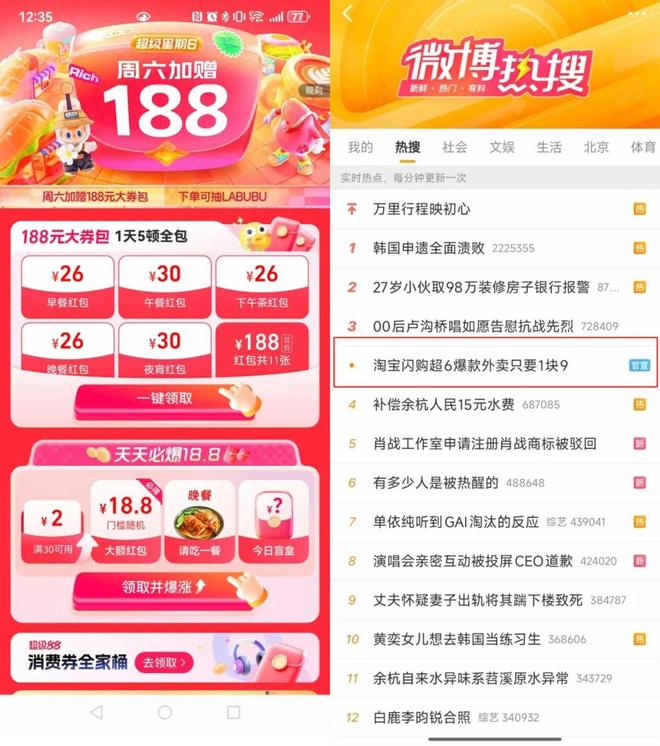
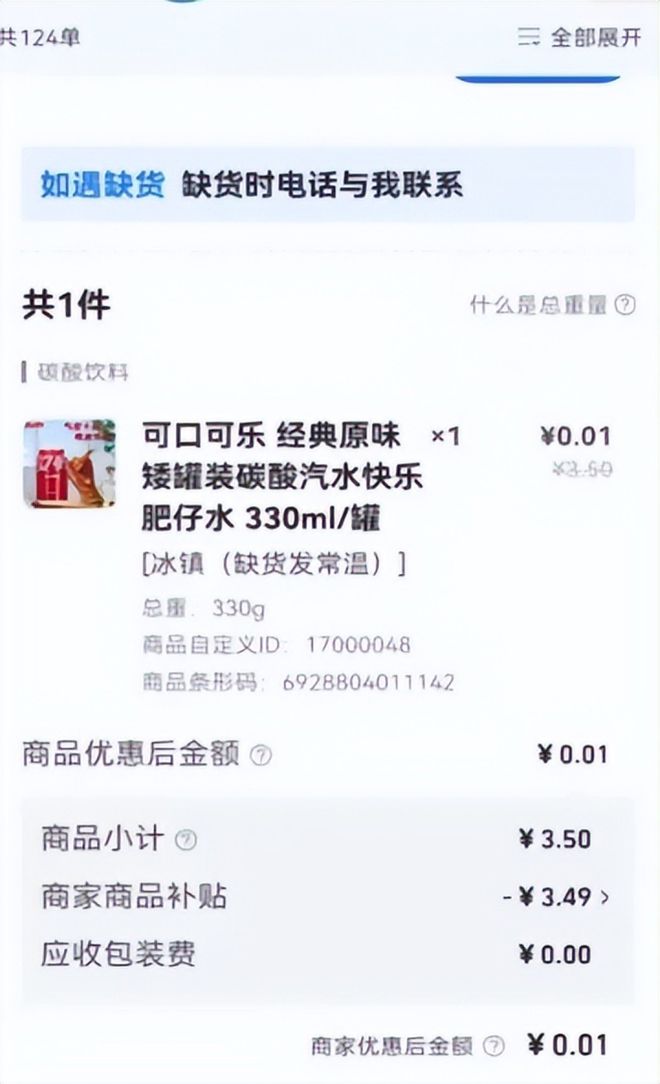
Judging from the promotional materials for this wave of Taobao flash sales, the focus is still on the "0 yuan" concept that has been refuted before. For example, some users found that large subsidies such as milk tea for 1 cent and free orders for newcomers continued to appear on the pages of Taobao and Ele.me.
In the circle of friends, Ele.me has launched a social sharing free order activity. After consumers receive coupons and share them, they can enjoy the free order benefits. In addition, Ele.me has also launched online promotions such as "25 off 25", "18 off 18", and "free milk tea card".
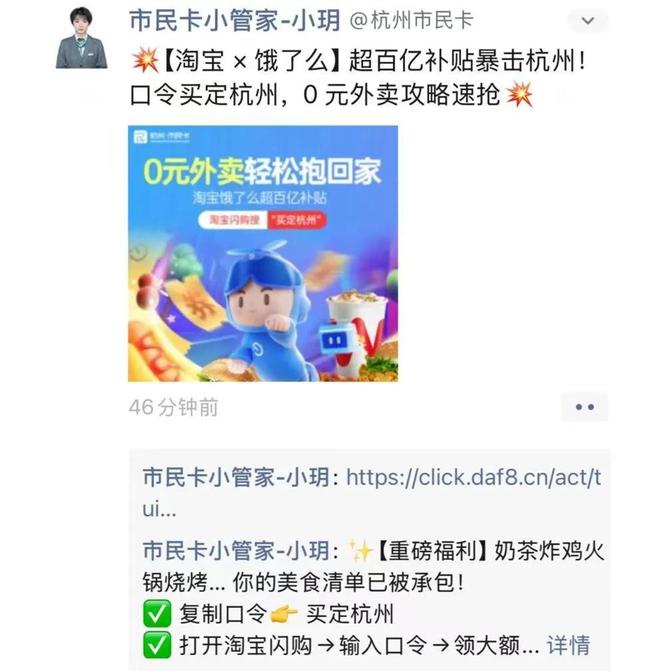
This Taobao flash sale also made use of the community for online promotion. In a group called "Ele.me Flash Sale Welfare Group", an organizer said that "you can get a cashback of 2 yuan by scanning the QR code and placing an order on Taobao." The subsidy is terrifying, equivalent to 1.9 yuan for an order of milk tea, 2 yuan in cash back, and the platform will rebate 10 cents.
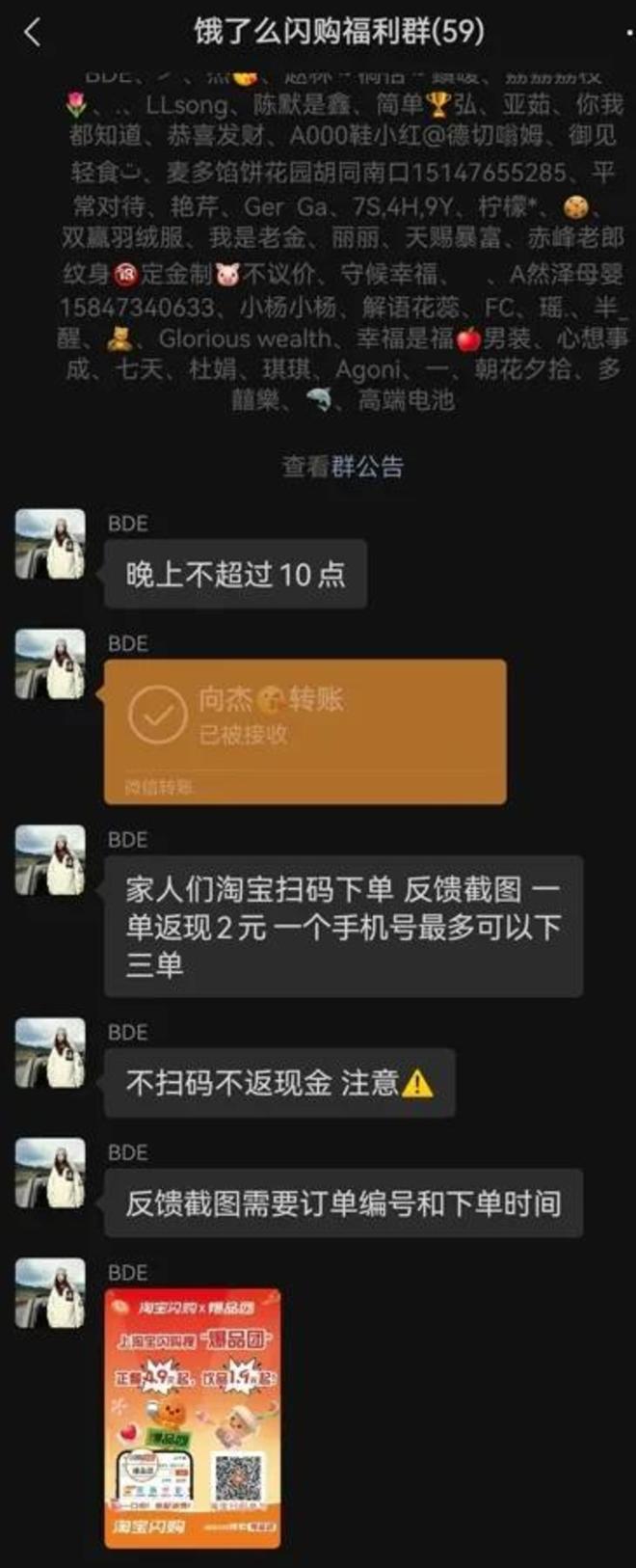
According to this level of intensity, I am afraid that if someone makes up for it, someone will pick it up. According to the mobilization capabilities of the e-commerce giant, with daily active users exceeding 100 million and an average conversion rate of 10%, it is easy to add 10 million orders. Because of these orders, there is almost no cost to users.
The other thing is offline,Some netizens saw Taoshan staff "setting up stalls" in subway stations and on the street, promoting the products to passers-by, helping users place orders, and launching the "front stall and back warehouse" model - picking up drinks directly from the warehouse, setting up stalls at the door, and picking up for 0.1 yuan. Based on the estimate of 100-200 orders per day at one point, there are at least one million new orders every day across the country.
In addition to Taobao’s flash sales, the other two companies have also not put down promotions. Especially Meituan, in order to keep up with the pace, still has to grit its teeth and follow up, but its methods are mostly based on food coupons.
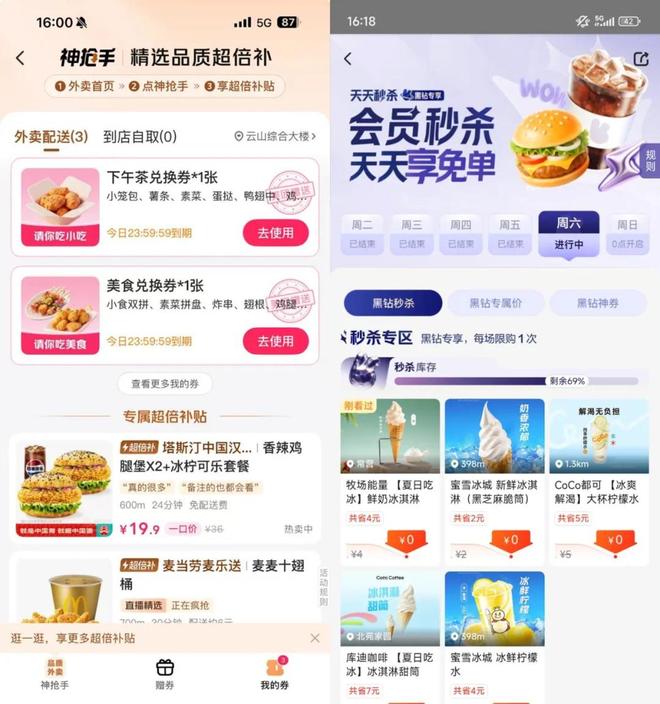
On the 19th, buttons such as "Surprise Takeaway Immediately" and "Takeaway Gifts" appeared at the bottom of Meituan's homepage, while coupons with varying amounts of reductions and exemptions popped up at the top of the takeout channel page, prompting "Your takeaway gifts have arrived." After entering, all the popular activities are displayed, and the prices of the meals involved range from about 15 yuan to 30 yuan. The platform subsidy for many meals exceeds 50% of the original price. In addition, Meituan also issued ice-drink coupons such as “free ice cream coupons” to Black Diamond members.
JD.com continues to strengthen subsidy measures such as full discounts. Among JD.com’s “Ten Billion Takeaway Subsidies”, one is the “Hundred New Customer Vouchers” and the other is the “Ten Billion Meal Subsidy Vouchers”. The corresponding subsidies for new passenger coupons are generally relatively large, such as "15 minus 14", "20 minus 16", "30 minus 19", "40 minus 26", "60 minus 44", etc. Meal subsidy coupons are mostly "15 minus 10", "20 minus 12", "60 minus 32", etc.
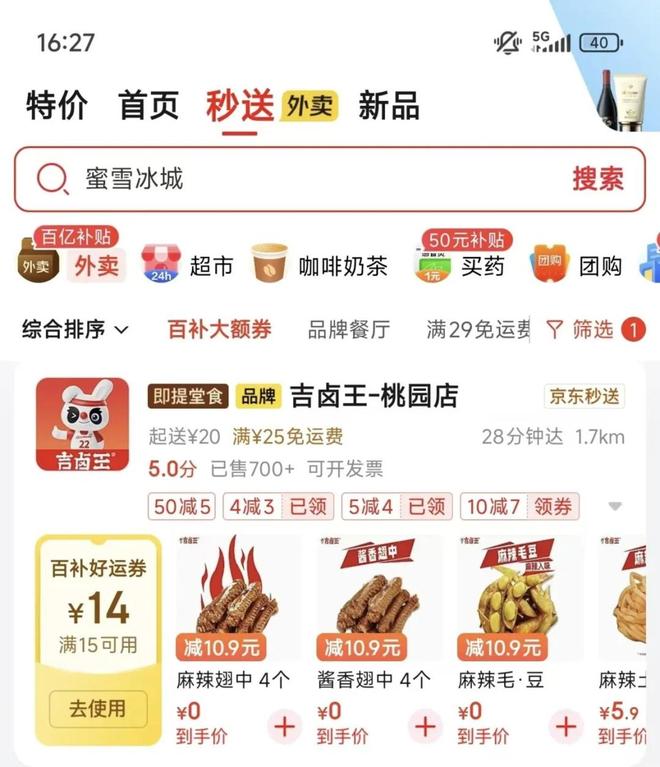
There are also multiple entrances to grab coupons. The most significant subsidy is the "Each person gets a 16 yuan takeout coupon" activity, which prompts users to get up to 16 yuan after sharing it with friends, which is equivalent to "buying for 0 yuan."
"The last struggle"
Subsidies have not stopped, and apart from the delivery guys, the happiest people may be the consumers. After all, in this round of food delivery war, not only can you harvest the wool, but you can also write it into jokes to entertain the public.
"If the business war continues, they will be unscathed, and we will become diabetic", "The food delivery war is the only era dividend for the post-00 generation", "The food delivery war, indeed, each generation has its own eggs" and so on.
Of course, some users reported that although the subsidies did not stop after the interview, there were more routines, such as the need for team formation, membership, and delivery, which was equivalent to setting more thresholds for consumers. As for riders, various control strategies have increased. For example, Meituan has begun to strengthen traffic safety control. Good riders are paid, and riders who run red lights are restricted from accepting orders; JD.com has removed the 20-minute overtime order exemption.
In fact, this is easy to understand. Platform promotion merchants are experiencing an explosion of orders, and the workload of riders has increased sharply. If conventional control measures are still adopted, the rider's food delivery time may be compressed, posing a great safety risk.
The direct effect of the interview is to reduce the bottom-line subsidies of the platform, merchants will not rush orders, riders will deliver normally, the decline from the peak will be stable, and all parties will compete rationally.
For merchants, the various abnormal problems caused by the food delivery war can also come to an end.
The order volume is soaring, and the instant pressure will have an impact on employees/store management, supply chain and the existing price system. More orders but less profit is the second best. The price mentality that was finally established is being broken by the subsidy war. In the words of Wang Puzhong, no matter how fierce the business war is, if it cannot promote progress or even violates business logic, then there will be no winner in this battlefield.
However, the reason why each company has not stopped subsidy is first and foremost because for the platform, strong regulatory constraints mean that the window period for relying on subsidy promotion to drive orders should end. There is no policy space for future subsidies, and now it is equivalent to a last ditch effort, so there will be "headwind" subsidies.
The supervisory side has a clear attitude and the general direction has been set. Involution promotions should be put on the brakes. This is a very clear signal. The level of this interview was high enough. The State Administration for Market Regulation came forward with serious words and clear directions. It can be seen that the reduction of subsidies will be a firm requirement.
Secondly, the golden period for placing orders is about to be missed.
Summer is the most important consumption season for major platforms. After summer students return to school and the peak catering demand period passes, the best opportunity to place orders will be lost. If you miss this stage, it will be more difficult to achieve your order goal.
Among the three, Taobao’s flash sale may be the one with the greater motivation to counter orders. After a record of 80 million, the new order volume has not been announced, but there is still at least 70 million gap from the first place. Taobao flash sales should have the idea of miracles, otherwise they would not even use social media, local promotion and other promotional methods.
For JD.com, it does not want to lose three months of results in just one month and has to make up for it. As for issues such as waste, single-volume foam, and wooly people, let’s put them aside for now. After all, the summer wind will pass by in a flash.
For Meituan, this is the last battle he wants to fight because it is completely unnecessary. Even if no senior executives stand up to "anti-involution", it can be seen that it is a war that it has to fight, and maintaining its leading position in the market is also a way of survival.
Another point is that each company has a lot of sunk costs in the early stage.
Alibaba has invested 50 billion yuan in subsidies for this war, JD.com announced 10 billion subsidies early, and Meituan has continued to make efforts to reduce subsidies in recent weeks. If it is stopped immediately, the previous huge investment will be in vain. The huge subsidies that have been invested on weekends and the high subsidies on weekdays are superimposed. Once it suddenly stops, the risk of user loss and merchant default will also increase. As far as the platform is concerned, it can only bite the bullet and continue to persevere.
squeeze out the bubble
In Goldman Sachs's forecast, a long-term investment strategy that regards food delivery losses as marketing expenditures will bring short-term pain to various platforms from 2025 to the first half of 2026, but it may lead to improvements in marketing efficiency in the medium term.
In particular, Alibaba and JD.com will not be able to achieve moderate profitability or break-even until 2027 after reallocating user acquisition marketing expenditures to food delivery subsidies, thereby increasing GMV profit margins.
But the problem is that the strong regulatory constraints on rational business competition have ended this subsidy war ahead of schedule. In other words, each company may not have to worry about short-term pain, but it must consider how to use reasonable subsidies and operations to gain more market share.
In particular, after the bubble is squeezed out, the advantageous means available to latecomers are curbed, which is not good news.
But given the damage the bubble has done to the entire industry, regulation is imperative. According to Wang Puzhong's observation when he was investigating Nanjing, a merchant placed 12 orders from morning to morning, 10 of which purchased products for 12 bottles of mineral water.
In addition to good-looking data, such orders have no practical significance for the development of the company or the industry: they cannot bring about long-term growth in the industry, nor can they generate users' brand recognition of the company, leaving only a money-burning game of spending money to buy volume.
After money-burning games make their "final struggle," subsidies will still exist, but they will be reduced to a reasonable range, and platforms will return to competition in transportation capacity, services, and infrastructure. For Meituan, the disadvantage of accompanying the company is that the balance among the platform, merchants, riders, and consumers is broken, and it will take some time to repair.
For JD.com and Alibaba, the former is the biggest beneficiary of the money-burning game. In Liu Qiangdong's words, 40% of takeout users will buy JD.com's e-commerce products. "The money you lose doing takeout is more cost-effective than buying traffic from Douyin and Tencent."
The essence of this genius logic of making money when winning and not losing when losing is because JD.com’s entry into the food delivery industry was too low. From the start to the subsidy war, consumers went from choosing one of two (Meituan/Ele.me) to one of three. JD.com, which joined later, directly locked the food delivery mentality of all participants.
In other words, although JD.com can no longer rely on large subsidies to win over users, the food delivery mentality it has planted will continue to attract traffic.
Because Alibaba has Ele.me, its food delivery war is both defensive and offensive. The defense is to prevent subsidies from Meituan and JD.com from taking away food delivery users, while the offense is to fill the gap with Meituan and JD.com through Taobao flash sales. Not only is there a gap in products, there is also a gap in mentality.
That’s why we can see that in this round of food delivery war, Taobao’s flash sales attack is more intense and comprehensive. There are not only combat headquarters, but also flash sales spokespersons who swipe the screen in the elevator. After the interview, the subsidy may drop significantly, but the advertising will never stop.
end
The unsustainability and high harm of the subsidy war have been proven in the last round of the taxi-hailing war.
In 2018, Meituan and Didi went to war in Wuxi. On that day, Wuxi’s daily order volume tripled. But a year later, Meituan compared Wuxi’s orders with Suzhou and Changzhou and found that compared with cities that did not engage in the food delivery war, there was “no additional growth at all.”
In other words, most of the huge orders generated by platform companies through subsidies are bubbles. Temporarily stimulated demand can expand short-term order volume, but after the bubble is squeezed out, there will be almost no increase.
That’s why Wang Puzhong said helplessly in an interview with LatePost: In order to protect itself, Meituan needs to actively respond to the challenge, otherwise “they will just think you are cowardly and will be even more motivated.”
Fortunately, supervision stepped on the brakes in time, otherwise the 92 billion losses predicted by Goldman Sachs may actually be scattered in every company's financial report next year.
Text | Decode Decode