GPT-5 is finally here. At 1 a.m. on August 8, Beijing time, OpenAI CEO Sam Altman did not miss the appointment. The day before the conference, he wrote on


As a result, the release, which was watched closely by the entire network, lasted for 1 hour and 18 minutes, and was called the "most important event."
Altman’s campaign is never empty talk. The most vocal "AI evangelist" in Silicon Valley even revealed before the meeting: "After testing GPT5, I feel like I am useless." This seemingly exaggerated statement unexpectedly became a real footnote to this release.
When introducing GPT-5 at the beginning, Altman briefly reviewed the process from GPT-3 to 4 and then to 5. He likened it to himself, "GPT-3 is like a high school student, GPT-4 is like a college student, and GPT-5 has become an expert, an expert in various fields."

GPT-5 does not disappoint, it may even make workers anxious, and programmers are the first to bear the brunt.
The greatest amount of information at this conference is not how strong the language understanding ability is or how rich the creative ability is, but its new dimension in code writing, debugging, and deployment: GPT-5 is no longer a "language model that can write code", it is an engineering-level development assistant.
At this press conference, OpenAI spent nearly half of its time "writing code on site." It can build a complete website in two minutes, a language learning app in five minutes, and can accurately identify and fix bugs. It not only understands complex requirements, but can also dismantle tasks in a clear structure, implement functions, and give deployment suggestions. This ability is no longer "assisted programming", but directly grabs the work.
What does this mean for someone familiar with AI programming tools? This means that Copilot will be retired, Replit will be reshaped, and "AI IDE" such as Cursor will be fully integrated. Altman even said directly at the scene: "This is the strongest programming model we have ever created."
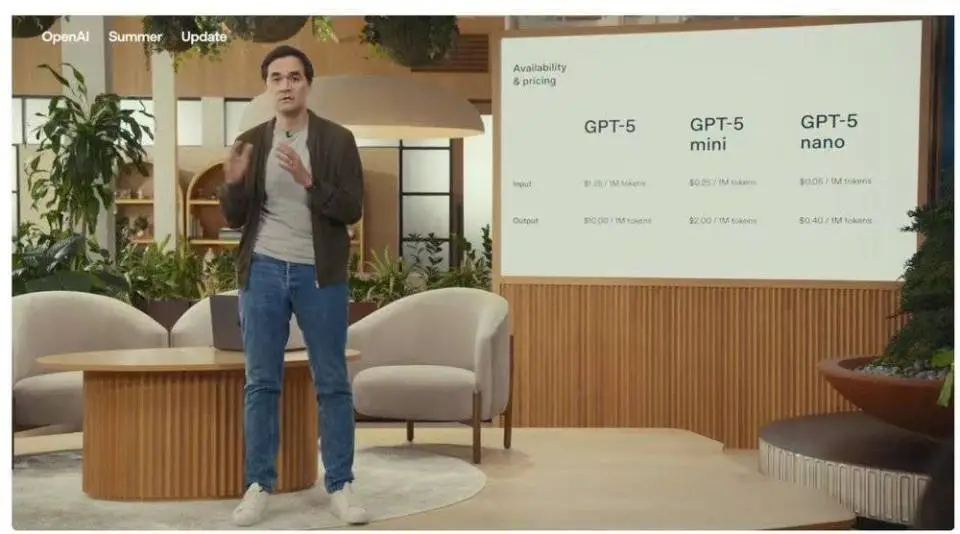
What supports all of this is GPT-5’s leaps in multiple dimensions such as reasoning capabilities, context management, and multi-modal understanding. OpenAI also released model matrices for different users this time, including: GPT-5 Standard, GPT-5 Mini (lightweight version), and GPT-5 Nano (for embedded and mobile use).
These three versions are open to API and enterprise customers and are priced per million tokens. The input prices are 1.25 / 0.25 / 0.05 US dollars respectively, and the output prices are 10 / 2 / 0.4 US dollars - extremely market penetration. For developers, this is another blow to the “entrepreneurship threshold” from dimensionality reduction.
It is worth mentioning that although Altman did not talk much about AGI, everyone in the industry knows that GPT-5 is no longer limited to involution in the world of AI large models, but continues to break through the upper limit and complete a great leap forward on the road of AGI.
This is not a "model upgrade", but a restructuring of the productivity structure.
The moment GPT-5 debuted, the ceiling of the AI world was raised again. And it is hard to say whether we are ready to face the new paradigm it brings.
Next, the author will restore the most exciting part of this conference:
Before the live demonstration, OpenAI first demonstrated a series of benchmark results of GPT-5 as always.
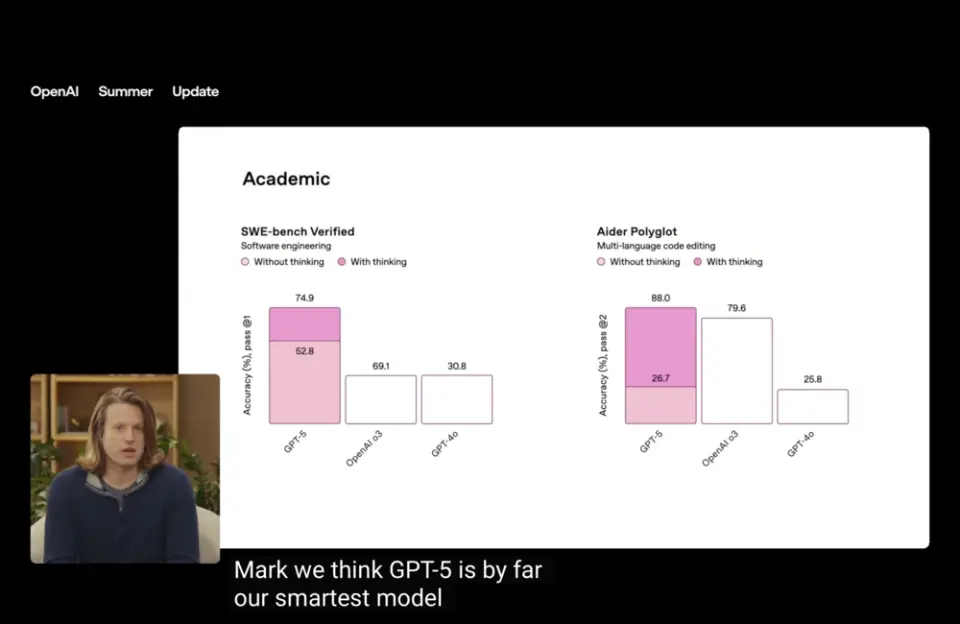
First of all, the most amazing thing about GPT-5 is that it achieves comprehensive crushing in terms of coding capabilities.
SWE‑Bench Verified: As a standard for testing a model’s ability to fix real software engineering problems, GPT‑5 achieved an astonishing 74.9% in this evaluation, ahead of o3’s 69.1%, demonstrating more efficient and accurate code understanding and generation capabilities.
Aider Polyglot: This is a cross-language code editing test. The GPT‑5 score soared to 88%, and the error rate was reduced by a third compared to before.
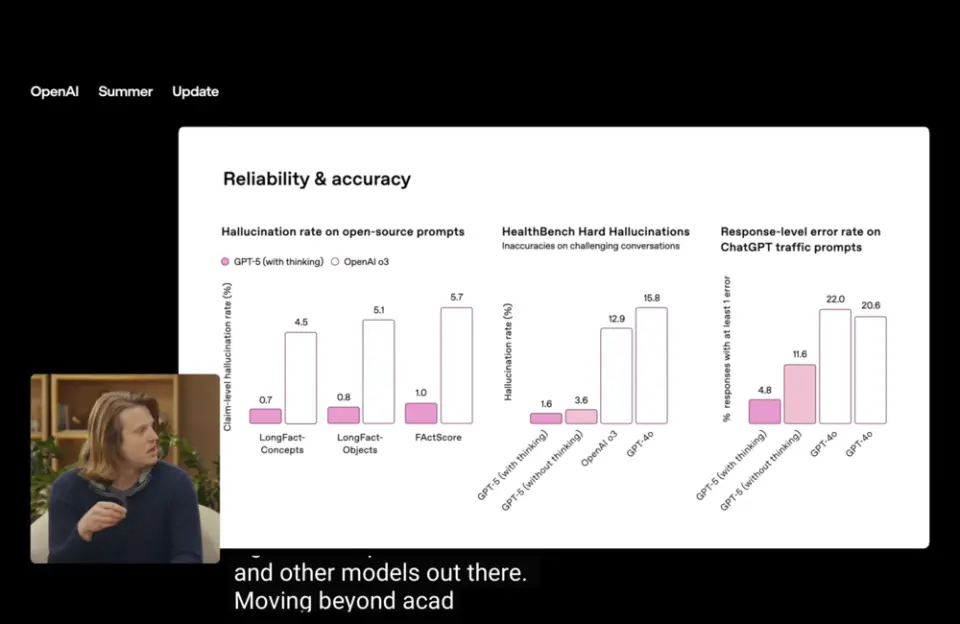
Secondly, GPT-5 also greatly reduces the hallucination problem caused by large models and improves both reliability and factual accuracy.
When answering factual questions, GPT‑5’s “illusion” error rate is reduced by about 45% compared to GPT‑4o and about 80% compared to o3.
At the GPT-5 press conference, in addition to coding capabilities, Ultraman particularly emphasized the performance of GPT-5 in the health and medical field. In medical scenario testing (such as HealthBench Hard Hallucinations), its generation error rate is only 1.6%, which is much lower than GPT‑4o’s 12.9% and o3’s 15.8%.
Will programmers be unemployed soon?
The most explosive part of GPT-5 is its coding capabilities.
This time, GPT‑5 really showed off at the press conference. Almost from the beginning to the end of the demonstration, there were a total of four "full-scenario, true-interactive" code capability demonstrations, which made both the developers present and the remote audience sigh: "Programmers, you are really going to panic."
1. Generate SVG animation in two minutes
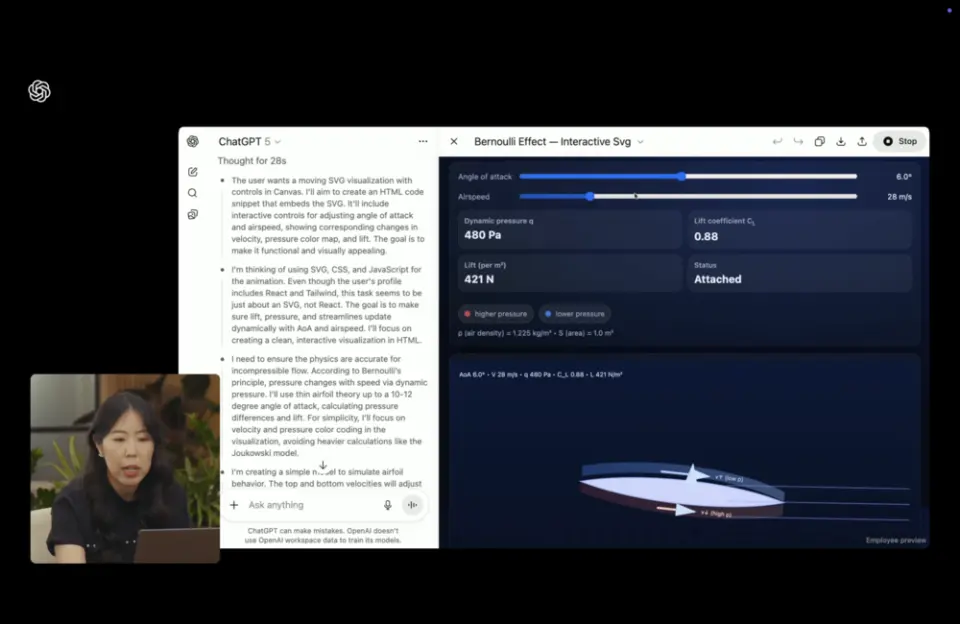
Prompt: Let me quickly understand what is the Bernouli effect (Bernouli effect)
Under this prompt, GPT-5 quickly gave a detailed explanation of the Bernoulli effect. When the user asked for an SVG animation demonstration, GPT-5 directly entered the deep thinking mode and generated 420 lines of code in two minutes. Finally, we saw this interactive animation.
It is worth noting that users can freely adjust the flight speed and angle, and the airflow lines will also change in real time. This is not only a visual knowledge output, but also a personalized simulation system with teaching assistance value.
2. Build APP in five minutes
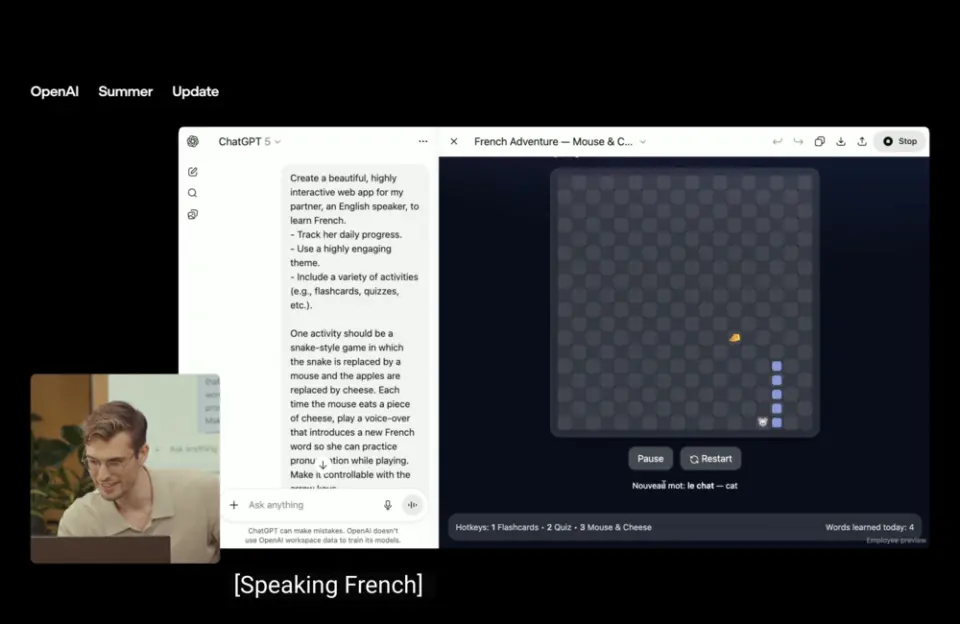
Prompt: "I am a native English speaker. I want to make an interactive learning app for my partner who is learning French. It should have cards, word guessing, and games. It is best to make it a mouse eating cheese to learn words."
GPT‑5 not only “understood” the requirements, but also implemented all the requirements within five minutes: card-style interface, interactive functions, and learning progress tracking were all online.
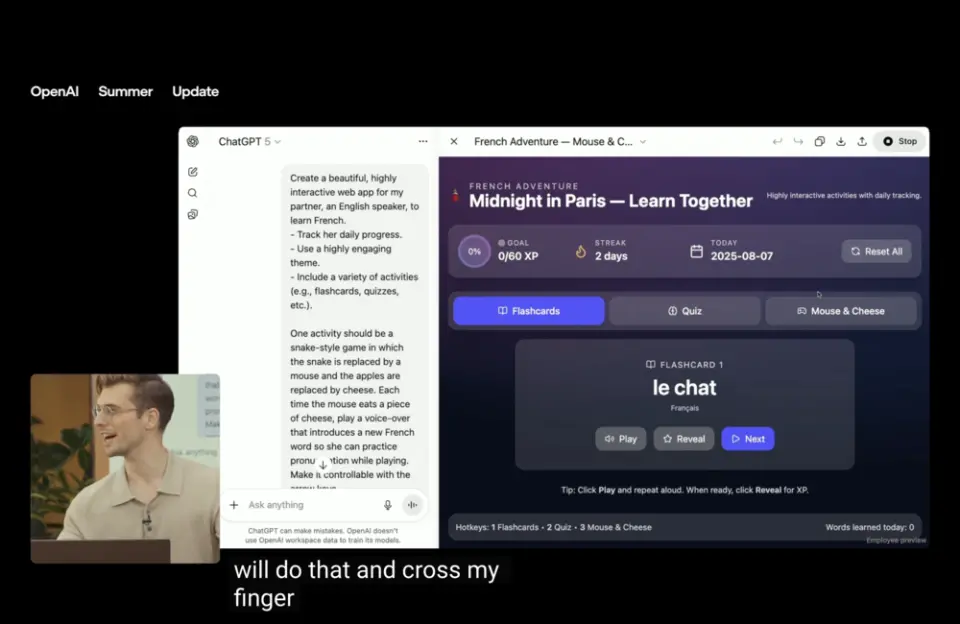
And the little game "Mouse Eats Cheese" is even more amazing - every time the mouse eats a piece of cheese, a French word voice will be automatically played, making learning and entertainment truly seamlessly integrated.
You can even see this AI actively optimizing interaction logic on details that are not explicitly requested by the user, which is enough to show that its level of understanding has jumped.
3. Fix code bugs
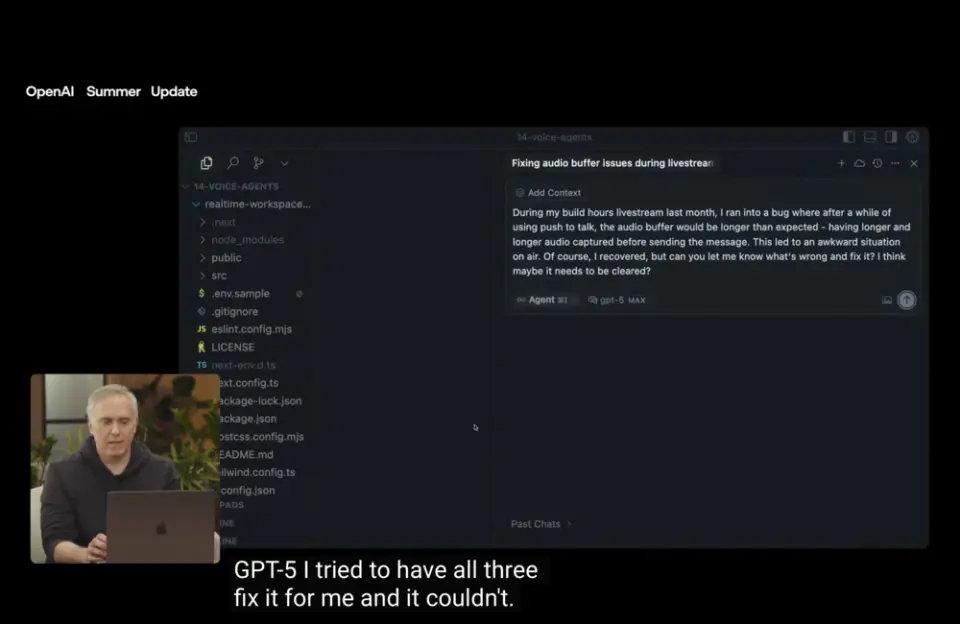
The setting of this scene is like a real work scenario: an engineer hands over a project code that looks normal but is actually riddled with problems, hoping that it will find potential problems.
In the past, writing code for AI models was difficult enough, and finding bugs was even more difficult. This time, GPT‑5 not only identified key issues, but also proposed solutions and passed the simulation without any errors.
You know, this is the first time that a developer has given real engineering tasks directly to AI to complete independently and successfully. This not only means automating code writing, but its next step may be to participate in the entire software life cycle management.
4. Create a visual financial dashboard in five minutes
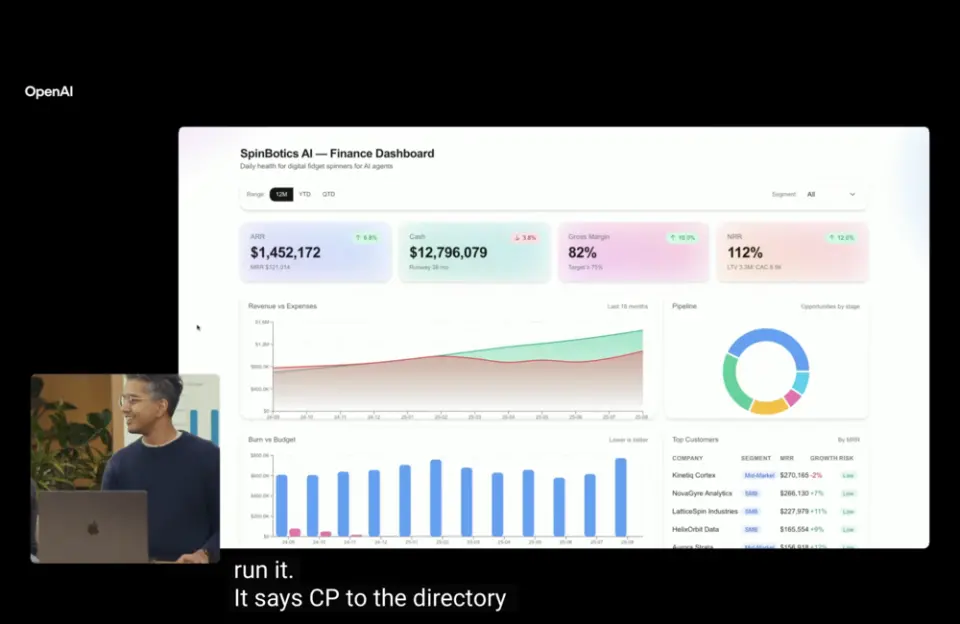
Prompt: Please create a financial dashboard for my AI agent company, which has completed Series D financing.
Users throw all kinds of company data to GPT‑5, and within five minutes the model delivers a dynamic financial dashboard comparable to the CFO level of a startup company. All data items are automatically mapped, supporting adjustment, updating, and filtering, and the UI can also be called "ready-to-use level."
During the GPT-5 press conference for more than an hour, Altman emphasized many times that "GPT-5 is the strongest code model we have ever produced."
In order to further confirm this judgment, OpenAI even invited Michael Truell, CEO of Cursor, to the platform. He announced at the press conference that GPT‑5 will officially be available in the Cursor editor in the next few days.
GPT-5 allows AI to “template”
If the first two parts still make people feel that GPT‑5 is an excellent "tool man", then in the third part, it completely demonstrates the potential of AI to evolve into an "intelligent companion".
One of the biggest breakthroughs in this release of GPT‑5 is its extremely deep personalization capabilities.
And this kind of personalization is no longer as simple as changing the "theme color" superficially, but - it can participate in your life decisions.
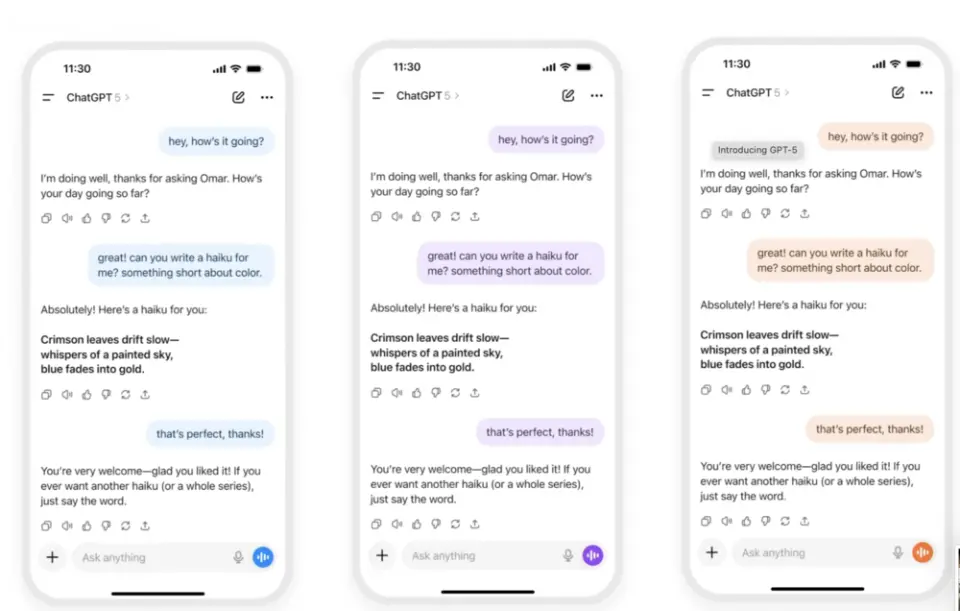
GPT-5 now supports changing the color of the chat box
In the live demonstration, GPT‑5 first demonstrated the identity of a “super personal assistant”:
It can access the user's calendar and email, automatically check for things you missed, such as an unprocessed meeting invitation, or even your usual fitness frequency; and based on this information, it can automatically generate a personalized schedule for you. You no longer need to manually set reminders, remember meetings, and organize your life - GPT‑5 will manage everything like a life coach who understands you based on your own past behavior patterns.
It's like tearing down the last wall between Chatbot and Agent.
In the past six months, AI companies at home and abroad have entered the Agent industry. Microsoft, Google, and Anthropic have successively released their own Agent systems; even OpenAI itself launched its first native Agent on a small scale last month. But all this seems more like a “preview” in front of GPT‑5.
However, the agentization of GPT-5 is a natural evolution based on the improvement of its own cognitive capabilities.
It does not rely on preset processes, but is based on understanding you, remembering you, and linking external information to dynamically adjust strategies and generate suggestions, truly achieving a "customized intelligence agent."
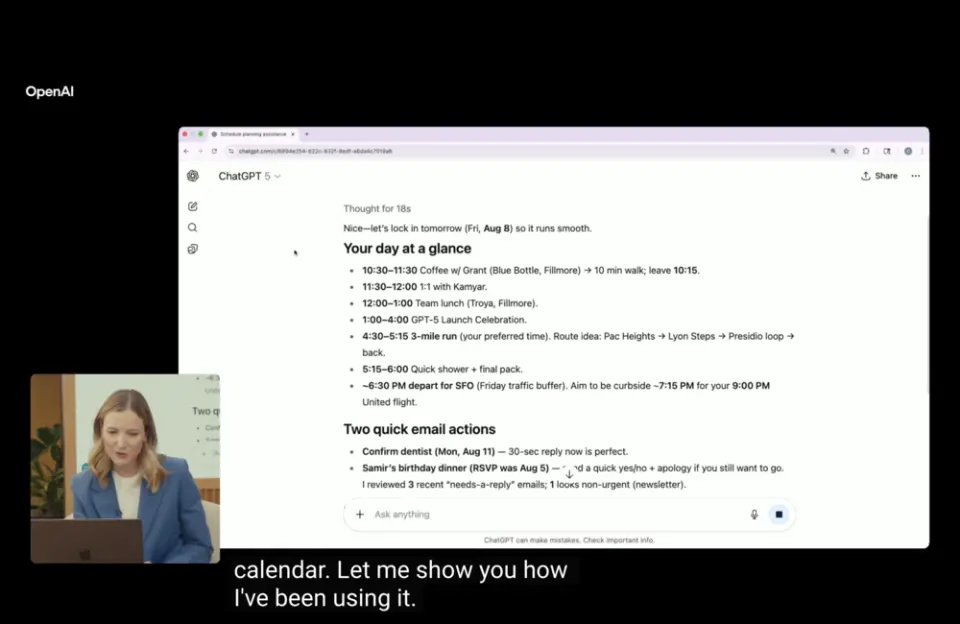
The most moving demonstration of GPT‑5 is also an “ultimate topic” that Altman deliberately emphasized—the application of GPT-5 in the field of health care.
The woman who came to the GPT-5 conference was a patient suffering from three types of cancer. Facing the complex medical report sent by the doctor, she was at a loss, and the choice of the final treatment plan rested entirely on her.
Then GPT‑5 came on the scene: it not only translated difficult medical terms into everyday language, but also made a clear comparison of the pros and cons of each treatment option, and even helped her evaluate which path was more suitable for her condition from a psychological and life perspective.

In this AI arena, overseas has begun to roll up.
One night, Ultraman fired 12 X's in succession;
During the GPT-5 press conference, not only Ultraman but also Musk was swiping the screen on X - he said, "Grok has surpassed GPT-5 in general reasoning tasks."