The day without "phone cards (SIM cards)" is coming soon. Today there is news that Huawei will launch a new tri-fold mobile phone that supports eSIM (electronic SIM card), which is expected to become the first commercial eSIM smartphone in China. This means that in the future, users will not need to use a physical SIM card, but can also use Huawei mobile phones that support the eSIM function to make calls, send text messages, and surf the Internet.
Although, Huawei has not responded yet on whether it will launch a mobile phone that supports eSIM function. However, considering that Apple phones have previously supported eSIM in the United States, and the iPhone 17 Air, which will be launched in September, has also been revealed to be negotiating eSIM commercialization with domestic operators, the launch of Huawei's eSIM phones may not be far away.
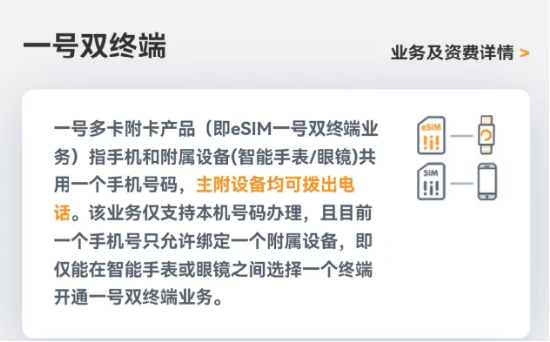
The "BUG" column learned from operator personnel that China Unicom has launched the "One Number Dual Terminal" eSIM service; China Mobile's eSIM service has been suspended on January 4, 2024, but will be gradually opened in the near future. China Telecom stated that it “cannot handle the upgrade until it is completed.”
As operators gradually restart, terminal manufacturers such as Huawei and Apple have supported the advancement, and the era of "cardless" mobile phones is accelerating. For ordinary users, it will be easier to change operator networks in the future, and there is no need to go to offline business halls.
Operators are taking action: China Unicom is fast, China Telecom is slow?
Public information shows that eSIM refers to an electronic SIM card, which is a data file that can be downloaded to a mobile terminal through the Internet. With it, you can achieve the same functional experience as ordinary SIM cards.
For mobile phone manufacturers, one benefit of supporting the eSIM function is that it can compress the space of the mobile phone and reserve more space for other hardware. At the same time, the eSIM solution is integrated into the hardware and takes up only 1/3 of the space of the Nano SIM card, which will also make the mobile phone smaller and lighter. It will also become easier for users to change operator networks, without having to go to offline business halls.
Of course, there are prerequisites for using the eSIM service. It requires terminal devices such as mobile phones to support eSIM in hardware, and the eSIM service must be activated at the operator. In addition, since eSIM is an emerging technology, it also requires more time to test in terms of security and other aspects.
The "BUG" column learned that as early as 2023, the three major operators had suspended eSIM business processing on the grounds of "business maintenance and upgrade". Although users who have already activated it can continue to use it, new users cannot apply. At that time, some people in the industry pointed out that there were technical risks - eSIM's remote writing mechanism was exploited by criminals, leading to a surge in fraud cases, and it was less secure than physical cards.
However, recently, operators' attitudes towards eSIM have also changed.
People from China Unicom told the "BUG" column that eSIM service applications are currently supported. The fee after activation is 10 yuan per month, and the terminal types involved include smart watches, glasses, etc. The regions are Beijing, Shanghai, Tianjin, Inner Mongolia, Hebei, Shanxi, Anhui, etc.
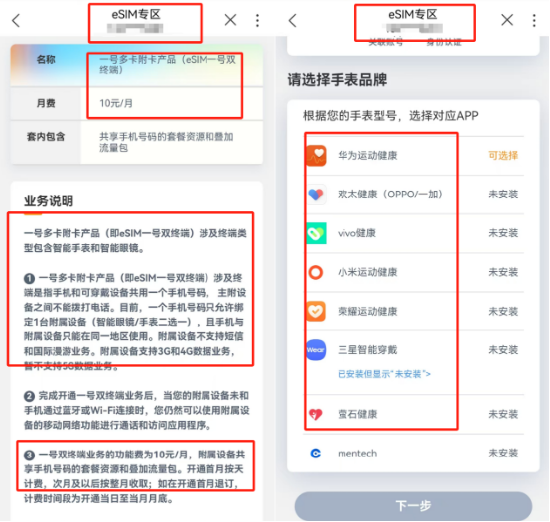
China Mobile customer service said, "Nationwide eSIM business support will be gradually opened in the near future, and corresponding system optimization and resource preparation are under way. The specific opening time has not yet been determined." After the opening of eSIM "suspended due to system upgrade" in 2023, although China Mobile's eSIM service is still suspended, relevant information pages can still be found in the system.
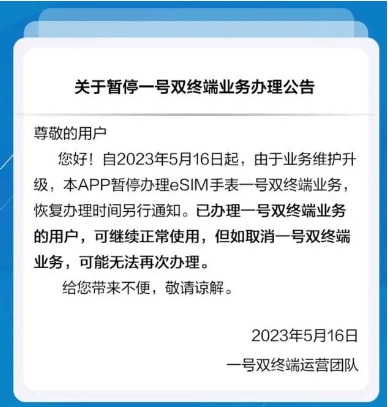
Among the three major operators, only China Telecom is currently making slow progress in eSIM services. Its customer service clearly stated: "Currently, the eSIM business has not yet been upgraded and cannot be processed, and there is no specific time notification for the completion of the upgrade." Others believe that the slow progress of Telecom is mainly due to the limitation of Telecom’s Tiantong satellite communication business, which requires authentication based on physical SIM cards.
An eSIM industry chain person revealed to the "BUG" column that "eSIM has been suspended for two years, and the three major operators will fully liberalize it in the second half of this year." Industry chain people pointed out that the previous suspension of eSIM business was due to the unclear switching rules of eSIM business between operators, which caused some operators' businesses to be affected. On the other hand, security is also an important consideration. Eventually, operators will suspend eSIM business processing in 2023.
"Recently, it is because the rules for switching between operators have become clearer, the process for switching to other manufacturers after a one-time launch has become clearer, and some security improvements have been made, so it has to be restarted again." said the aforementioned insider.
Huawei VS Apple: Fighting for the domestic debut of eSIM?
In addition to operators, the change in attitude of mobile phone manufacturers towards eSIM will also be the key to whether eSIM can be quickly popularized and used.
Huawei did not respond to whether Huawei will launch a new three-fold mobile phone that supports eSIM. But it is foreseeable that as mobile phone brands such as Apple support eSIM and gradually cancel physical card slots in the United States and other regions, domestic manufacturers such as Huawei are also on the way to support eSIM.
In fact, as early as 2017, Google and Apple began to support eSIM in mobile phones, but retained the physical card slot. By 2022, the iPhone 14 released by Apple in the United States will cancel the physical card slot and only support eSIM. According to overseas media reports, Apple’s iPhone 17 Air, which will be launched in September, will cancel the physical SIM card slot and adopt a pure eSIM solution globally. It is also currently negotiating eSIM commercial cooperation with domestic operators.
A senior observer in the communications industry told the "BUG" column: "Huawei is likely to launch a tri-fold flagship phone that supports eSIM in September, so Huawei will seize the first eSIM phone from Apple in China. However, if it fails to 'launch' and follow up, some users who are eager to experience the eSIM function first may switch to Apple."
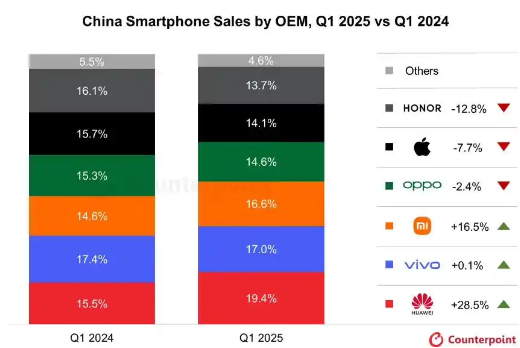
According to a CounterPoint Research report, in the first quarter of 2025, the overall sales volume of China’s smartphone market increased by 2.5% year-on-year. Among them, Huawei ranks first with a market share of 19.4%, while Apple’s market share has declined. In the second quarter, Huawei once again topped the list with a market share of 18.1%, while Apple ranked fifth.
"Competition in the domestic mobile phone market has become increasingly fierce in recent years. After Huawei's mobile phones were affected in overseas markets, the domestic offensive has been very rapid in recent years. They should not fall behind." said the aforementioned person.
As operators and leading mobile phone manufacturers such as Huawei and Apple successively support eSIM services, the wave of card-less mobile phones will soon become a new feature that major mobile phone manufacturers are chasing, and will quickly become popular.