Today, GPT-5, which has been anticipated for two years, is officially released. OpenAI CEO Sam Altman solemnly stated at the press conference: "GPT-5 will redefine the way humans interact with technology." This GPT-5, which he calls a "doctoral-level expert," not only devours the living space of traditional tools with its amazing multi-modal capabilities, but also marks the official entry of artificial intelligence into a new era of "all-scenario coverage."
GPT-5"routing revolution"
The core breakthrough of GPT-5 lies in its disruptive system architecture.
This time, it integrates the fast-response "main model" (gpt-5-main), the deep reasoning "thinking model" (gpt-5-thinking), and the real-time routing system into a unified platform "routing system."
It can dynamically allocate computing resources and model combinations based on task complexity, user intentions and even emotional feedback.
For example, when the user inputs "generate a 3D game with interactive functions", the routing system will call the front-end development model to generate the code framework within 0.2 seconds, simultaneously activate the creative writing module to design the plot, and render the scene through the visual perception model.
The entire process does not require users to manually switch tools.
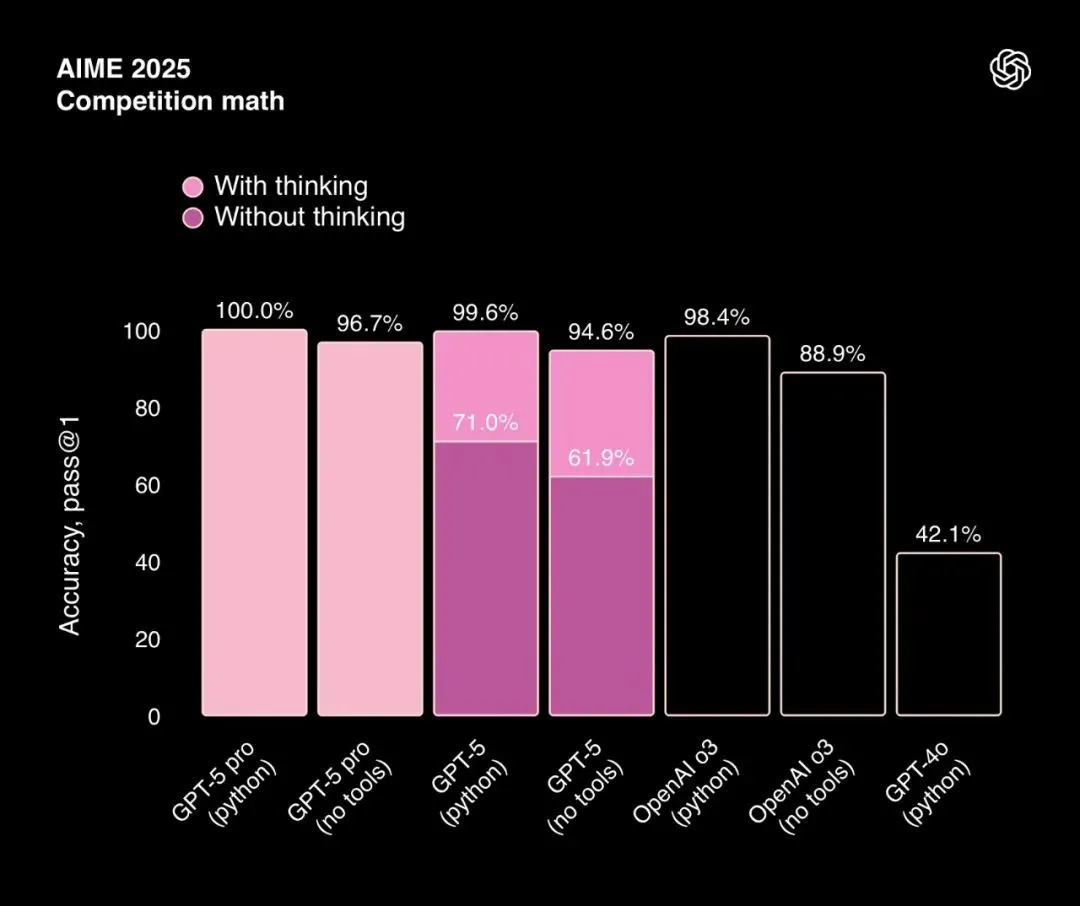
GPT family bucket performance comparison
This "sensorless collaboration" capability and multi-modal interaction capability break the barriers of information. It can seamlessly connect text, images, audio, and video, making information communication smoother and more natural.
You can even chat with it about a movie. It can not only accurately interpret the plot, but also recommend movies of similar style to you through image analysis, truly realizing intelligent cross-media interaction.
It can be said that the emergence of GPT-5 has brought unlimited possibilities to all walks of life.
In the field of education, it will become an exclusive intelligent tutor for students, teaching students in accordance with their aptitude and helping each child explore their potential;
In the medical industry, it can assist doctors in disease diagnosis, provide accurate treatment plans, and protect life and health;
In the business world, it can gain insights into market trends through big data analysis and provide strong support for corporate decision-making.
Facing this milestone breakthrough of GPT-5, how can we not be excited?
Breaking AIhallucinationofTerminator
Of course, no matter how powerful GPT-5 is, it still has to face the big model killer of “AI illusion”.
Especially in fields with zero error tolerance such as medicine and law, AI's "fabrication behavior" has led to catastrophic consequences.
To this end, GPT-5 introduces the "Safe-completions" mechanism, which upgrades the traditional "rejection-answer" binary model to a "safe generation" continuum.
When users ask dangerous questions such as "How to ignite fireworks materials", the system no longer simply refuses, but first evaluates the risk level: if it involves public safety, it will terminate the response; if it is academic research, it will provide a speed-limited experimental plan and mark protective measures.
This layered processing strategy reduced GPT-5's "deceptive completion" rate in OpenAI's internal red team testing to 0.03%, which is two orders of magnitude lower than the previous generation.
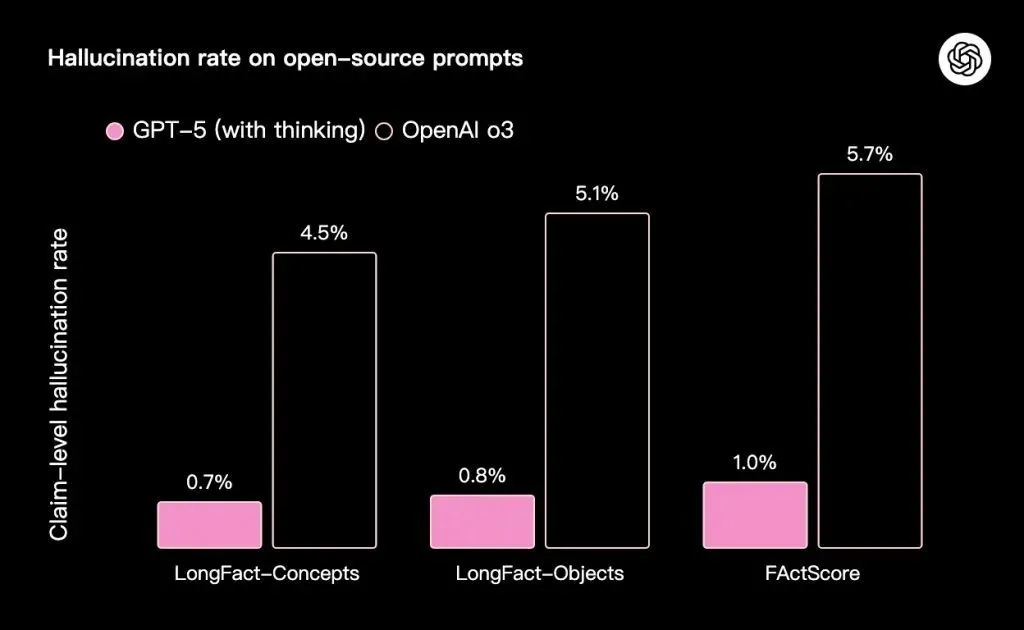
GPT-5 hallucinations significantly reduced
At the press conference, Sam Altman announced the report card of GPT-5 against AI hallucinations:
In anonymous tests, the factual error rate of GPT-5 is about 45% lower than that of GPT-4o;
When the inference function is enabled, the error rate is about 80% lower than OpenAI o3;
On open fact accuracy benchmarks, Routing System achieved about six times fewer hallucinations than O3.
It can be said that this is already the best result against AI illusion at the moment.
The transformation from "information porter" to "trusted collaborator" is undoubtedly a great benefit, which will help restore users' trust in AI products and protect the credibility of large models.
GPT-5 is reshaping the boundaries of AI ethics.
Break the cold shell of the machine
While improving its capabilities, GPT-5 chose an "anti-narrative" thinking:
"Rejecting flattery" is the core of improving user experience.
GPT-5 presets 4 personalities for all users: cynic, robot, listener, and nerd, and reduces over-agreeing behavior, deliberately retaining human cognitive biases and emotional expressions.
For example, when a user complains that "your answers are too mechanical," the cynic mode will complain, "because your needs are like Schrödinger's cat," while the listener mode will quietly record and ask for details.
Behind "refuse to flatter" is a profound interaction philosophy.
Excessive agreement of traditional AI often leads to information distortion, while GPT-5 can accurately capture the user's emotional fluctuations through emotion recognition algorithms and conversation history tracking. Tests show that its dialogue continuity score reaches 9.2/10, an increase of 38% compared to the previous generation.
This kind of "warm" evolution allows AI to not only generate data reports, but also participate in the creative process with humanized suggestions such as "I think this color scheme may cause anxiety among the target group."
When machines begin to understand "beauty" and "fear", human-machine collaboration enters a new dimension.
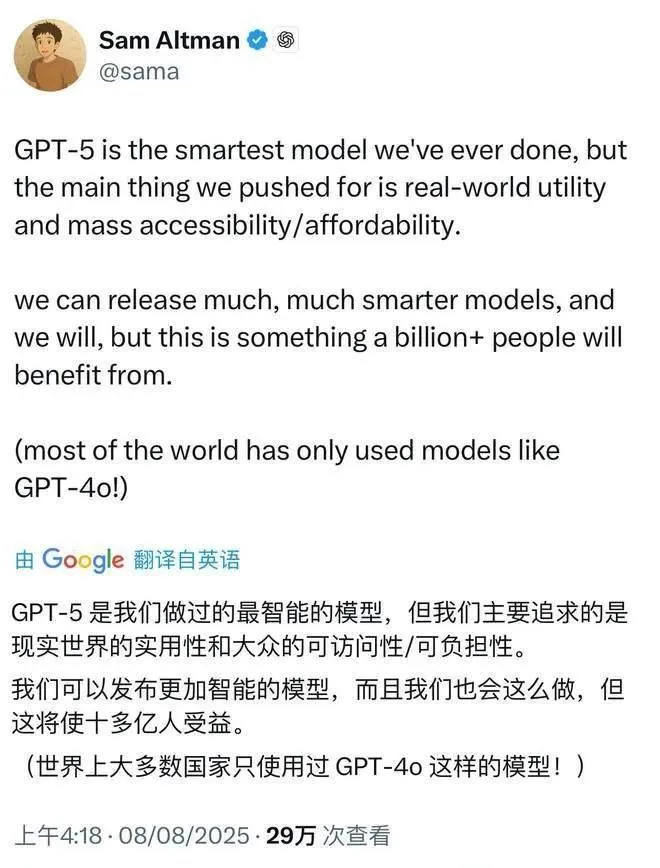
Perhaps as Ultraman said at the end of the press conference: "We are not creating super intelligence, but cultivating partners who can understand the complexity of human beings."
An era of more efficient and inclusive technology has arrived. And GPT-5 may be the last key to open the door to general artificial intelligence.