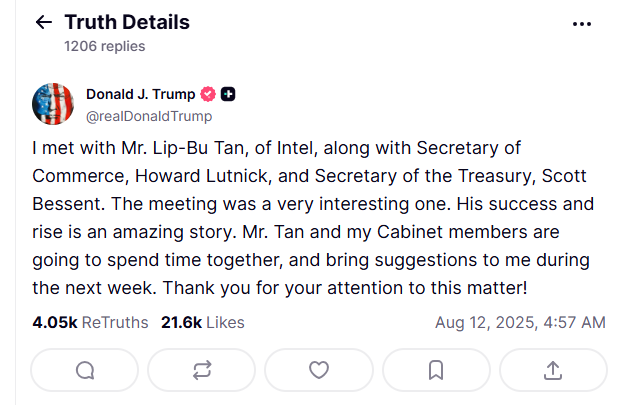
A White House meeting appears to have temporarily calmed tensions between the U.S. president and chip giant Intel. On Monday, U.S. President Trump met with Intel CEO Chen Liwu at the White House. Media reports said that he was also accompanied by U.S. Commerce Secretary Lutnick and Treasury Secretary Bessent.
After the meeting, Trump posted on his social platform Truth Social,The meeting was "very interesting" and he praised Chen Liwu's personal struggle history as an "amazing story". It is worth noting that four days ago, Trump was still publicly calling for the resignation of Intel CEO.
The two sides will also make recommendations within the next week on how the U.S. government can support Intel. Trump made it clear in the post that Chen would spend time with members of his cabinet and "make recommendations to me within the next week." Intel said in a statement that the two sides had "candid and constructive discussions" and looked forward to working closely with the current administration to "revitalize this great American company."
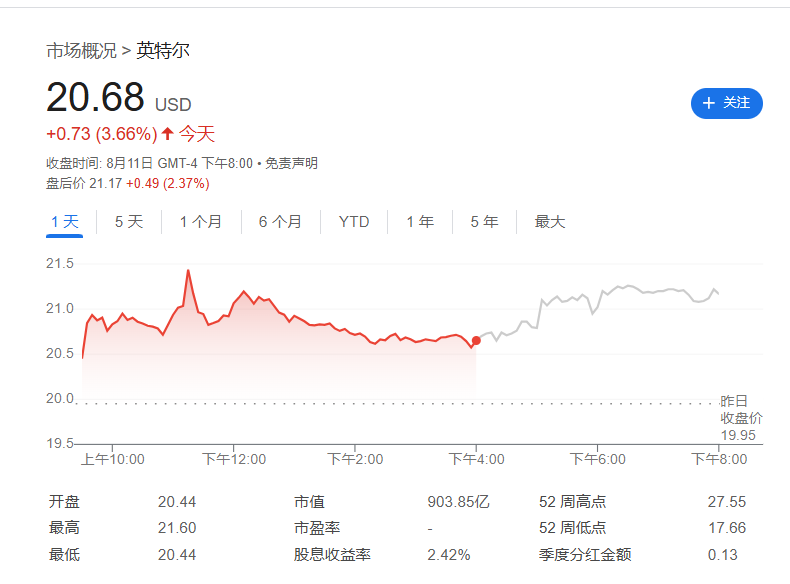
The market reaction was immediate. Intel's stock price, which had closed up 3.66% before the meeting, rose again by about 2.4% in after-hours trading.
The turmoil started last week. After Tom Cotton, head of the U.S. Senate Intelligence Committee, wrote to the Intel board of directors expressing "security and integrity" concerns about Chen Liwu's past business activities, Trump quickly followed up and publicly demanded Chen Liwu's resignation, saying that there was a "high degree of conflict of interest."
According to reports, Intel admitted last month that it had violated U.S. export controls during Chen Liwu's tenure. In the face of accusations, Tan Liwu, who was born in Malaysia, quickly fought back, calling the claims about his background "wrong information" and emphasizing that he has lived in the United States for 40 years and has always adhered to the highest legal and ethical standards.
According to Axios analysis,Chen Liwu's response to this crisis reflects an effective strategy for corporate executives to deal with the "Trump spotlight".
Faced with sudden political pressure, Chen Liwu chose to quickly contact the White House and publicly expressed his recognition and support for the president's priorities. Intel's board of directors also expressed support for the CEO during this period.
This proactive communication strategy is exactly the same as what business leaders such as Apple CEO Tim Cook have done in the past, aiming to resolve conflicts through direct dialogue rather than engaging in open public opinion confrontation. As one consultant pointed out to Axios, "Every company is one Truth Social post away from being caught in a political storm." Through this meeting, Chen seemed to have succeeded in temporarily pulling Intel back to safety from the center of the storm.
Intel faces transformation challenges
The reason why the White House's "handshake and peace" has attracted much attention is inseparable from Intel's own predicament and its core position in U.S. technology strategy.
As one of the main beneficiaries of the Biden-era chip subsidy bill, Intel is facing severe financial challenges, with its chip foundry business continuing to lose money and failing to fully profit from the wave of artificial intelligence infrastructure.
Since taking over from his predecessor Pat Gelsinger in December, Chen Liwu has launched a series of cost-cutting measures, including layoffs and abandoning manufacturing projects in Europe.
Even more warningly,Chen Liwu warned last month that Intel may withdraw from competition in the field if its most advanced 14A manufacturing process fails to win major customers.This move will have an impact on the global semiconductor industry and deprive the United States of a key alternative to TSMC in domestic advanced chip manufacturing.