"3, 2, 1, link up!" "Only the last 100 orders left!"... During the "Double 11" promotion, some e-commerce anchors frequently released amazing sales data, created a hot-selling atmosphere, and induced consumers to place orders. However, some consumers have reported that the "limited-time benefits" in some live broadcast rooms are not "limited-time", and some products that are claimed to be "sold out" are still on sale. Are the sales data of these live broadcast rooms real? How to manage the live broadcast e-commerce environment? "Xinhua Viewpoint" reporters launched an investigation.
Inventory figures can be forged, and there are a lot of “shills” among interactive users
"Today is the anchor's birthday. The special price only lasts for 5 minutes. Once sold out, it will be out of stock!" A reporter recently saw in a live broadcast room on a certain platform that an anchor was promoting a sweater that was said to be "fragmentally priced." After the sweater went on sale, the live broadcast room kept scrolling with user purchase information.
"The sales are so good, I will extend it for another 5 minutes for my family. Don't miss this opportunity, it will never come again!" said the anchor. But the next day, the sweater appeared in the same live broadcast room again.
The extremely high number of people online, the inventory that disappears in seconds, and the rhetoric of "last few orders" can easily make consumers make impulsive purchases. “As soon as the anchor said ‘limited time grab’, I felt a sense of urgency and placed the order without even realizing it.” Consumer Ms. Zhou said.
What is the truth? “Many plots of ‘inventory space’ in live broadcast rooms are carefully designed ‘performances’.” Mr. Luo, the head of a media company in Jiangxi that mainly engages in live broadcast business, said that this is a method of “hungry marketing”.
Ms. Wu from Foshan, Guangdong said that she once squatted in a live broadcast room for more than ten minutes and found that there were only a few people coming and going in the comment area. However, as soon as the link was posted, the inventory was quickly sold out. “I thought I was lucky when I grabbed it, but I calmed down and came to my senses afterwards. It turned out that I was the only one who really consumed it, and everyone else was just a shill!”
Industry insiders said that in order to gain more exposure, some merchants and anchors will set up their inventory in the system backend in advance, and ask the navy to interact with the comment area to boost praise, and cooperate with the live broadcast script to create the illusion of "empty in seconds", thereby attracting real traffic to the site. The real transaction rate of some live broadcast rooms is even less than 5%.
"Current e-commerce platforms generally adopt the recommendation logic of 'the higher the sales volume, the more exposure'. This algorithm mechanism can easily cause merchants to fall into 'data anxiety', which to a certain extent aggravates data fraud." said Li Qian, executive vice president of the Tianjin E-Commerce Association. Mr. Zhu, the person in charge of a leather goods firm in Liwan District, Guangzhou, said frankly that competition on the live broadcast track is fierce. Without the support of data and popularity, it will be difficult to "break through" in the early "starting" stage of creating a live broadcast account.
A professional team recruits "brushers" to form a counterfeiting industry chain
In the traffic fraud industry chain, how are the false inventory and number of people in the live broadcast room operated?
——Some professional teams claim to provide “data ‘heating’” services to “pace” businesses.
The reporter searched on multiple social platforms and found that there are many advertisements about "heating data in the live broadcast room". A blogger posted that he could "manually brush recommendations and coordinate with the rhythm." This also gave rise to the industry's "lingo": users purchasing services are called "grocery shopping", people who sell live broadcast data are called "directors", real people participating in interactions are called "actors", and the total number of purchases is called "box office".

The picture shows a live broadcast room "data heating" service advertisement posted by a blogger. (Photo courtesy of interviewee)
"The interactive business costs 5 yuan per person per hour. All performances are performed by real people with different IP addresses, and the speeches can be customized." The blogger said that real-person traffic can be used to increase the number of clicks and views of the customer's work 20 minutes in advance. During the live broadcast, people can like, comment and follow, and then join the user's fan group, light up the sign, and not leave the venue within an hour.
——"Brushers" are mostly recruited in the name of "part-time job".
On some social platforms, there are a large number of "brushing hands" recruitment posts. These posts, under the banner of "watching live broadcasts of harvesting wool" and "part-time side jobs", attract users to join the community, receive instructions through the group to earn task money, and then use the task money to exchange for viewing bonuses. "The main task is to enter the designated purchase link and complete the '15 words + positive review', which is to exchange time for money. You can earn a few dollars per order." Zhu Yingying, a student at a university in Dongguan, Guangdong, said that some of her classmates have participated in this kind of "part-time job".
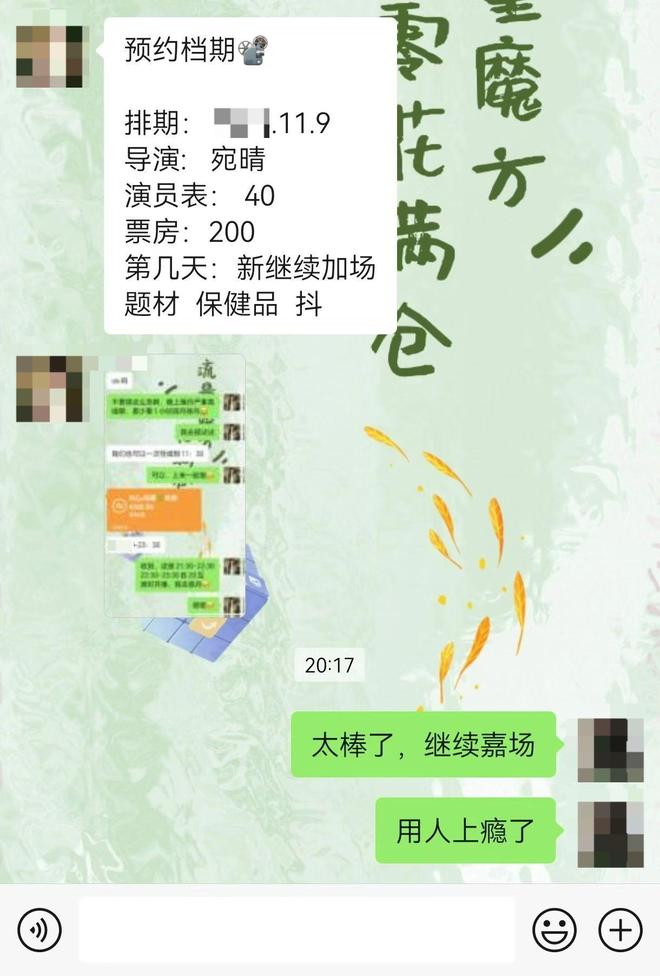
The picture shows the sales content posted by a "Qihao" blogger in Moments. (Photo courtesy of interviewee)
"Traffic fraud will lead to misjudgments by the platform algorithm and tilt traffic to traffickers. This behavior undermines the order of fair competition in the market and damages the interests of merchants operating with integrity," Li Qian said.
This issue has attracted the attention of regulatory authorities. Data released by the Central Cyberspace Administration of China in early 2025 shows that since 2024, the cyberspace department has seriously investigated and dealt with issues such as recruitment, promotion and diversion, and volume control and evaluation of online troll organizations. It has coordinated the closure and delisting of more than 400 website platforms, urged key platforms to clean up 4.82 million pieces of illegal information, and disposed of 2.39 million accounts and merchants, and 52,000 groups. This year, the Beijing Municipal Bureau of Market Supervision successfully investigated and handled the first case of "professional barrage" in live broadcast e-commerce in the country's market supervision field. It issued a fine of 100,000 yuan to a biotechnology company for hiring trolls to post false user reviews during the live broadcast to mislead consumers. The Shenzhen Municipal Bureau of Market Supervision recently announced a case of using "live broadcast + order brushing" to conduct traffic fraud, and the company involved was fined 200,000 yuan.
Improve regulatory measures to combat traffic fraud
"Some businessmen and trolls work with trolls to forge real-time online numbers in live broadcast rooms and create false product sales, which is suspected of infringing on consumers' right to know and violating the principle of fair trade." Liu Xiaochun, associate professor at the Law School of the University of Chinese Academy of Social Sciences, said that controlling data fraud in live broadcast rooms can encourage businesses to invest resources and energy in improving product quality, help create a good consumption environment, and promote the sustainable development of the industry.
The reporter learned that many mainstream live broadcast platforms are strengthening monitoring of abnormal traffic in live broadcast rooms. Douyin issued an announcement to severely crack down on "internet trolls" who illegally provide paid services such as "boosting likes and boosting reviews". Recently, the platform has removed more than 40,000 illegal videos, and has imposed indefinite bans and short-term bans on more than 30,000 accounts. Kuaishou said that it uses its risk control system to identify and intercept live broadcast sales fraud in real time. For users who assist merchants and others in making false transactions, measures such as deleting transaction data and restricting orders will be taken depending on the severity of the case.
Xiang Lanjin, a lawyer at Guangdong Southern Fred Law Firm, believes that the rapid iteration of Internet technology has made counterfeiting more intelligent and invisible, especially the immediacy of live broadcasts, which has increased the difficulty of evidence collection. In addition, the correlation between the authenticity of platform data and the algorithm is complex, and requires a combination of electronic evidence and subjective and intentional comprehensive judgments. The application of the law needs to be further refined.
Experts such as Liu Xiaochun suggested that the platform should further strengthen technical means, improve the identification mechanism for traffic fraud, accurately identify fraudulent orders through real-time monitoring of abnormal behavior in transaction links, establish merchant credit files, and restrict traffic for counterfeiters. Implement key monitoring of leading live broadcast rooms, leading anchors and accounts, and live broadcast activities with high traffic or high turnover, and develop anti-cheating tools such as AI identification and blockchain certificate storage.
In the middle of this year, the State Administration for Market Regulation publicly solicited opinions from the public on the "Measures for the Supervision and Administration of Livestreaming E-commerce (Draft for Comment)", which aims to regulate the chaos in the livestreaming e-commerce industry and further clarify the legal responsibilities and obligations of various participants in the livestreaming e-commerce industry. Experts believe that after the measures are promulgated, the supervision of the entire process of live streaming will be further strengthened and the healthy development of live streaming e-commerce will be promoted.
The market supervision department reminds consumers that when shopping online, they should be vigilant about products that have experienced a surge in sales in the short term, have similar reviews, or are overly beautified. They should comprehensively refer to information from multiple sources and make rational consumption decisions. (Reporters Hu Linguo, Hu Nayun, Li Yating)