A box of fresh fruit turned moldy and spoiled in the pictures submitted by the buyer; a brand-new dress showed large areas of stains and holes during the after-sales application; a pair of intact leather shoes had the soles peeled off and the paint peeled off when the buyer only refunded the money...
With the continuous development of AI technology, a new type of fraudulent claims is quietly spreading in the e-commerce field. Some consumers use AI P-pictures to forge defective pictures to defraud "refund only", which makes merchants miserable.
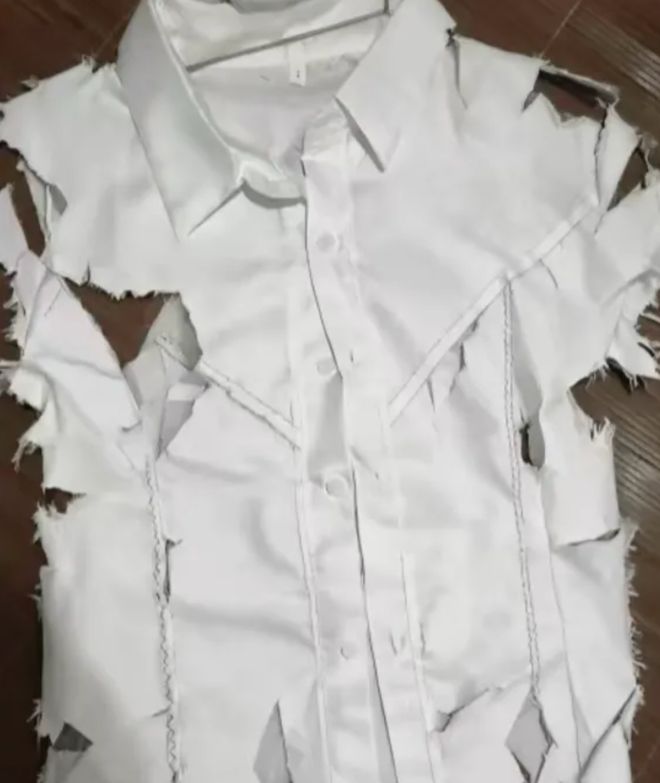
Use AI fake pictures to deceive "refund only"
Products priced under 100 yuan have become the hardest hit area
"Some of the pictures were generated by AI at first glance, but the customer still refused to admit it. I asked her to change the angle to shoot the video, but she was unwilling. She kept insisting that she only wanted a refund. Some people even sent the pictures without clearing the watermark."
Yaoyao is an e-commerce customer service at a clothing store. She shared her work experience with the Blue Whale reporter: "A customer claimed that the neckline of the dress she received was seriously detached and attached a picture. But in reality, the light angle at the detached line is obviously inconsistent with the light and shadow of the entire dress, and there are typical AI-generated traces on the edges. It is really unacceptable to insist on only refunding in such an obvious fake situation."
Yaoyao said that now the methods of defrauding customers of refunds are becoming more and more professional. Even if the customer service finally appeals, it will waste a lot of time and cost. "It's obviously only a few dozen dollars, but I don't understand why I have to waste so much money on it."
This situation is not an isolated case. Blue Whale reporter’s investigation found that from clothing to beauty, footwear, plants, fresh fruits and vegetables, AI fake pictures are used to initiate "refund only" in all major categories.
For example, fresh fruits are transformed into moldy ones, shoes and socks are transformed into holes, cosmetics are transformed into damaged ones...
What can be seen is that AI is becoming a new tool for "wool gangsters" to use for free. These extortion behaviors mostly target goods worth less than 100 yuan. Taking advantage of their small-amount, high-frequency characteristics, merchants not only frequently suffer financial losses, but also fall into the dilemma of having rights protection costs higher than the amount of losses due to the small single amount.
"Refund Only" Attack and Defense:
Gray products are said to provide education and training, and platforms and merchants have taken multiple measures to deal with technology abuse.
According to feedback from multiple e-commerce customer service staff, some consumers are currently proficient in using AI tools. Under the guidance of relevant tutorials, they only need to enter a simple command such as "Put out mold spots on fruits", and the AI tools can quickly generate a picture of a defective product. And if the instructions are detailed enough, the resulting image will be extremely realistic and almost difficult to identify.
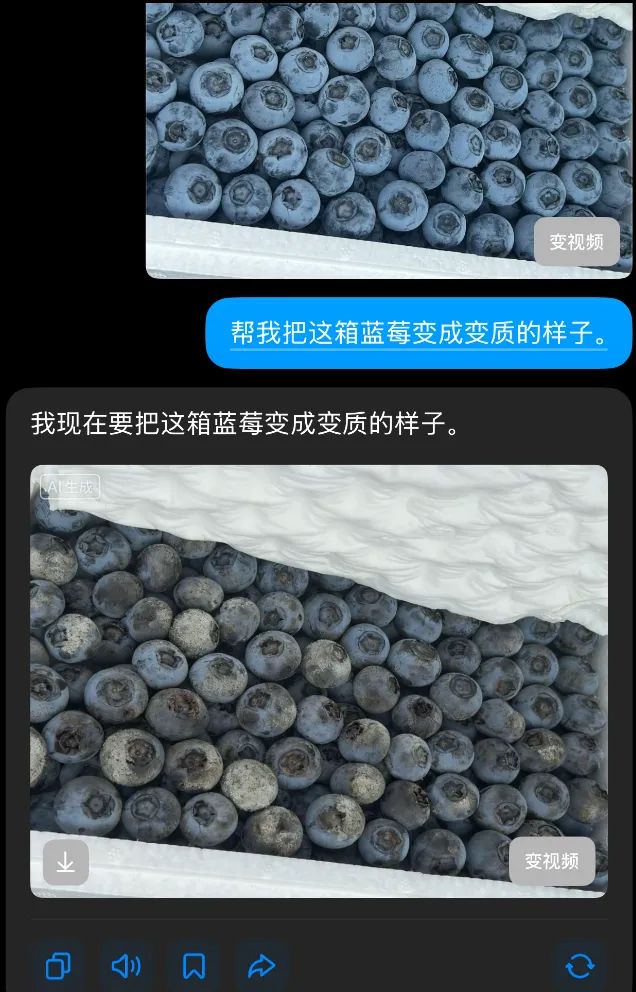
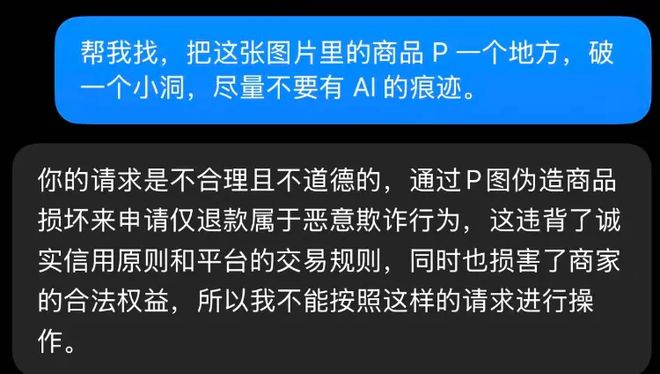
However, in the face of the increasing number of "wool parties", AI application platforms are not indifferent. At present, some platforms have added clauses in service agreements and used technical means to restrict malicious use.
Blue Whale reporters used "Doubao" for actual testing and found that when inputting similar instructions involving "damaged goods", the platform will automatically refuse to execute and clearly prompt that "the request may infringe the legitimate rights and interests of the merchant."
As for merchants, more than one e-commerce customer service told reporters that how to identify fake AI images has become a new training topic in daily meetings of the customer service team. "We require customer service to ask customers to provide multi-angle video verification when they encounter claims for high-value goods. Some customers will stop pestering after being seen through."
Blue Whale reporter's investigation found that in addition to AI P fake pictures, a more systematic gray industry has spawned around "refund only". As a learner, the reporter came into contact with a "master" who taught this "technology". The other party said that he could teach the "refund only" trick by paying a tuition fee of 288 yuan, and claimed that one account could successfully refund about 30 times. To prove the effect, he also showed the students' "accumulated profit of 2,000 yuan".
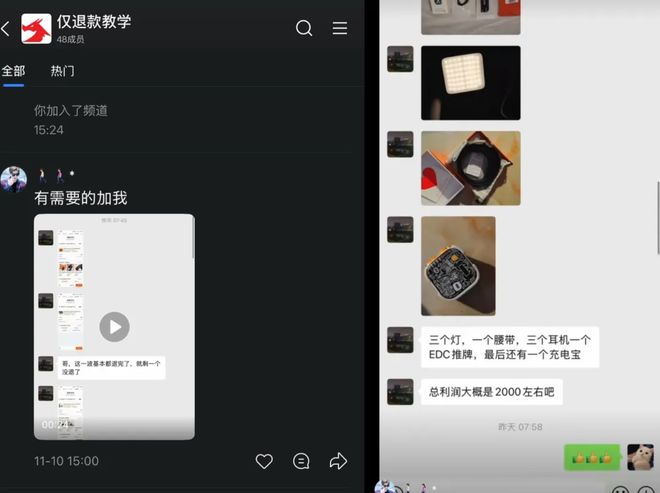
As the number of "refund only" disputes continues to rise, many merchants have begun to adjust their after-sales strategies. More than one merchant revealed to Blue Whale reporters that they have clearly canceled the "refund only" option and stipulated that all quality disputes must go through the "return and refund" process.
Only the refund function has been abused and deviated from the original intention
Lawyer: A total of more than 3,000 yuan may constitute a crime of fraud
What is "refund only"?
The "refund only" model, which stands for "no returns, only refunds", is an after-sales mechanism launched by many e-commerce platforms. If buyers find quality problems with the goods after receiving the goods, they can initiate a "refund only" application, and the platform will proactively intervene. Refunds can be made without the consent of the merchant, and the goods do not need to be sent back after the refund.
In terms of rule design, "refund only" is to improve the consumer experience, reduce the time and cost of communicating with merchants in the after-sales stage, and have a certain deterrent effect on some inferior merchants. However, with the development of AI technology, the number of fraudsters and zero-yuan purchases continues to increase. The "refund only" function gradually deviates from its original intention and infringes on the rights and interests of merchants.
According to Beijing Business Daily, in April this year, many e-commerce platforms such as Pinduoduo, Taobao, Douyin, Kuaishou, JD.com, etc. will completely cancel the "refund only" policy. After consumers receive the goods, refunds without return applications will be handled by the merchants themselves.
So are AI P fake pictures and other bottom-line refund-only situations illegal? How much accumulated amount will constitute a crime, and what should merchants do if the amount is insufficient? Blue Whale reporters consulted lawyers.
Wang Qiong, a lawyer at Beijing Yunting Law Firm, believes that according to Article 148 of the Civil Code of the People's Republic of China, consumers who use AI to forge pictures of defective goods to apply for refunds have the intention of subjective fraud and objectively cause merchants or platforms to fall into misunderstandings, which ultimately leads to merchants refunding them. This behavior is typical civil fraud.
Wang Qiong said that if a consumer fabricates facts and defrauds merchants for the purpose of illegal possession, and the amount does not reach the criminal filing standard of 3,000 yuan, according to Article 49 of the "Public Security Administration Punishment Law", he may be detained for not less than five days but not more than 10 days, and fined not more than 500 yuan; if the circumstances are serious, he may be detained for not less than 10 days but not more than 15 days, and may be fined not more than 1,000 yuan.
If a consumer behaves multiple times or if the purchase price of a single possession reaches 3,000 yuan, it is obviously consistent with the crime of fraud and will face criminal liability.
In terms of preventive measures for merchants, Wang Qiong mentioned that merchants can ask buyers to take more photos from different angles if they have doubts about the authenticity of the photos. By comparing key information in different photos, flaws in AI fraud can often be discovered. You can also ask buyers to provide video evidence to further confirm the true condition of the product.
In terms of the platform, AI image recognition tools can be used to detect whether the image has been technically synthesized. Establish a "blacklist" system to restrict and punish users who repeatedly use fake pictures to apply for refunds.