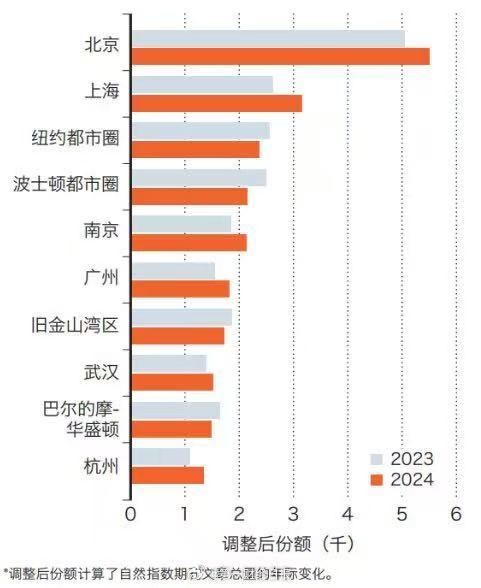
Today, Springer Nature released the supplement "Nature" "2025 Nature Index - Research Cities". It focuses on the latest scientific research output changes in major cities and metropolitan areas around the world in 2024 in high-quality journals tracked by the Nature Index. It is worth noting thatFor the first time, China occupies more than half of the top ten global scientific research cities, increasing from five seats in 2023 to six in 2024.
Beijing continues to maintain its position as the top scientific research city in the world since 2016, and Shanghai still ranks second.
In addition to Beijing and Shanghai, the other top ten scientific research cities in the world in 2024 are the New York metropolitan area, the Boston metropolitan area, Nanjing, Guangzhou, the San Francisco Bay Area, Wuhan, Baltimore-Washington, and Hangzhou.
The performance of Chinese cities has improved significantly: Guangzhou rose from eighth to sixth in 2023, surpassing the San Francisco Bay Area; Wuhan continued to climb one place; Hangzhou entered the top ten from thirteenth in 2023.
However, Shenzhen, among the four first-tier cities, is still not in the top ten.