The AI chip market is undercurrent. One of the giants, Google, is accelerating the commercialization of its self-developed AI chip TPU. There are reports that Google is discussing outsourcing cooperation with major technology companies such as Meta. From the perspective of the outside world, if the cooperation is implemented, TPU will enter ultra-large-scale data centers outside the Google system, which may have an impact on the computing power market dominated by NVIDIA GPUs.
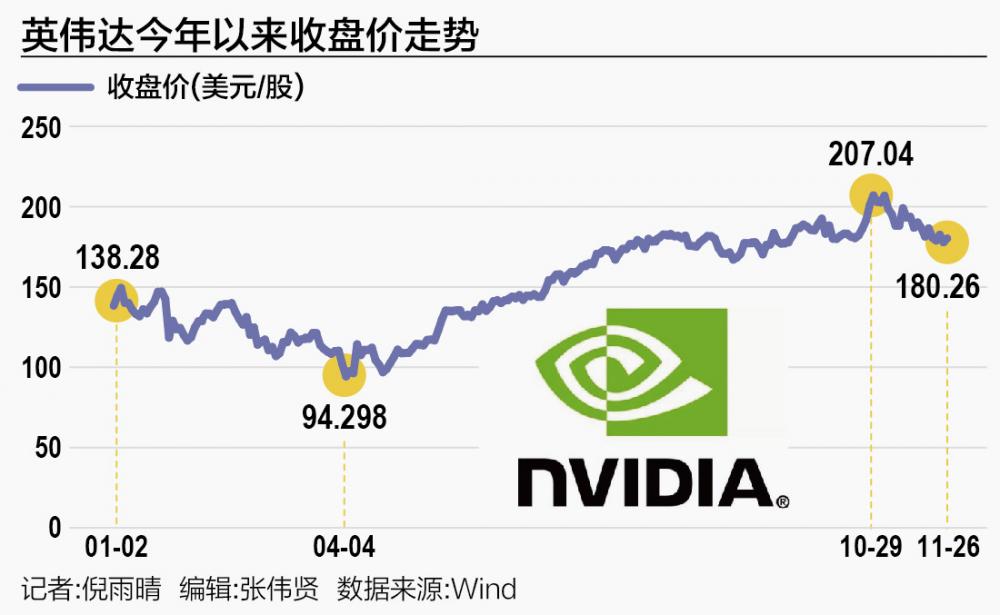
As soon as the relevant news came out, Nvidia's stock price immediately fluctuated. In early trading on U.S. stocks on Tuesday, Nvidia's stock price fell 7%, and finally closed down about 2.6%. Since October 29, NVIDIA’s market value has dropped from US$5.03 trillion to US$4.32 trillion as of the closing price on November 25. In less than a month, the market value has shrunk by more than US$700 billion (approximately RMB 5 trillion).
In the early morning of November 26, NVIDIA responded directly to Google's competition on social platforms: "We are happy with Google's success - they have made significant progress in the field of artificial intelligence, and we will continue to supply Google. NVIDIA leads the industry for an entire generation and is the only platform that can run all AI models and can be deployed in all computing scenarios."
As the leader in the global GPU market, NVIDIA responds to the challenges posed by this self-developed chip with "lead generation" and "all-scenario advantages". And even if Google TPU can enter the data centers of giants such as Meta, it does not mean that GPU will be replaced in the short term. In fact, Google also stated that the demand for its own customized TPU and Nvidia GPU is accelerating.
More industry views believe that as the load of AI training and inference increases and becomes highly diversified, heterogeneous deployments of ASICs and GPUs are more likely to occur in the future, rather than any one architecture dominating the world.
Google accelerates TPU commercialization
Google has been developing TPU for a long time, starting in 2013, and is closely integrated with Google cloud services.
In the past, TPUs were primarily used for Google's internal AI workloads and Google Cloud services. However, multiple media reports have stated that Google is promoting its self-developed chips to external customers. Meta is considering deploying Google's TPU in its data center starting in 2027 and may rent TPU capacity through Google Cloud as early as next year. The potential contract value may reach billions of dollars.
Currently, NVIDIA occupies more than 90% of the AI chip market, and manufacturers represented by Google are capturing more shares. Google's move is not sudden. On the one hand, it is a natural extension of its long-term "software and hardware integration" strategy. On the other hand, with the cost of training large models rising exponentially, self-developed chips have become a key path for giants to reduce energy consumption and control costs.
In April this year, Google launched the latest generation of TPU - TPU v7 (Ironwood), and recently iterated on Gemini 3. Google is strengthening its technical closed loop in the era of large models through model and hardware coupling. It is reported that Gemini 3 has extensively used TPU to complete training and inference, providing a stronger verification scenario for Google to promote the commercialization of TPU.
As an AI veteran, Google has covered everything from clouds, terminals, chips, large models, platform tools, etc. Nvidia, the GPU king, is also building a complete system of AI infrastructure, including CUDA, NVLink, high-speed interconnection and other barriers.
Faced with outside discussions about the vacillation of its dominance, Nvidia quickly spoke out and responded proactively. On the one hand, it emphasizes that the cooperation with Google is stable and continuous; on the other hand, its key argument is very clear. The versatility and compatibility of GPU are still irreplaceable infrastructure for current AI innovation.
In contrast, ASIC chips such as TPU, Gaudi, and Trainium often achieve extremely high efficiency on specific loads based on specific frameworks or task scenarios. Google still purchases NVIDIA GPUs, but in the future, manufacturers will adopt a diversified computing power supply strategy for AI training and inference.
"Besieging" NVIDIA
Google's acceleration is just one example of the challenges Nvidia faces. The broader trend is that global technology giants are generally accelerating the development of self-developed AI chips to compete for computing power sovereignty. From training to inference, from general models to professional applications, various enterprises have begun to regard mastering their own computing power as the key to their competitiveness in the next stage.
In addition to Google, AWS and Microsoft are also constantly iterating self-developed chips. AWS continues to update the Graviton, Trainium, and Inferentia series with strong momentum. However, after Microsoft released the self-developed AI chip Maia series, the new chip plan has been delayed.
In the Chinese market, rising stars such as Huawei Ascend, Cambricon, Baidu Kunlun, etc. are advancing rapidly. It can be seen that the entire industry is evolving from a GPU single-wire system to a multi-architecture and multi-vendor heterogeneous system.
This trend is even more evident in Anthropic’s latest collaboration. On the one hand, Anthropic has signed a long-term infrastructure agreement with Nvidia built around Blackwell and Rubin systems; on the other hand, it has also purchased Google's latest Ironwood TPU. This "multi-line parallel" procurement method strengthens a signal that large AI companies are no longer willing to bet their future entirely on a certain chip architecture, but prefer to maintain the diversification of the computing power supply chain.
At NVIDIA's second fiscal quarter financial report, when talking about the competition between ASICs and GPUs, NVIDIA founder and CEO Jensen Huang responded that there are many companies making AI ASICs on the market, but very few products can actually be put into production, because accelerated computing is completely different from general computing and cannot be achieved just by writing software and compiling it into the processor. The technology stack for accelerated computing is already extremely complex.
However, the market was not completely reassured. After the news of the commercialization of Google TPU, Nvidia's stock price fluctuated significantly. This reflects that the market is re-evaluating the share and profit margin of GPUs in future AI infrastructure, and has touched the sensitive nerves of investors about whether Nvidia's peak moment has passed.
No matter which route ultimately prevails, what is certain is that the AI infrastructure industry is shifting from single hardware competition to system-level competition. With changes in software frameworks, model systems, and energy efficiency, the AI chip landscape continues to evolve.