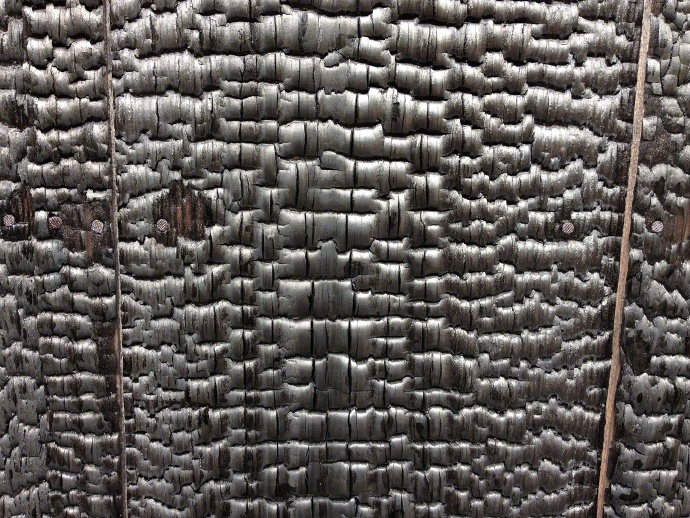
Recently, the latest research shows thatMore than a hundred years before Japan officially recorded the "Yakisugi" process in the 17th century, Leonardo da Vinci had mastered similar wood preservation technology.Annalisa Di Maria, a Leonardo da Vinci expert from the UNESCO Club of Florence, and her team made the discovery after studying the Madrid Manuscript II.
It is reported that this manuscript was written between 1503 and 1505. There is an inconspicuous record on page 87:“If you strip off the bark and burn the surface, the wood will be preserved better than any other method.”
This description is exactly the same as Japan's famous "Yakisugiban" craft, but it is more than a century earlier than Japan's earliest written records.
Information shows that yakisugi ban is a wood protection technology developed in Japan's Edo period. It was originally used to deal with floating wood at sea to solve the problem of wood shortage.
Later, people discovered that the flame-roasted driftwood was more durable due to the carbonized layer formed on the surface. This process gradually evolved into the modern cedar-burning technology.
The principle is that under high temperature and low oxygen environment, hemicellulose in wood is degraded, reducing hygroscopicity and attraction to insects and ants, while retaining the cellulose structure to enhance physical properties.