On January 2, the scientific research team of the Institute of Plasma Physics, Hefei Institute of Physical Sciences, Chinese Academy of Sciences announced that,The fully superconducting tokamak nuclear fusion experimental device (EAST), known as the "artificial sun", experimentally confirmed the existence of the tokamak density free zone, found a way to break through the density limit, and provided an important physical basis for the high-density operation of the magnetic confinement nuclear fusion device.Relevant research results were published in the international academic journal "Science Advances".
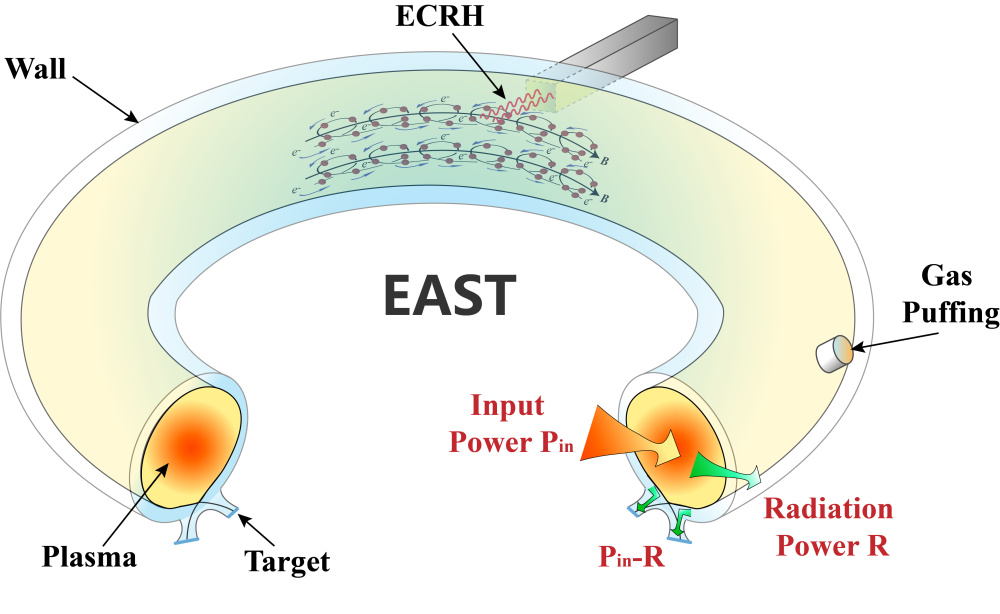
Schematic diagram of EAST high-density experiment. (Provided by the scientific research team)
The tokamak device is a ring-shaped device that uses magnetic confinement to achieve controlled nuclear fusion. It is like a spiral "magnetic racetrack" that locks high-temperature plasma to achieve the purpose of nuclear fusion. Plasma density is one of the key parameters of tokamak performance and directly affects the fusion reaction rate. In the past, scientific researchers have discovered that there is a limit to plasma density. Once the limit is reached, the plasma will burst and escape the constraints of the magnetic field, and huge energy will be released to the inner wall of the device, affecting the safe operation of the device. The international fusion community has discovered through long-term research that the physical process that triggers the density limit occurs in the boundary area between the plasma and the inner wall of the device, but the physical mechanism is not very clear.
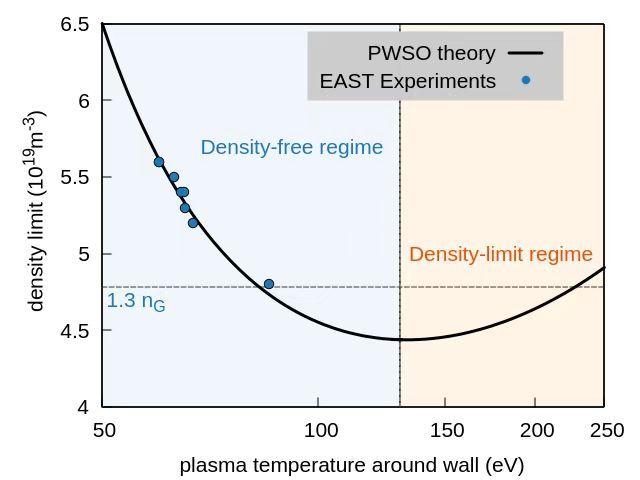
The EAST experimental results and the PWSO theoretical predictions mutually confirm each other. (Provided by the scientific research team)
This time, our country's scientific research team developed the boundary plasma-wall interaction self-organization (PWSO) theoretical model, discovered the key role of radiation instability caused by boundary impurities in the triggering of the density limit, and revealed the triggering mechanism of the density limit. Relying on EAST's all-metal wall operating environment, researchers used methods such as electron cyclotron resonance heating and pre-charge cooperative startup to reduce boundary impurity sputtering, actively delaying the occurrence of density limit and plasma rupture. By regulating the physical conditions of the target plate, the physical sputtering dominated by tungsten impurities in the target plate is reduced, the plasma is controlled to break through the density limit, and the plasma is guided into a new density free zone. The experimental results are highly consistent with the PWSO theoretical predictions, confirming for the first time the existence of the tokamak density free zone. This innovative work provides important clues for understanding the density limit and provides an important physical basis for high-density operation of tokamak.
This work was completed in collaboration with the Institute of Plasma Physics of the Hefei Institute of Physical Sciences, Chinese Academy of Sciences, Huazhong University of Science and Technology, Aix-Marseille University in France and other units, and was supported by the National Magnetic Confinement Fusion Special Project.