The BMW Group recently announced its group sales. Data shows that BMW’s full-year sales in 2025 will be 2,463,715 vehicles, a slight increase of 0.5% year-on-year. In terms of regions, the cumulative sales in the European market reached 1,016,360 vehicles, a year-on-year increase of 7.3%; the cumulative sales in the U.S. market were 417,638 vehicles, a year-on-year increase of 5.0%.
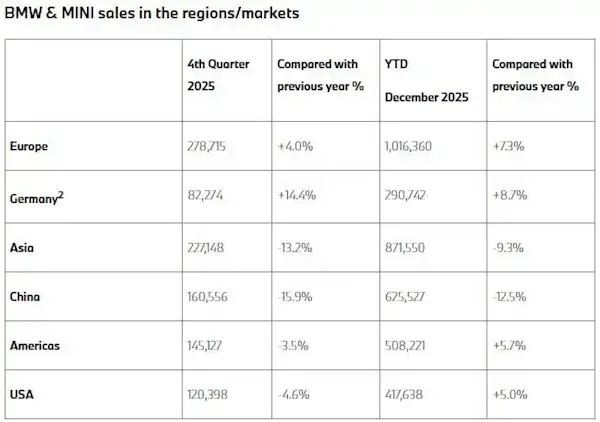
China remains the BMW Group’s largest market in the world.Cumulative sales for the whole year were 625,527 vehicles, a year-on-year decrease of 12.5%, which was also the single market with the largest decline in the world.
It is worth noting that this is the second consecutive year of sales decline for BMW China. As a comparison,The BMW Group will deliver 714,530 vehicles in China in 2024, a year-on-year decrease of 13.4%.
BMW's loss of ground in the Chinese market in 2025 is related to the poor performance of its SUV models. Third-party platform data shows that in 2024, BMW X3 sales in the Chinese market exceeded 110,000 units and dropped to 76,900 units in 2025, a year-on-year decline of 30%; BMW X5 sales also fell by nearly 20% year-on-year.
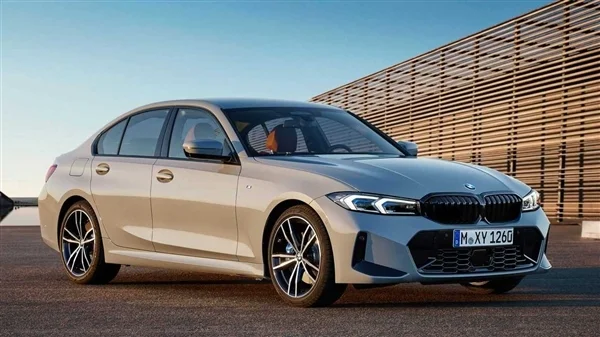
In contrast, the market performance of BMW sedans is even more impressive. In 2025, in the luxury mid-size sedan segment, the BMW 3 Series will rank first in sales for 15 consecutive months; the average monthly sales of the 5 Series will exceed 10,000.
However, in the context of China's new power brands increasing the launch of luxury models, the competition for luxury models in the Chinese market has further intensified, which has also led to a sharp decline in sales of traditional luxury car brands including BMW, Mercedes-Benz, and Audi.
It is obvious that when Chinese people buy luxury brand cars, their best choice has gradually transitioned from BBA to domestic brands.