Google today released a new open source translation model family, TranslateGemma, based on its latest open source weight model Gemma 3, which is officially called "an important step in opening up the translation field". The first batch supports up to 55 languages, covering mainstream languages such as Spanish, French, Chinese, and Hindi.
The timing of this release closely follows the dynamics of competitors: just a few hours ago, OpenAI had just launched the ChatGPT Translate tool, which focuses on tone and context control. Through a dual-column interface and automatic language recognition, it attempts to challenge traditional translation services such as Google Translate in terms of user experience and context understanding. In contrast, TranslateGemma places more emphasis on open model capabilities and overall translation quality on multiple benchmarks.
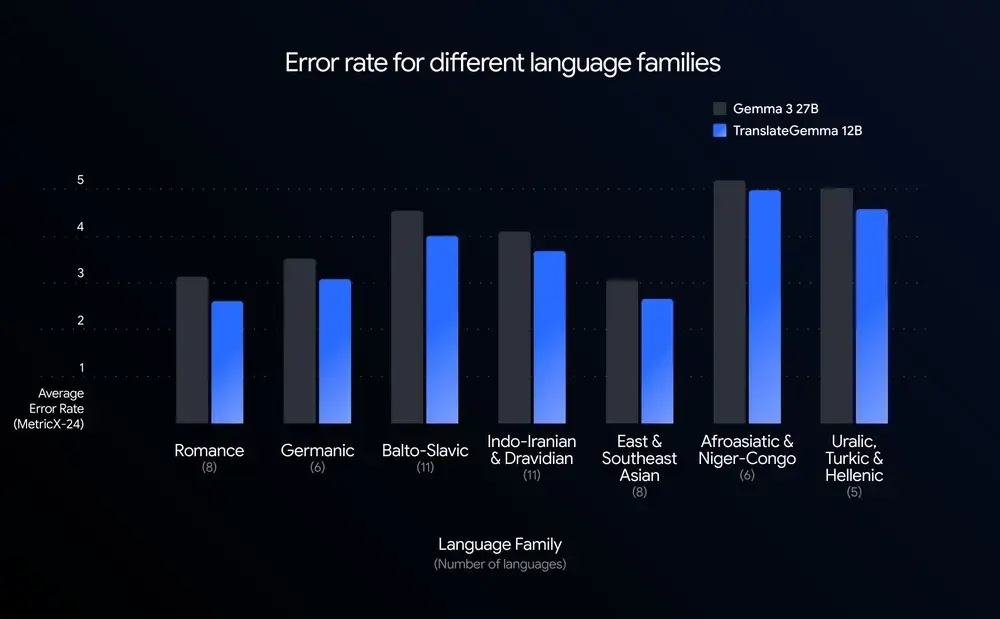
The TranslateGemma family is currently available in three sizes: 4 billion, 12 billion, and 27 billion parameters. Evaluation results given by Google show that on the WMT24++ benchmark, TranslateGemma 12B outperformed the basic version of Gemma 3 27B, which means that with less than half the number of parameters, it can achieve higher throughput and lower latency, while maintaining or even improving translation accuracy, which is beneficial to developers in deploying high-quality translation models in environments with limited computing power.
In terms of deployment scenarios, Google said that the 4B model is optimized for mobile inference and is suitable for running locally on terminal devices such as mobile phones; the 12B model is oriented to local computing power scenarios such as consumer laptops; and the 27B model requires stronger computing power support, such as cloud single-card NVIDIA H100 and other configurations. On the Vistra image translation benchmark, TranslateGemma also achieved better results on the intra-image text translation task, even though it was not specifically fine-tuned for this scenario, demonstrating the model's potential for multimodal text understanding.
Google disclosed that TranslateGemma’s performance improvement comes from a two-stage training process. The first stage is supervised fine-tuning. The research team introduced a large amount of human translation corpus on top of the Gemma 3 base model and combined it with high-quality synthetic data generated by the Gemini model for training. The second stage uses reinforcement learning to guide translation quality optimization through a set of reward models, including MetricX-QE, AutoMQM and other advanced indicators, making the model more natural and contextually suitable for translation output.
Currently, the full range of TranslateGemma models are available for download on the Kaggle and Hugging Face platforms for researchers and developers to freely experiment and develop. While OpenAI further integrates translation into chat-based front-end products, Google provides more technical options for third-party application construction by opening up high-performance underlying models, which also indicates that the machine translation track will intensify competition at the two levels of open models and service-oriented tools.
Related articles:
ChatGPT Translate is online: OpenAI launches a new round of challenges to Google Translate