The latest discovery by astronomers shows that at least some fast radio bursts (FRBs) do not originate from isolated stars, but are born in binary star systems in which two stars orbit each other. This provides the most powerful clue yet to the cause of this most mysterious radio burst phenomenon in the universe.
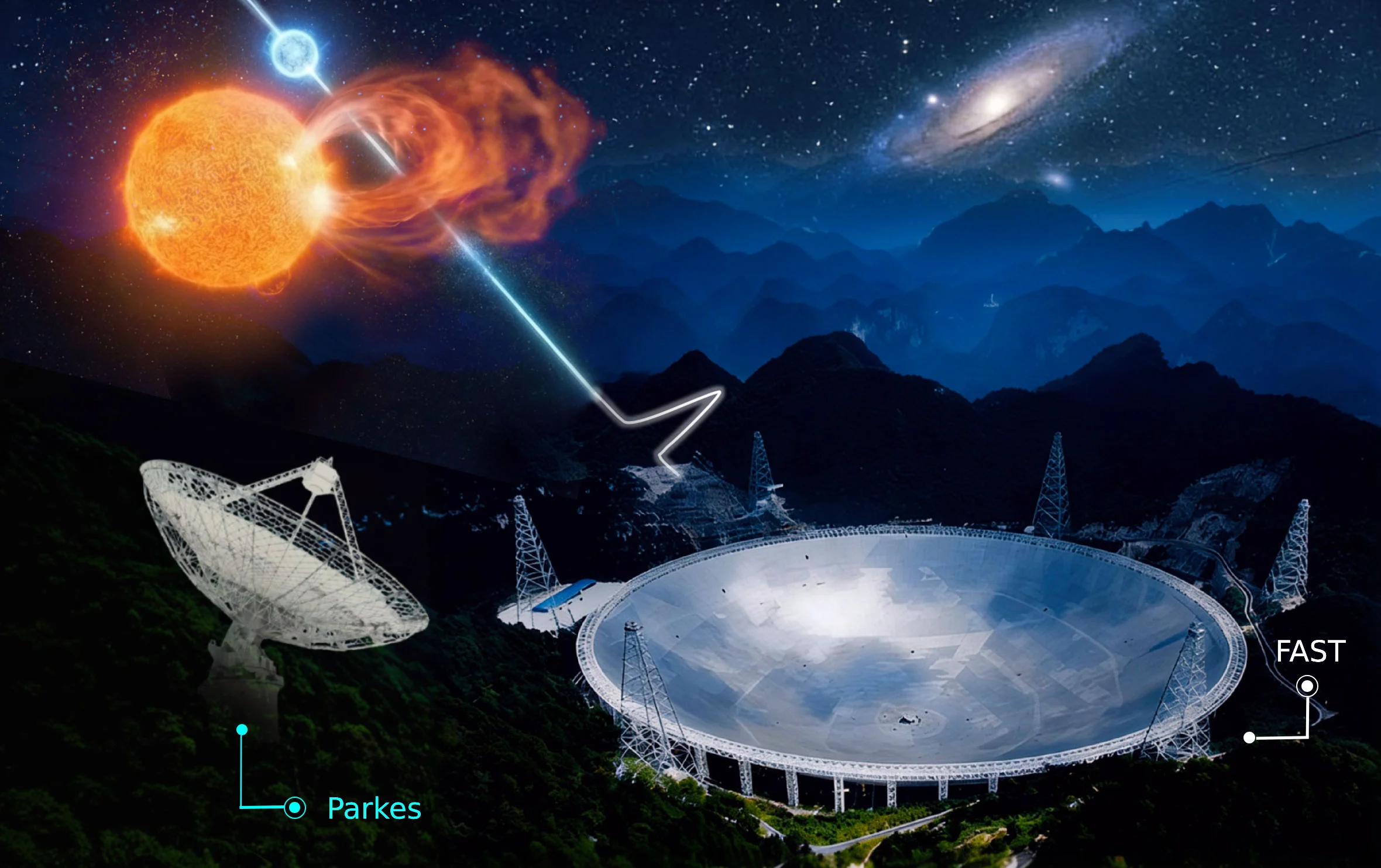
This result was achieved by an international team including researchers from the Department of Physics of the University of Hong Kong. They used China's "Sky Eye" - the 500-meter Aperture Spherical Radio Telescope (FAST) in Guizhou to conduct continuous monitoring of a repeatable fast radio burst for nearly 20 months. Observational results show that in some events, the source of the FRB is not a single compact object, but a member of a binary star orbit, and its surrounding environment will be significantly affected by the activities of a nearby companion star.
The target source locked by the research team is FRB 220529A, which is a recurring burst source from a galaxy about 2.5 billion light-years away. It has been included in FAST's regular monitoring plan many times. At first, the source's performance was mediocre, but at the end of the 17-month long-term tracking, the telescope recorded an extremely rare event of dramatic changes in polarization signals, which became the key to this breakthrough.
FRB is known for its ultra-short duration on the order of milliseconds and nearly 100% linear polarization. When the radio wave it receives passes through the magnetized medium, the polarization plane will rotate with frequency, which is the so-called Faraday rotation. Its strength is characterized by the "rotation amount" (RM). During this observation, the researchers found that the RM of FRB 220529A suddenly surged at the end of 2023, with an increase of more than a hundred times, and then quickly fell back to the original level in just two weeks. This "sudden rise-recovery" process was named "RM Flare" by the team.
Such brief and violent RM changes point to dense magnetized plasma clumps that suddenly appear near the line of sight and quickly leave. Researchers proposed that the natural explanation is that there is a companion star near the FRB source, which undergoes violent activities similar to the sun's coronal mass ejection (CME), ejecting high-density charged plasma clouds that briefly pass through the line of sight, thus causing strong disturbances in the radio polarization during the FRB burst.
Zhang Bing, one of the co-corresponding authors of the paper, chair professor of astrophysics at the University of Hong Kong and founding director of the Institute of Astronomy and Astrophysics at the University of Hong Kong, said that this discovery provides decisive clues to the origin of some repeatable FRBs. He pointed out that relevant evidence strongly supports such a scenario: the FRB source is a magnetar with an extremely strong magnetic field, and there is a sun-like star nearby, and the two together form an actively interacting binary star system.
Li Ye, the first author of the paper from the Purple Mountain Observatory of the Chinese Academy of Sciences and the University of Science and Technology of China, said that the properties of plasma clumps required in RM flare events are highly consistent with the typical parameters of ejected material when the sun and other stars explode into CME. Although this companion star cannot be confirmed by direct imaging at a distance of billions of light-years, its existence has left a clear "fingerprint" in radio data through continued joint observations by FAST and the Parkes Radio Telescope in Australia.
Yang Yuanpei, one of the co-first authors of the paper and a professor at Yunnan University, pointed out that the theoretical model based on the binary star framework can well reproduce the observed dramatic changes and recovery processes of RM, providing important theoretical support for this explanation. Another co-corresponding author, researcher Wu Xuefeng from the Purple Mountain Observatory and the University of Science and Technology of China, emphasized that this result benefits from the long-term collaborative investment of multiple world-class telescopes and the continuous observation and data analysis work of the scientific research team over the years.
This discovery further supports a unified physical picture proposed by Zhang Bing and his collaborators in recent years: all fast radio bursts originate from magnetars, and whether they can frequently repeat bursts and the probability of being detected on Earth may be closely related to whether the magnetar has a companion star and the geometric configuration of the binary star system. Under this framework, binary star systems provide a more complex and changeable plasma and magnetic field environment around magnetars, making it easier to produce high-frequency, repeatable bursts.
Compiled from /ScitechDaily