"China's Aerospace" official Weibo announced today that through systematic analysis of Chang'e-6 lunar soil samples, our countryFor the first time in the world, naturally formed single-walled carbon nanotubes and graphitic carbon were discovered and confirmed, revealing the exquisiteness of high-energy physical-chemical processes on the lunar surface, confirming that the geological activity on the far side of the moon is more active, and providing key data for studying the evolution history of the moon..
This study by Jilin University comprehensively used a variety of microscopy and spectroscopic techniques to systematically characterize the samples from the far side of the moon (No. CE6C0000YJYX060, CE6C0100) collected by Chang'e-6.
It was the first time that graphitic carbon was clearly identified and its possible formation and evolution processes were traced. It was also the first time in the world that the existence of naturally formed single-walled carbon nanotubes without artificial intervention was confirmed.
Research shows that the formation of these carbon nanotubes may be closely related to the iron catalysis process under the synergistic effect of multiple factors such as micrometeorite impacts, volcanic activity, and solar wind irradiation in the moon's history, demonstrating nature's ability to synthesize key materials under extreme conditions.
The team compared and studied the samples from the back side of the moon from Chang'e-6 and the samples from the front side of the moon from Chang'e-5.It was also found that the carbon structure in the Chang'e-6 samples has more obvious defect characteristics, which may be related to the more intense micrometeorite impact history experienced by the far side of the moon.; This discovery also revealed a new asymmetry in the material composition and evolution process between the front and back of the moon.
This research result of Jilin University was officially published in the journal Nano Letters on December 30, 2025, titled "The first international discovery of natural single-walled carbon nanotubes and graphitic carbon on the far side of the moon."
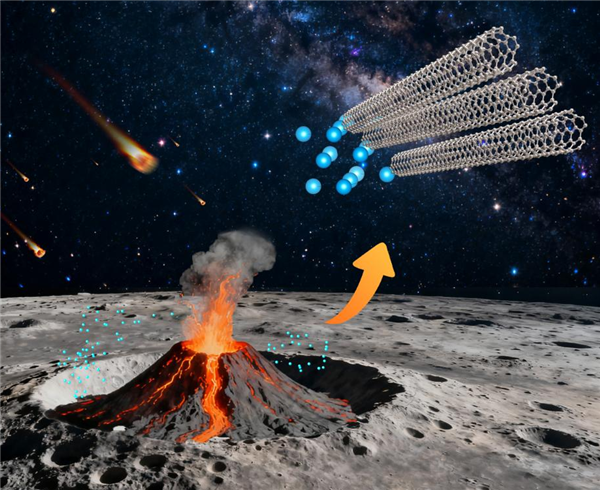
Schematic diagram of the formation mechanism of carbon nanotubes