A recent lawsuit filed in the United States between Spotify and several major record companies was confirmed to be the direct cause of the suspension of multiple domain names of the “shadow library” website Anna’s Archive. Relevant court documents were recently unsealed, showing that the court has issued a broad preliminary injunction to multiple third parties, including hosting service providers, Cloudflare, and domain name registration agencies, requesting assistance in restricting related services of the website.
Anna’s Archive has always been known as a “shadow library metasearch engine” and is mainly used to index pirated e-books and related resources. However, in December 2025, the website announced that it had "backed up" Spotify and claimed that it had a massive amount of data from Spotify. This move immediately triggered alarm within the music industry. At first, the website only disclosed Spotify's metadata and did not directly release music audio files. However, major record companies still quickly organized legal teams during the Christmas holiday to prepare for the response.
On December 29, 2025, Spotify, together with Universal Music (UMG), Sony Music, Warner Music and other record companies, filed a complaint in the U.S. Federal Court for the Southern District of New York. The plaintiffs accuse Anna’s Archive of massive copyright infringement, breach of contract, violations of the Digital Millennium Copyright Act (DMCA), and alleged violations of the Computer Fraud and Abuse Act (CFAA). The complaint alleges that the website "blatantly" bypassed Spotify's digital rights protection (DRM) and scraped 86 million music files and metadata covering 256 million tracks from Spotify, with the ultimate goal of "volume releasing" this data to the public. The plaintiff claimed that once these unauthorized recordings were disseminated for free on a large scale, "irreparable harm" would be caused to the music industry.
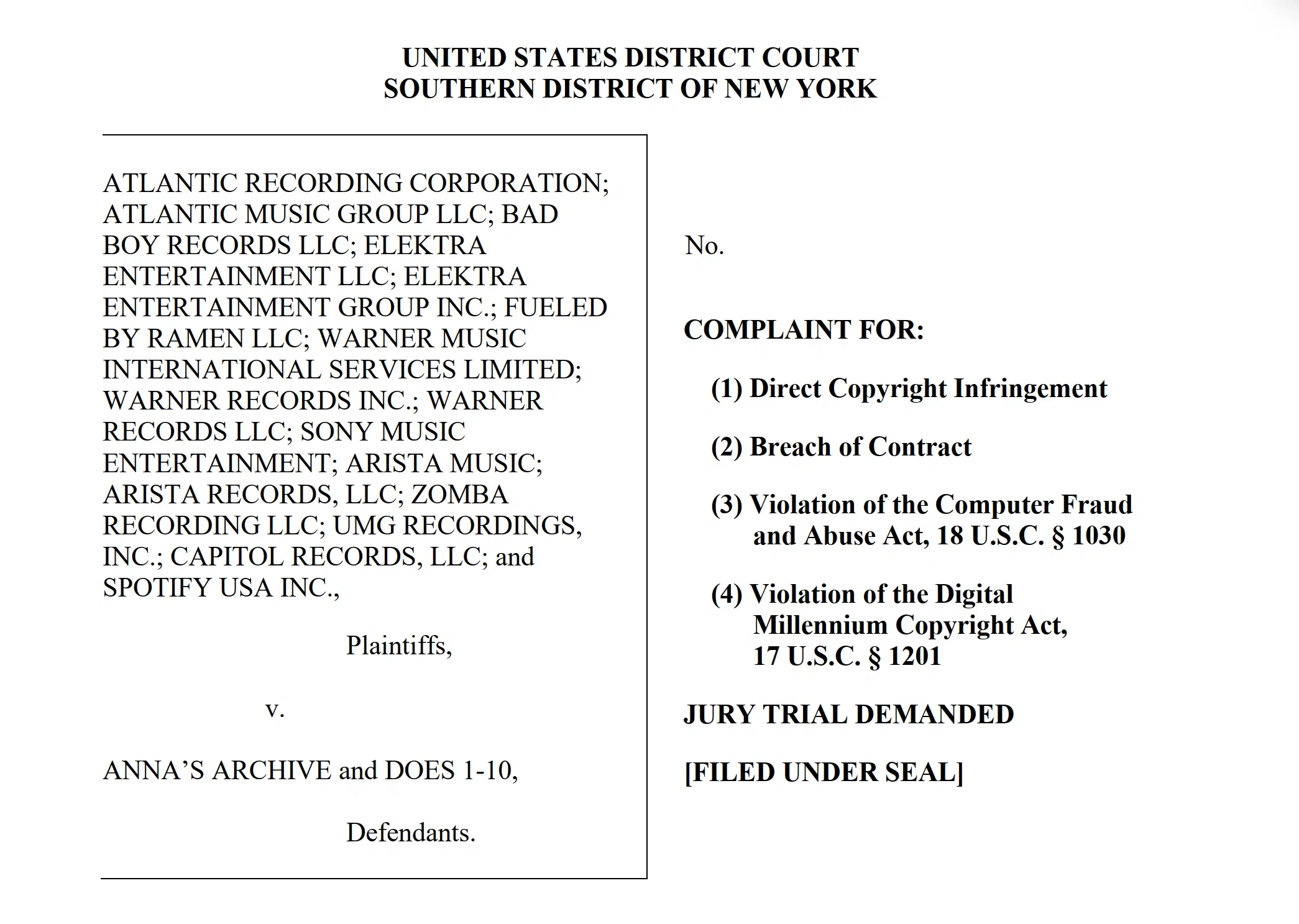
While formally suing, Spotify and the record company also applied to the court for a temporary restraining order and preliminary injunction, trying to remove Anna’s Archive online before the other party took countermeasures. In order not to alarm the defendants, these documents were initially applied for “sealing”, and Anna’s Archive was not notified at the time. In its application, the plaintiffs stressed that action must be taken before the other party learns “in case Anna’s Archive pre-empts the measures we seek”.
After the lawsuit documents were recently unsealed, the outside world saw how this temporary restraining order directly led to the "loss of contact" of multiple domain names of the website. In early January this year, the Public Interest Registry (PIR), the US public interest registry responsible for the .ORG top-level domain, suspended Anna’s Archive’s .org domain name. A few days later, its .se domain name was also taken offline by the domain name registrar. At the time, Anna’s Archive operator “AnnaArchivist” publicly stated that they “did not believe this was related to Spotify backups,” but unsealed court records show that the domain name suspension was a direct result of the lawsuit. The court issued a temporary restraining order on January 2, targeting the website’s hosting and domain name resources. The sealed status of the order also explains why the .ORG registry previously refused to comment on the reason for the suspension.
Currently, the .org and .se domain names are no longer available, but Anna’s Archive still maintains access through other domain names, which illustrates from the side that not all relevant registrars and registries will automatically implement the US court’s ruling. While the temporary restraining order remains undisclosed, a more substantial preliminary injunction was issued on January 16 by Federal District Judge Jed Rakoff. Hearing only the plaintiff’s side, the court found that the music company’s claims of copyright infringement had a “high likelihood of success” and therefore ruled that Anna’s Archive is prohibited from hosting, linking to or distributing the copyrighted works at issue.
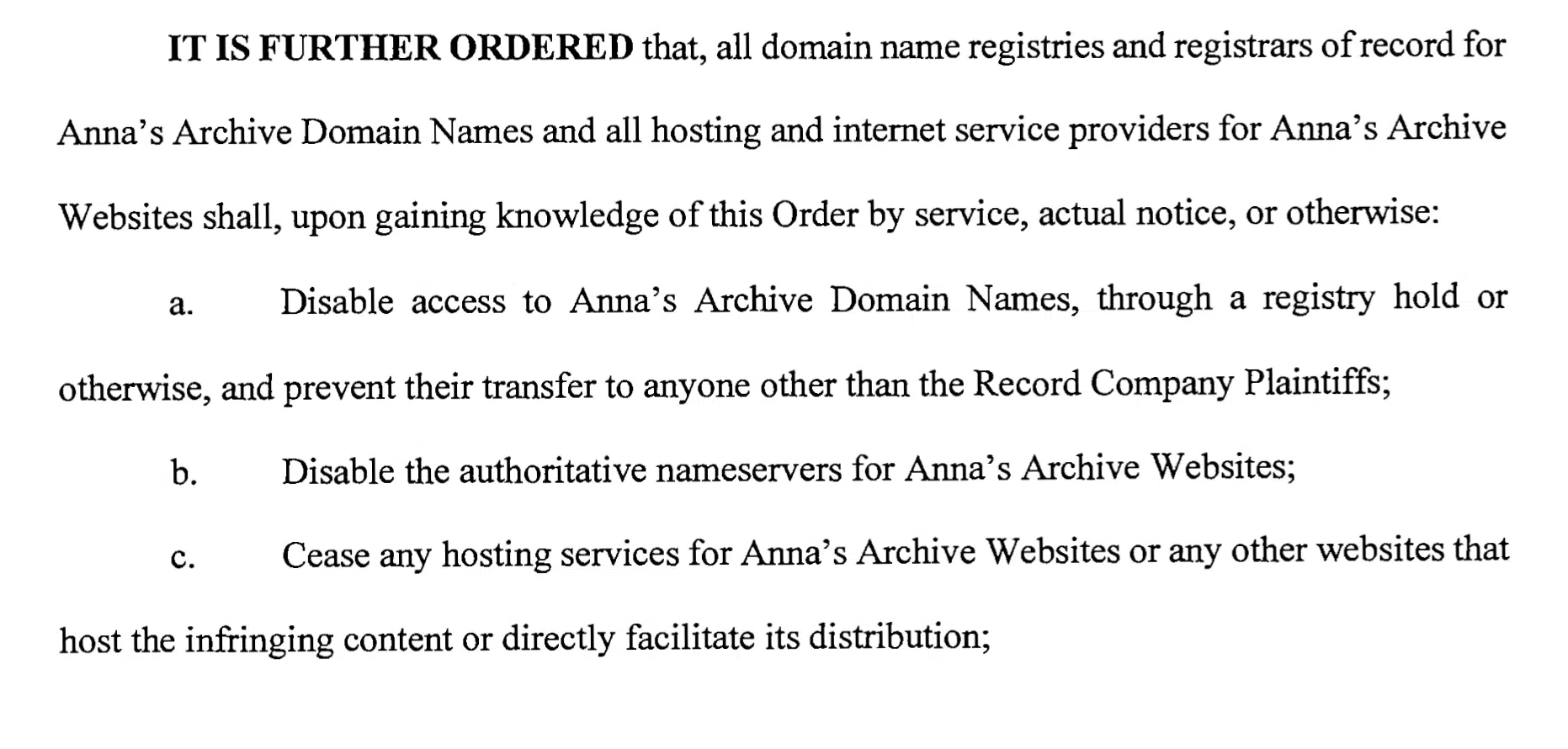
Since the defendants cannot be expected to comply proactively, the court's injunction further extended to a large number of third-party intermediary service providers, including domain name registries and registrars, hosting service companies, and other network service providers. These companies are required to take reasonable steps to help stop infringing activity on Anna’s Archive. For the avoidance of doubt, the ban names multiple organizations, including Public Interest Registry, Cloudflare, Switch Foundation, Swedish Internet Foundation, National Internet Exchange of India, Njalla, IQWeb FZ-LLC, Immaterialism Ltd., Hosting Concepts B.V., and Tucows Domains Inc., among others. The emergence of Cloudflare is particularly eye-catching because it mainly provides reverse proxy and acceleration services and does not store the content of Anna’s Archive for a long time. However, the court still believed that its connection with the operation of the website was close enough to be the subject of an injunction.
While the background of the lawsuit gradually emerged, there was also an intriguing development in the case: Anna’s Archive has quietly removed the download section dedicated to listing Spotify content. The section page currently says "temporarily unavailable until further notice," but the website has not publicly stated whether this is directly related to the lawsuit. On the face of it, this change appears to stop the specific distribution of the Spotify content alleged in the complaint, to a certain extent "partially consistent" with the injunction's prohibition on "making relevant documents available to the public." However, this does not mean that the legal risks have been eliminated. Copyright infringement and other charges are still pending in court. It remains to be seen whether more measures will be introduced in the future.
At present, Spotify and many record companies are obviously not going to stop there, and are expected to continue to use various legal tools to force Anna’s Archive to stop related activities or even go offline as a whole. For Anna’s Archive, which has always played a core indexing role in the “shadow library” ecosystem, this lawsuit not only exposed the new risks it faced after expanding into the music field, but also reflected the copyright industry’s increasingly tough judicial line in dealing with large-scale data capture and “backup of the Internet.”