OpenAI launched the video generation application Sora with high profile last fall. It was downloaded more than 100,000 times on the first day of its launch with the iOS version and it was still in the "invitation-only" status. It quickly topped the US App Store free list and exceeded 1 million downloads faster than ChatGPT. It was once regarded as OpenAI's iconic product to enter the mobile and social fields. However, the latest market data shows that the popularity of this application, once known as the "AI version of TikTok", is significantly declining.
Statistics from Appfigures show that Sora's downloads in December 2025 dropped 32% month-on-month from the previous month. This performance is particularly glaring because the year-end holidays are usually the peak season for mobile applications to acquire customers and drive consumption. Entering January 2026, the decline in Sora's downloads intensified, falling another 45% month-on-month. There were approximately 1.2 million new installations that month, and in-app consumer spending also experienced a 32% month-on-month decline in January. So far, Sora has been downloaded approximately 9.6 million times on iOS and Android platforms, and cumulative user spending has been approximately US$1.4 million, of which the US market contributed approximately US$1.1 million, followed by countries such as Japan, Canada, South Korea and Thailand. In January 2026, monthly user spending on Sora was approximately $367,000, down from a peak of $540,000 in December 2025.
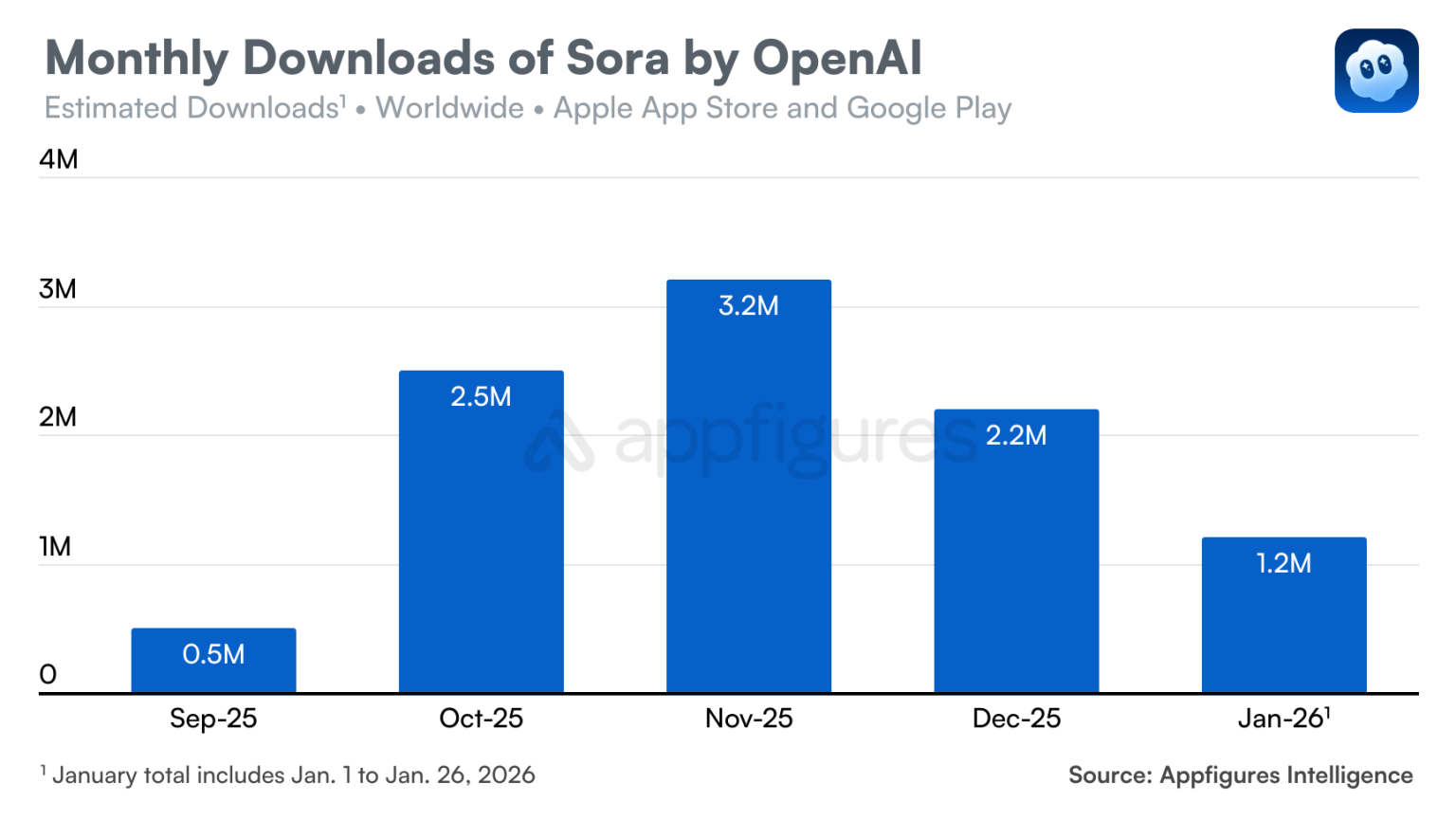
In terms of app store performance, Sora’s ranking has also dropped significantly. In the U.S. App Store, Sora is no longer in the top 100. It currently ranks 101st among the overall free apps and can only maintain its 7th position in the "Photos and Videos" category. In the US Google Play Store, Sora is even more disadvantaged, ranking only 181st on the overall list of free apps. Although this is still not a "dead end", for a new application that has appeared strongly at the top and has high hopes, this trend is worrying enough.
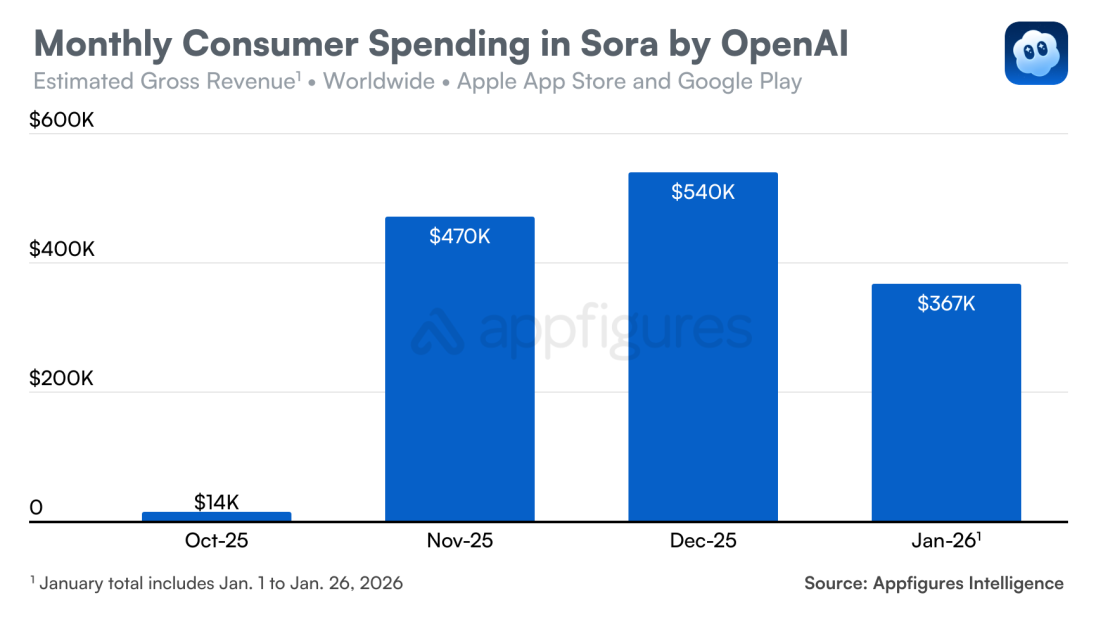
Sora's core positioning is a video social application with strong AI color. Users can generate videos through text prompts, and can choose to "cast" themselves or their friends as the protagonist of the video. The generated content can also be re-created and customized by others. The application supports adding music, sound effects and dialogue to videos, allowing users to "direct" complete scenes in natural language. This experience relies on OpenAI's video generation model Sora 2. However, as the early novelty faded, Sora encountered challenges at multiple levels such as product design, competitive product pressure, and copyright management, resulting in pressure on user retention and monetization capabilities.
Changes in the competitive environment are one of the important factors contributing to Sora's slowdown in growth. Gemini from Google, especially its Nano Banana image and multimedia generation model, has promoted the popularity of Gemini standalone applications on the App Store, becoming a direct alternative for users in the field of generative content. During the same period, Meta also introduced the AI-driven video content stream Vibes in its own application. With the pull brought by the launch of this function, the download volume and daily active users of the Meta AI application increased significantly during October 2025, forming a head-on competition with Sora in terms of user attention and usage time.
Additionally, copyright issues surrounding Sora are weighing on its trajectory. In the early days of the product, OpenAI sent a signal to Hollywood studios and brokerage companies, stating that if the other parties did not want their IP to appear in Sora, they needed to actively "opt out". This approach quickly triggered a strong backlash from industry organizations such as the Film Association. In the absence of strict copyright control, ordinary users could use well-known characters such as SpongeBob SquarePants and Pikachu to generate second-generation videos. This undoubtedly stimulated user interest and content dissemination in the short term, but also increased the legal risks of the platform. In order to appease the film and television industry and reduce the pressure of potential lawsuits, OpenAI subsequently changed its policy from "available by default, opt-out" to "disabled by default, requiring active authorization", and strengthened copyright restrictions within the application, weakening users' ability to call popular IP at will.
In December 2025, OpenAI announced a cooperation with Disney, allowing users to generate AI videos based on Disney characters in Sora, theoretically reintroducing some officially authorized well-known IP resources to the platform. However, data from Appfigures and app store performance indicate that this blockbuster cooperation has not yet translated into visible growth in downloads or user spending. At the same time, the outside world has expressed concerns about the "deformed" or "spoof" videos with Disney characters generated by some users using Sora, which also makes the cooperation between Disney and OpenAI quite subtle at the level of public opinion.
It is worth noting that Sora 2 caused a huge sensation in the industry when it was first launched. Some comments described it as "a technology capable of subverting social media" and even directly called it "TikTok in the field of AI". However, in actual use, not all users are willing to let friends or even strangers use their portraits to create AI videos. This psychological and privacy concern has to a certain extent inhibited the social links and content dissemination effects that the platform originally hoped to form. After the platform imposed more restrictions on the use of commercial IP and it became difficult for familiar faces to appear in content on a large scale, user interest in Sora seemed to have further weakened.
As of press time, OpenAI has not publicly responded to questions related to the decline in Sora downloads and consumption. It remains to be seen whether this application, which was once regarded as a symbol of OpenAI’s mobile strategy and video social ambitions in the early days of its launch, can rekindle user enthusiasm through the introduction of more copyright cooperation, more detailed creation tools or new product forms.