On February 5, Meituan announced on the Hong Kong Stock Exchange that it would complete the acquisition of 100% equity in Dingdong Maicai’s China business for an initial consideration of approximately US$717 million. According to the agreement, the transferor has the right to withdraw no more than US$280 million from the target group before August 31, 2026, but must ensure that the target group's net cash is no less than US$150 million. The announcement stated that the fair value of all equity interests of the target group’s shareholders based on the valuation date (i.e. January 31, 2026) assessed in accordance with the market method is US$1.006 billion.
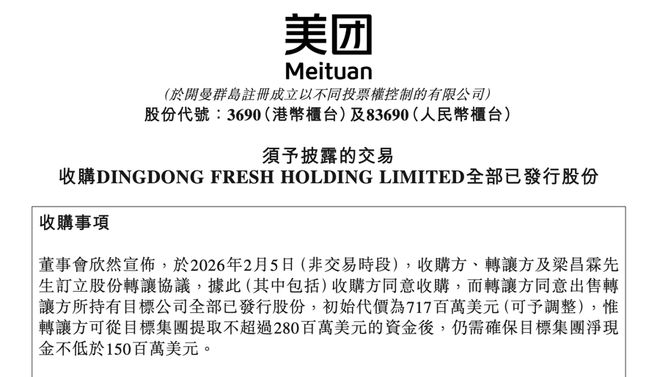
According to announcements from both parties, the acquisition will be completed through installment payment, and Meituan’s indirect wholly-owned subsidiary will serve as the acquisition subject. However, Dingdong Maicai's overseas business is not within the scope of this transaction and will be divested before the closing. During the transaction transition period, Dingdong Maicai will continue to operate according to the pre-transaction model.
At almost the same time, Liang Changlin, the founder of Dingdong Maicai, issued a letter to all employees confirming that he “formally signed a sales agreement with Meituan.” Liang Changlin also revealed the reason for choosing Meituan in his letter. He said that Dingdong has established strong supply chain capabilities in the past eight years, including more than 85% of fresh food purchased directly from the source, 12 self-operated factories and 2 self-operated farms. "After the merger of the two parties, Dingdong's three core competitiveness: ultimate commodity power, unexpected service power and extreme efficiency created through the supply chain system will exert greater value on a larger platform."
The acquisition took several months. According to market sources, another e-commerce giant, JD.com, was the earliest party to in-depth negotiations. However, Meituan intervened strongly in the later stage and eventually won.
Public information shows that Dingdong Maicai was founded in 2017 and focuses on "delivery in as fast as 29 minutes." In 2021, Dingdong Maicai was listed on the New York Stock Exchange. Financial report data for the third quarter of 2025 showed that Dingdong Maicai achieved revenue of 6.66 billion yuan, a record quarterly high. Before the market opened on February 5, the market value of Dingdong Maicai was US$694 million.
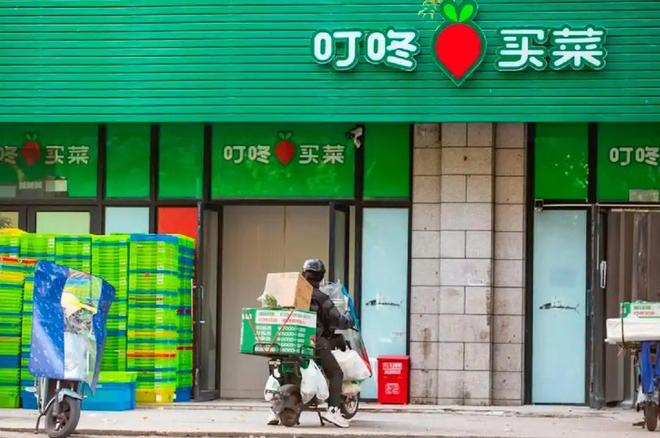
Meituan targets real-time retail business
By acquiring Dingdong Maicai, Meituan’s goal is obvious—directly targeting the real-time retail business.
Prior to this, Meituan had also made efforts in the grocery shopping business. In December 2023, "Meituan Maicai" will be upgraded to "Little Elephant Supermarket", expanding from a single fresh food field to full-category retail; in 2024, the GMV of Little Elephant Supermarket will be close to 30 billion yuan; in 2025, Meituan Little Elephant Supermarket will restart its offline business. The market estimates that Xiaoxiang Supermarket’s agricultural product sales exceeded 20 billion yuan last year.
However, Xiaoxiang Supermarket still lacks in the "direct procurement" capability of the fresh food supply chain and the front-end warehouse model, which is the strength of Dingdong Maicai - the latter has significant advantages in the Yangtze River Delta, especially the Shanghai market, operating more than 1,000 front-end warehouses and has more than 7 million monthly purchasing users. Meituan announced that "this acquisition will help give full play to the advantages of both parties in terms of product strength, technology, operations, etc." However, Meituan did not disclose how Xiaoxiang Supermarket and Dingdong Maicai will be integrated in the future.
From the perspective of strategic value, Dingdong Maicai is an asset that Meituan urgently needs. Analysts generally believe that Meituan’s move has the dual purpose of strategic defense and market reinforcement: it not only prevents competitors from enhancing its instant retail strength through the acquisition of Dingdong, but also quickly makes up for its shortcomings in the core area of the Yangtze River Delta.
Analysts believe that after completing this acquisition, Meituan will significantly strengthen its real-time distribution network in fresh food and fast-moving consumer goods categories, and build scale and efficiency barriers in core areas such as the Yangtze River Delta. This is also a key step for Meituan to build a more real-time retail ecosystem.
Instant retail moves towards competition among giants
Meituan’s acquisition of Dingdong Maicai marks the end of the era of fresh food e-commerce as an independent platform, and the entire industry has shifted to the “giant competition period” of real-time retail.
Competition in the just-in-time retail industry has become increasingly fierce over the past year.
Online, the “takeaway war” continues to escalate. In February last year, JD.com suddenly announced the launch of its food delivery business. Within 90 days of its launch, the daily order volume exceeded 25 million, and more than 2 million merchants were involved. Faced with the fierce entrants, Alibaba launched the "big consumption platform" strategy in June last year. At the end of December, the Ele.me app was renovated into "Taobao Flash Sale". At the end of January this year, "Taobao Flash Sale" and Qianwen opened up the underlying architecture. Through the blessing of large models, it became possible to order takeout in one sentence.
Offline, the front-end warehouse network has once again increased its presence. In addition to Meituan's Xiaoxiang Supermarket accelerating the opening of stores and warehouse expansion, JD Qixian's recent warehouse openings have also significantly increased, and now cover Beijing, Tianjin, Shijiazhuang, Guangzhou and other places; Hema has also restarted its front-end warehouse business. As of December 2025, its front-end warehouses have been operational in about 200 stores.
Taken together, the competition among giants has been upgraded from a single-point competition to a comprehensive system competition based on supply chain, flow, technology and capital. "The potential of the consumer life service platform has been fully unleashed. The current average daily order volume has reached 150 million orders. It is expected that the real-time retail track will reach an average daily order volume of 300 million orders in the next two or three years. It may be a trillion-dollar market in the next three years." Fang Yongxin, president of Taobao Flash Sales, believes.
Analysts believe that for Meituan, the acquisition of Dingdong Maicai, which has both a fresh food supply chain and a front-end warehouse network, will undoubtedly consolidate its dominant position in the real-time retail track and defend its moat. However, for the world of instant retail, the battle between giants may have just begun.