An American Tesla owner recently complained on social media,With the FSD turned on, the vehicle I was driving suddenly slammed on the brakes at an intersection where the light was all green, and the bag and lunch placed on the passenger seat were thrown away.
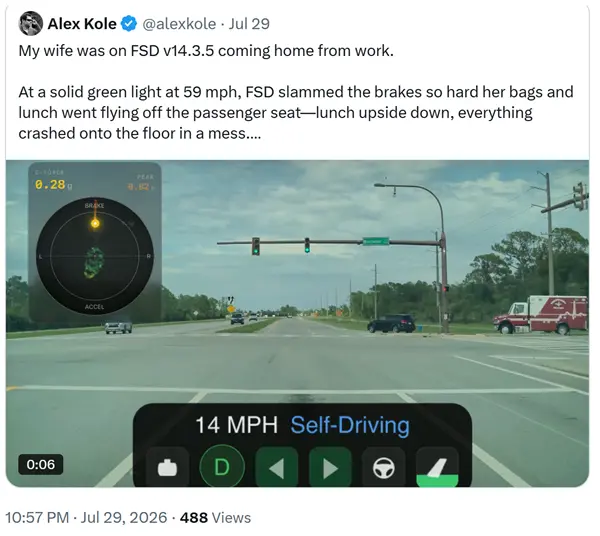
According to reports, the vehicle speed at the time of the incident was about 80 kilometers per hour, and the FSD system triggered sudden braking without warning. The car owner later looked back at the driving video and discovered that the "culprit" was an ambulance approaching the intersection.
But what is ironic is that the ambulance neither turned on its lights nor sounded its siren, and was completely out of commission. The FSD system only relied on visual recognition of the ambulance's shape and made the avoidance braking decision on its own.
The car owner is using the FSD v14.3.5 version. In fact, this is not the first time a similar "overreaction" problem has occurred in the v14 series.
According to previous reports by Electrek and others, after FSD v14 was pushed, many car owners reported that the system had "hallucinations", sometimes mistaking other vehicles' turn signals as emergency vehicle lights, and then pulling over; complaints about "slamming on the brakes" also increased significantly.
"Ghost braking" has always been a persistent problem with Tesla's assisted driving system. As early as 2022, the U.S. National Highway Traffic Safety Administration (NHTSA) received hundreds of related complaints, and car owners reported that their vehicles suddenly braked for no reason while driving at high speeds.
From FSD v13 to v14, Tesla launched a major update one year later. Crowdsourcing data shows that the average mileage between key disengagements is about 732 miles.Although there is an improvement compared to before, there is still a huge gap between the nearly 10,000 miles required to achieve unsupervised operation.