Recently, hardware blogger Hardware Tea Talk released the latest quotations for the RTX50 series through domestic channels. Prices across the board have been significantly increased, with the increase for high-end models being particularly exaggerated. According to the news, the starting price of RTX5080 in the channel reaches 12,000 yuan, which is an increase of 44.6% compared to the guide price of the public version of 8,299 yuan.Far beyond the range that can be covered by the increase in graphics memory costs; the base prices of other models have simultaneously increased. The bottom line of the 5060Ti 16GB channel has directly reached 5,500 yuan, and the installed cost of mid-range machines has increased significantly.
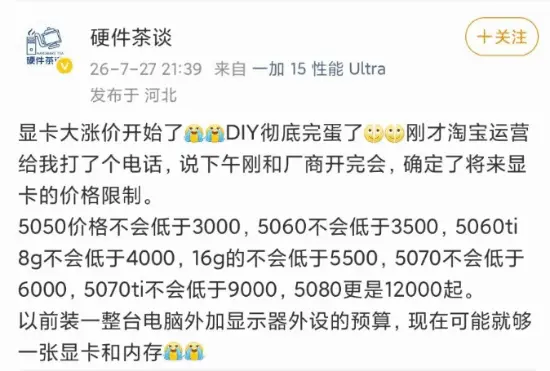
Channel wholesale prices have continued to rise. The price of RTX5070 has increased by 800 yuan per week, just one step away from the base price of 6,000 yuan. The two video memory versions of 5060Ti have also increased by 400 and 600 yuan respectively, and the terminal selling price is quickly approaching the leaked price.
The price increase comes from two sources:Nvidia has raised its GPU and video memory supply prices, while Samsung, Micron, and Hynix have shifted their production capacity to high-profit HBM server memory. Consumer-grade GDDR video memory production capacity has shrunk. Organizations predict that DRAM contract prices will increase by up to 63% in the second quarter.
At present, Nvidia's AI chip business is booming, and the dividends in the computing power market are visible to the naked eye. This has also caused many players to question: Is the sharp increase in the price of game graphics cards a passive price adjustment forced by upstream costs, or is it that manufacturers are taking advantage of the AI trend to raise consumer-grade hardware prices and pass on the premium costs generated by industry expansion to ordinary gamers?
The demands of gamers are actually very simple: they can accept reasonable price increases brought about by rising costs, but they cannot accept unlimited price increases by taking advantage of industry trends.Most of the dividends generated by the AI wave go to high-end computing power business. Ordinary PC players do not enjoy the benefits brought by this technological change, but are forced to bear higher hardware expenses.
Rising costs should be taken seriously, but the price difference of several thousand has long been out of line with reasonable cost transmission logic.
With mid-range graphics cards exceeding 5,000 yuan and flagship cards firmly standing at 10,000 yuan, it means that ordinary players who purely pay for stand-alone games need to pay an increasingly higher threshold. The booming AI industry should not be the reason for the continued increase in the price of consumer graphics cards. Ordinary gamers have no obligation to continue to pay for the industry's AI bubble.