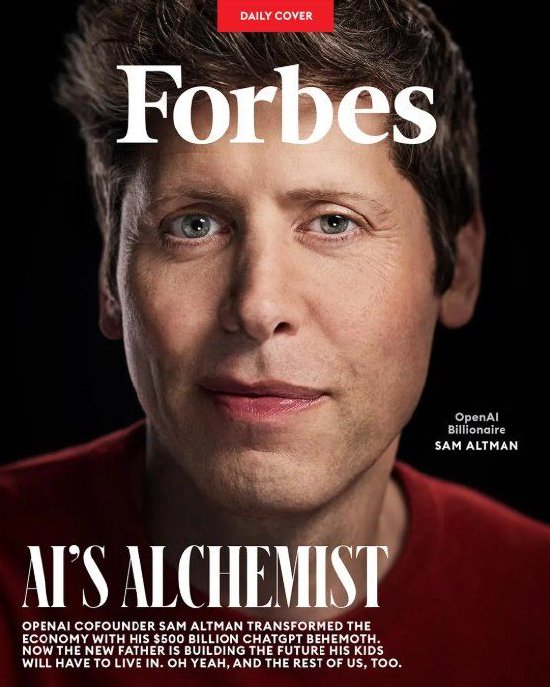
The cover interview of "Forbes" "AI Alchemist: Why Sam Altman is preparing to make the largest business bet in history" mentioned that Sam Altman's past experience is already well known: he grew up in St. Louis, thousands of miles away from Silicon Valley. He has been a nerd obsessed with science, energy and artificial intelligence since he was a child. “I have been obsessed with a few ideas in my life,” he said, and these ideas “haven’t changed since I was about 18 years old.”
In 2003, Altman entered Stanford University and determined to study artificial intelligence. The trend of the times at that time was more Web2.0. During his sophomore year, he won a competition with a business plan that eventually spawned his first startup, Loopt, a mobile app that allows you to share your location with friends. It was at that time that he first heard about YCombinator. He took a red-eye flight to Boston overnight to interview founder Paul Graham. "I thought at the time, this must be the kind of person Bill Gates is." Graham recalled the first time the two met.
Graham was so impressed by him that when he stepped down in 2014, he selected the 28-year-old Altman to run YC. reason? "Sam always gets what he wants," Graham said, "so if the only way Sam succeeds is if YC succeeds, then YC will succeed."
Altman participated in many projects at YC, but he was particularly fond of one side project: an artificial intelligence research organization called OpenAI. OpenAI was established as a non-profit in 2015 with the goal of building AGI - artificial general intelligence, that is, AI that can "think" like humans. Altman personally recruited Greg Brockman, Stripe's chief technology officer at the time, and Ilya Sutskov, an AI guru known for his pioneering research on neural networks, as co-founders, and successfully persuaded his idol at the time, Elon Musk, to invest $38 million in support.
Altman quickly devoted himself to OpenAI with an almost paranoid attitude, causing YCombinator to gradually fade in his heart and no longer be the focus of his career that Graham expected. In 2019, Graham and YC co-founder Jessica Livingston were shocked when they saw a press release announcing Altman as CEO of OpenAI’s new for-profit subsidiary. Livingston demanded that he either return to YC full-time or resign.
Altman now admits: "I really deserve criticism on this matter. When I knew that OpenAI could be successful and I was at the helm of both, I knew in my heart: 'I can pretend that I still care about YC, but OpenAI is my mission and I have to do it.'"
This is not the first time Altman has had conflicts with colleagues over priorities. A few days before Thanksgiving in 2023, he was fired by the OpenAI non-profit board of directors for "not being candid enough." It was co-founder Sutskofer who launched this "coup". He accused the board of directors of "Sam consistently lying" and "creating chaos, launching a large number of new projects, and sowing interpersonal relationships" to achieve his goals.
But just five days later, Altman was reinstated - this can be called the most absurd corporate drama in the history of Silicon Valley. During the incident, OpenAI employees protested collectively and threatened to resign if Ultraman did not return; Microsoft suddenly intervened and announced his hiring; there were also rumors that a new AI model was so powerful that it frightened those who knew about it.
The whole incident was accompanied by a large number of accusations of "double-dealing and reckless advancement", and public opinion was in an uproar. A follow-up investigation by the board of directors ultimately determined that Altman was indeed the right leader of OpenAI, but the incident left an indelible mark on his reputation.
To make matters worse, an internal power struggle broke out at OpenAI three years ago: a group of core employees, including brother and sister Dario Amodei and Daniela Amodei, left to establish a competing company, Anthropic, which focuses on AI security. Anthropic is now valued at approximately US$350 billion, with revenue of approximately US$4.5 billion in 2025, making it one of OpenAI’s most powerful rivals.
Even more explosive than Anthropic's departure is OpenAI's decision to reorganize its structure and add a profit-making department. This move allows OpenAI to operate like an ordinary company and accept external investment, including a critical $13 billion investment from Microsoft since 2019. Musk objected vehemently and quit without holding any stake in the for-profit entity.
There are constant rumors of palace fighting between the two sides. In the lawsuit, Musk claimed that he left because OpenAI gave up its original intention of "benefiting mankind" and instead pursued profit maximization. OpenAI countered that Musk left because the company did not let him control the profit department. Musk quickly turned around and launched a competing product xAI in 2023, which is currently valued at US$250 billion. The case is expected to go to trial this spring.
"I didn't want to spend so much time on this, but I feel confident in where we stand," Altman said.
Although Altman believes that establishing a for-profit arm is crucial to the development of OpenAI, there is no doubt that this arrangement has also benefited him personally. The move greatly increased his influence and power - although, to the perplexity of his critics, it did not increase his personal wealth. When OpenAI was founded, Altman did not directly hold shares. Even though he could have obtained equity during the reorganization, he still does not. Why?
"I don't know. I don't have a perfect answer," he said. "Maybe I should just get one so I never have to answer that question again." He added that he didn't own an equity stake. "It's just so confusing that it's a breeding ground for conspiracy theories."
This restructuring caused Altman's former idol Musk to turn against him. Musk immediately launched Grok, a competitor to ChatGPT, through xAI. This AI model, which claims to be "pursuing the truth," has been riddled with controversy, constantly spreading false statements about "white genocide," calling itself "Mechanical Hitler," and generating suspected pornographic images of minors (the company later apologized).
"I hope they can change their approach. I think it's ridiculous that he spends so much time attacking us." Altman expressed dissatisfaction with Musk's accusation that OpenAI does not pay attention to security. "They themselves have been in trouble on these issues."