Cars are one step closer to fully autonomous driving. Today, Tesla Europe, Middle East and Africa’s official account @teslaeurope released a latest test video of FSD Supervised. Video shows the system being able to recognize and respond to human hand signals in real time while driving on narrow lanes in the Netherlands.
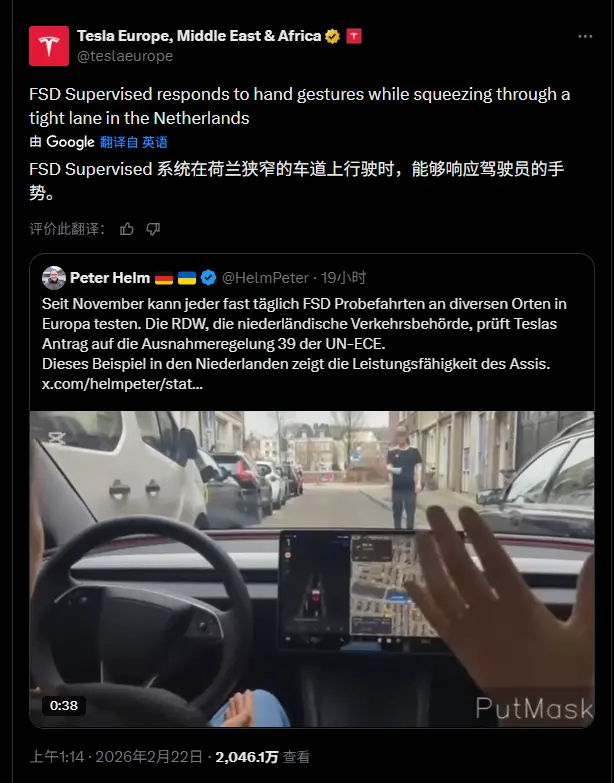
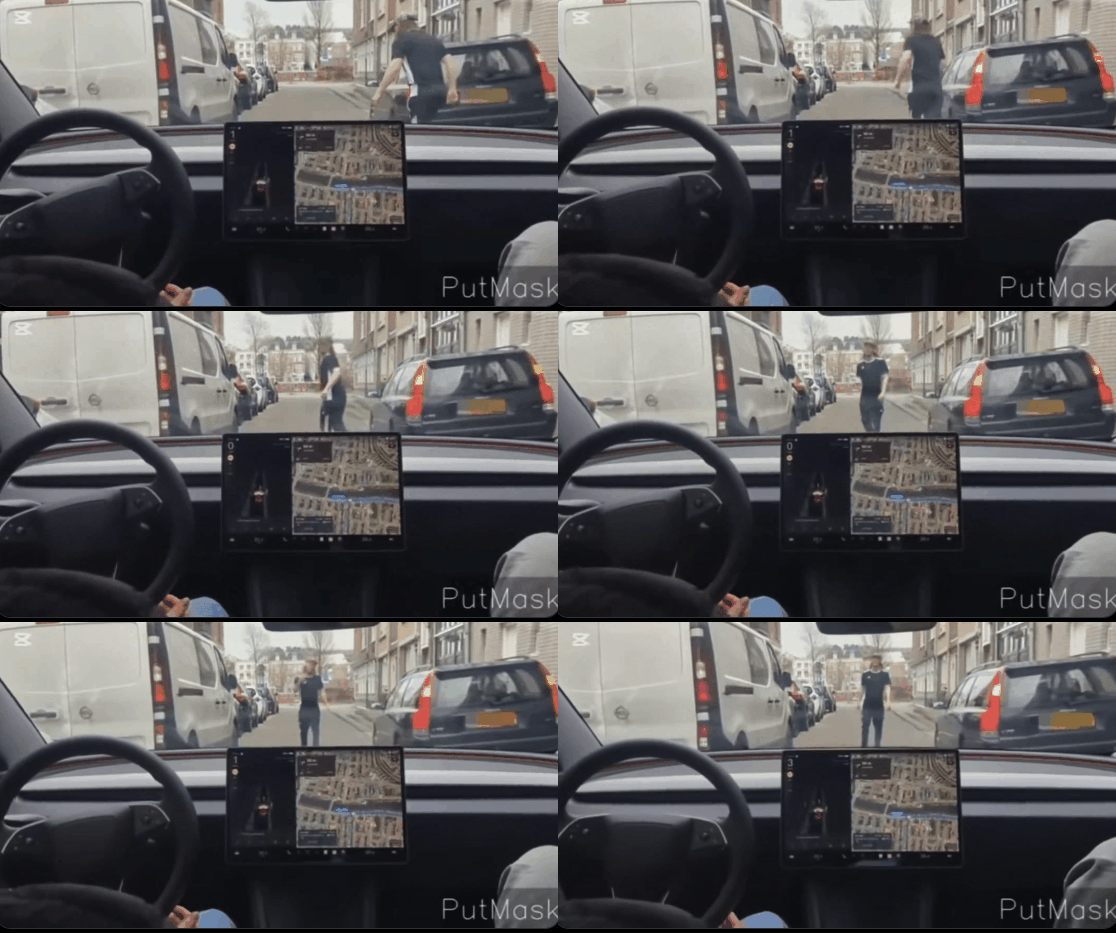
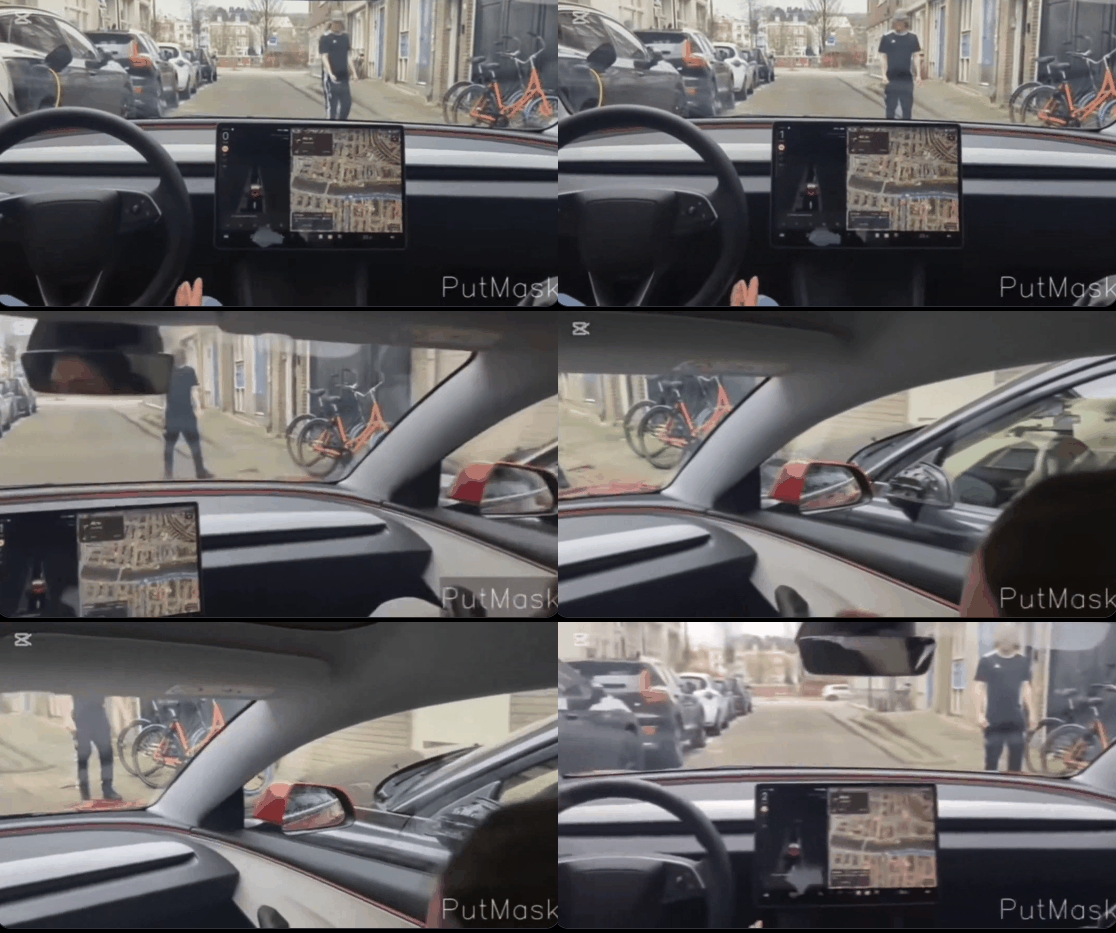
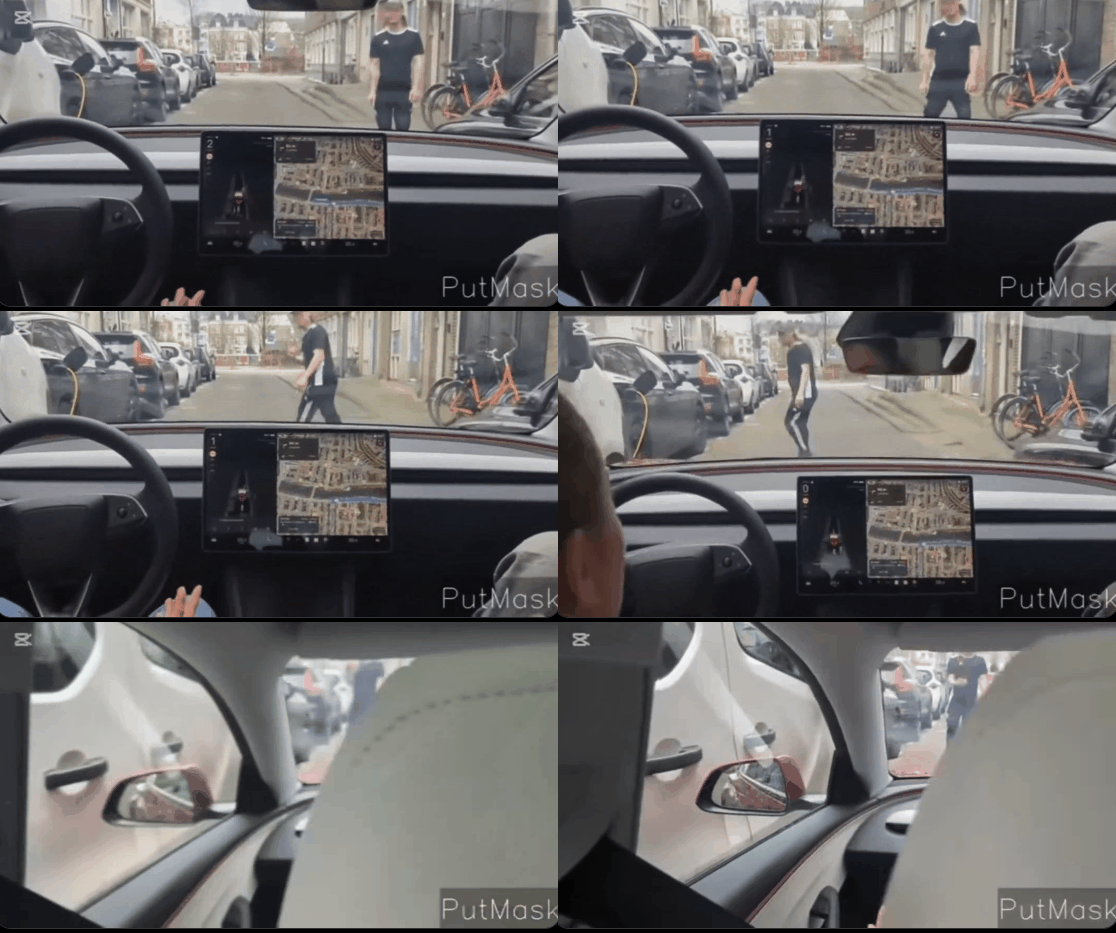
Judging from the video, the vehicle can quickly recognize the gestures of the human in front and make a judgment to move forward or stop, just like a human driver.
Later, Musk forwarded the above post and said: "Tesla's autopilot system can now recognize hand signals."
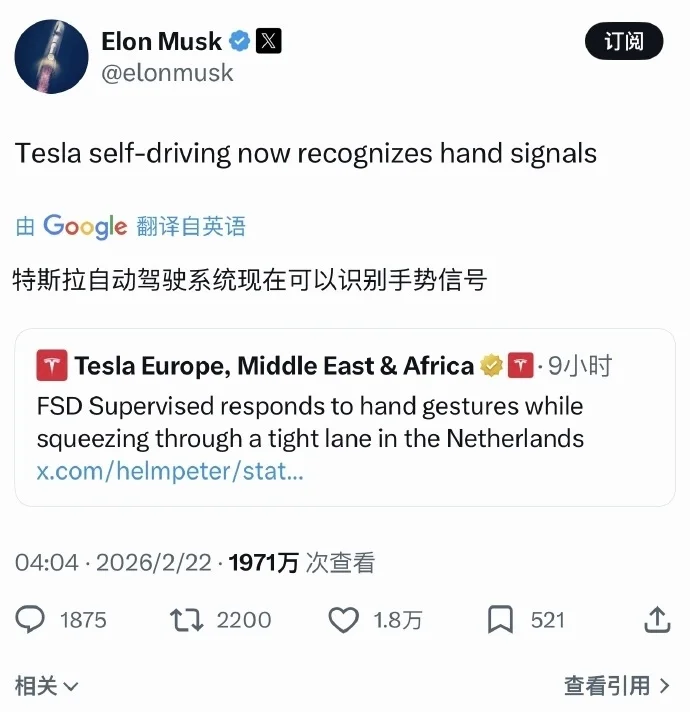
FSD Supervised (Supervised Fully Autonomous Driving) is an advanced driving assistance system developed by Tesla. Its core is to achieve a near-fully autonomous driving experience under the continuous supervision of the driver. It is not completely driverless, but uses neural network technology to handle complex road conditions, significantly reducing the driving burden.
Since the FSD V12 version, the system has completely abandoned the traditional method of relying on a large number of manually coded rules, and instead adopted an end-to-end artificial intelligence model. The model is trained on millions of hours of real-life driving videos and directly translates sensor inputs (such as camera images) into driving decisions (steering, accelerating, braking), making its behavior closer to that of a human driver.
As long as the driver remains focused, FSD Supervised can do the following:
Navigate, steer and change lanes on city roads and highways.
Recognize and respond to traffic lights and street signs, and perform operations such as going straight, turning left, and turning right.
Automatically find and complete parallel or perpendicular parking (Autopark).
Through the "Smart Summon" function, the vehicle can drive to or from the parking lot autonomously.
A few days ago, Tesla officially announced that its FSD mileage exceeded 12.8 billion kilometers.
According to official statements, FSD Supervised’s global cumulative driving mileage has exceeded 8 billion miles (approximately 12.875 billion kilometers), of which vehicles have experienced one major collision every 5.3 million miles, far exceeding the safety performance of manual driving.
For comparison, Tesla vehicles with active safety systems turned on once every 2.18 million miles, those without safety systems turned on once every 860,000 miles, and the U.S. average is once every 660,000 miles.
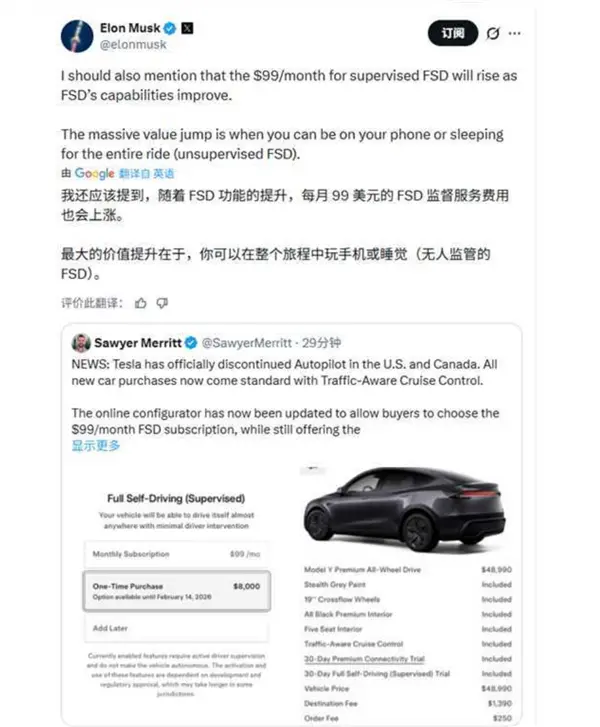
Musk has publicly stated that as FSD’s functionality improves, the monthly fee for FSD supervision services of $99 will also increase. The biggest value improvement is that you can play on your phone or sleep during the entire trip (unsupervised FSD).
Duan Yongping, founder of BBK and a well-known investor, also believes that FSD is indeed easy to use and Model Y is not uncomfortable to drive. Now driving a Tesla is his first choice.
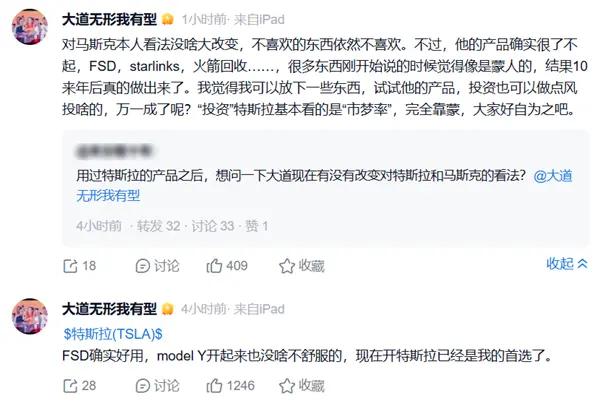
Duan Yongping responded: "My opinion of Musk himself has not changed much, and I still don't like the things I don't like. However, his products are indeed amazing, such as FSD, starlinks, rocket recycling... many things seemed to be deceptive when they were first mentioned, but they were actually made 10 years later."
Later, another netizen asked, "After using Tesla products, I would like to ask if your views on Tesla and Musk have changed now?"
But unfortunately, domestic Tesla owners can only look at it and be greedy for the time being.
Tesla Vice President Tao Lin said in a recent interview with the media that there is no specific date for the launch of Tesla FSD in mainland China, but all work (including the deployment of local training centers) is progressing steadily.
"We have set up a local training center in China to be responsible for this part of the adaptation. Once officially released, it will be as good as or even better than local drivers," she said.