A recent recruitment information from Intel revealed that they want to unify the CPU core and abandon the P+E core design introduced in the 12th generation Core in 2021. The advantages and disadvantages of P and E cores have been clear in recent years, so the design of a unified CPU core has attracted everyone's attention. However, it is hard to say how to unify them. Intel has not officially responded to this issue, and there is a high probability that the product will not be implemented in the next two to three years.
The previous view was that the P and E cores disappeared, but the well-known uncle party Olrak29_ denied this statement and gave a more detailed view,He believes that Intel's unified kernel approach is somewhat similar to AMD's.The latter also has designs like Zen5 and Zen5c. The core architecture is the same, but the cache, frequency, power consumption curve and core area are different.
also,Olrak29_ believes that Intel's unified core is actually derived from the E core,If this statement is true, it means that Intel will abandon the previous P-core design in the future, because although this core has strong performance, it consumes a lot of power and easily loses control of heat dissipation, similar to the previous 14900K, and is not suitable for mobile platforms.
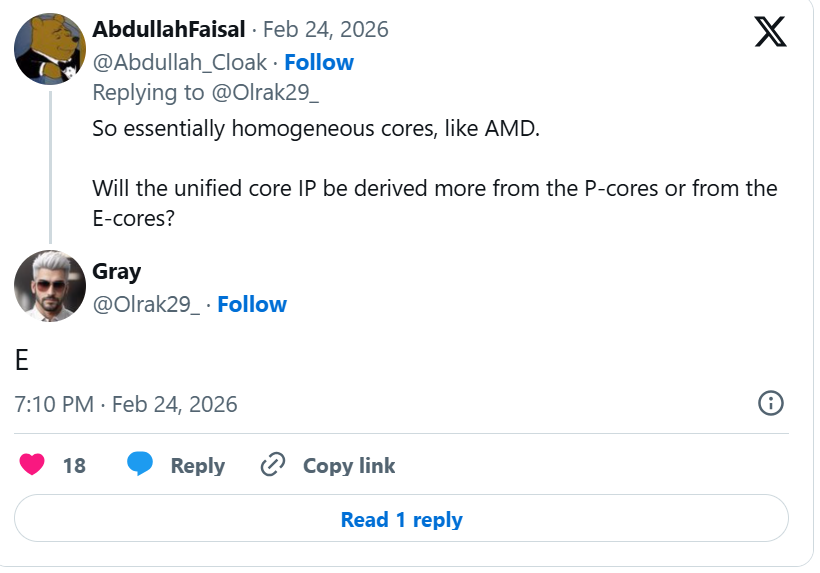
From his point of view,Intel's future unified CPU core is actually more like using the current E-core route as the standard, abandoning the current P-core route, and distinguishing it by cache, frequency, etc.
If you understand the performance of the P core and E core of these generations of Core processors, you should agree with Olrak29_'s view. The E core of recent generations is indeed better. Although the ultimate performance is not as good as the P core, the core area and energy efficiency curve are dominant. The gap between IPC performance and the P core is not big. This may be the reason why Intel plans to use the E core route to unify the CPU core.
Of course, the final choice will have to wait for Intel's results to be compared. The unified kernel team is still recruiting people, and the product will not come out so quickly. It will take three or four years to worry about who will win.