In the critical hours after an oil spill occurs at sea, rescuers often face a dilemma: either allow the oil film to spread, threatening the vast sea area and fragile ecosystems, or use in-situ burning to ignite the oil layer on the sea surface. Although traditional in-situ combustion can prevent oil pollution from drifting, it will produce a large amount of thick smoke, black carbon and incompletely burned residues, bringing a new round of pollution to the atmosphere and marine environment.

In a first-of-its-kind large-scale field experiment, a scientific research team at Texas A&M University in the United States recently proposed a completely different idea: using giant "fire tornadoes" - pillars of flame that rise vertically and rotate like tornadoes - to burn oil on the sea surface. Research shows that this controlled flame vortex not only significantly improves combustion efficiency, but also significantly reduces smoke and dust, making it a faster and cleaner means of responding to oil spills.
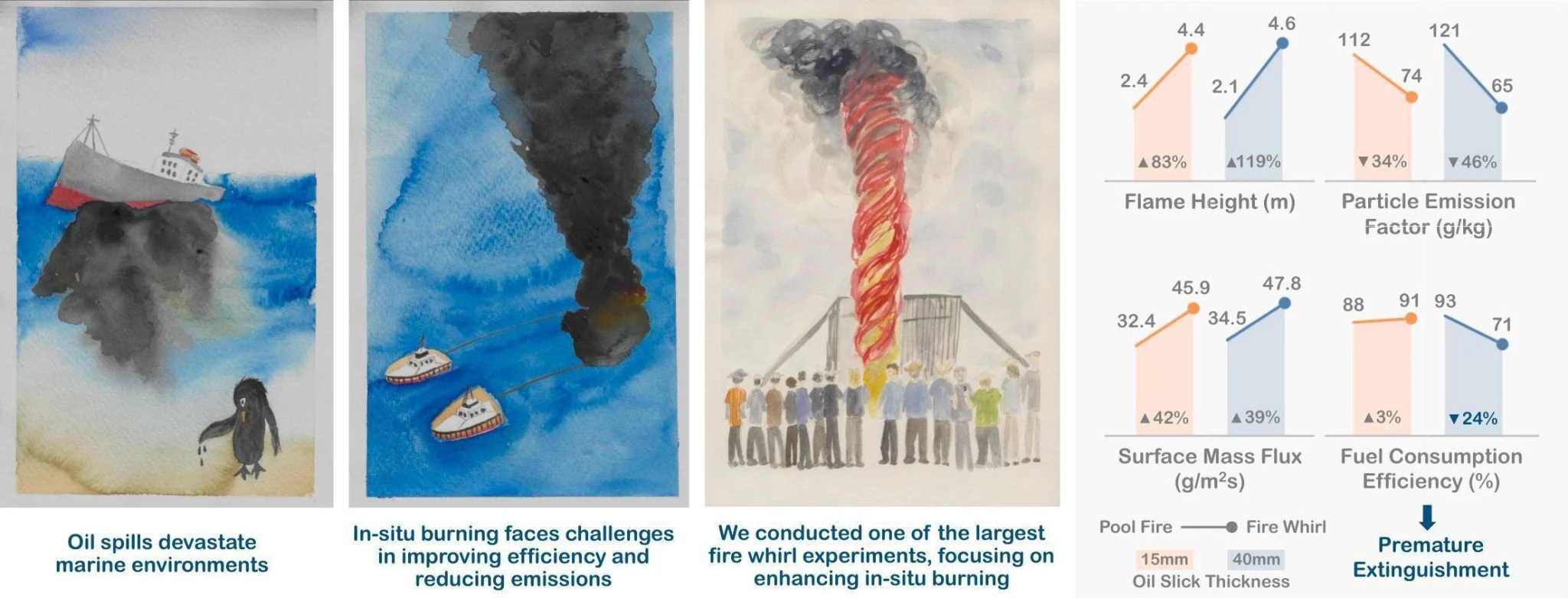
Compared with the "fire pool" formed by conventional in-situ combustion, the fire tornado draws a large amount of oxygen into the flame through strong rotation, making the combustion temperature higher and the reaction more complete. Experimental results show that under the same conditions, the fire tornado's burning speed increases by about 40%, it can burn almost 95% of the oil, and the harmful particles and toxic residues left behind are significantly reduced. At the same time, smoke and dust emissions are also reduced by about 40%, which means that the impact of emergency combustion on air quality is significantly alleviated.
The research was funded by the Bureau of Maritime Safety and Environmental Enforcement (BSEE) under the U.S. Department of the Interior and was jointly conducted by Professor Elaine Oran, Professor Wang Qingsheng and collaborator Michael Gollner from the Texas A&M University School of Engineering. Oran pointed out that this is the first time that someone has proposed using firespouts for marine oil spill control. "Our goal is to turn the originally chaotic and difficult-to-control firespouts into a powerful and precise environmental restoration tool to protect coastlines, marine ecosystems, and the wider environment."
The research team believes that mastering the generation and control technology of fire tornadoes is expected to usher in a new, faster and "greener" oil spill response model. The 2010 Deepwater Horizon accident—the largest offshore oil spill in U.S. history—killed 11 workers, killed thousands of marine life, and severely damaged the Gulf of Mexico ecosystem. It also highlighted the real risk that a major oil spill can turn into an environmental disaster in a short period of time.
From an efficiency perspective, the advantages of Fire Tornado are very prominent. Studies have shown that it can burn out crude oil nearly twice as fast as traditional fire pools, buying a critical window of time for rescue forces and helping to quickly remove oil pollution before it spreads to sensitive or protected sea areas. In terms of improving air quality, firespouts use an efficient combustion process similar to that of industrial incinerators to decompose large particles that would otherwise form dense smoke clouds, so that emergency combustion can reduce marine pollution without sacrificing serious air pollution.
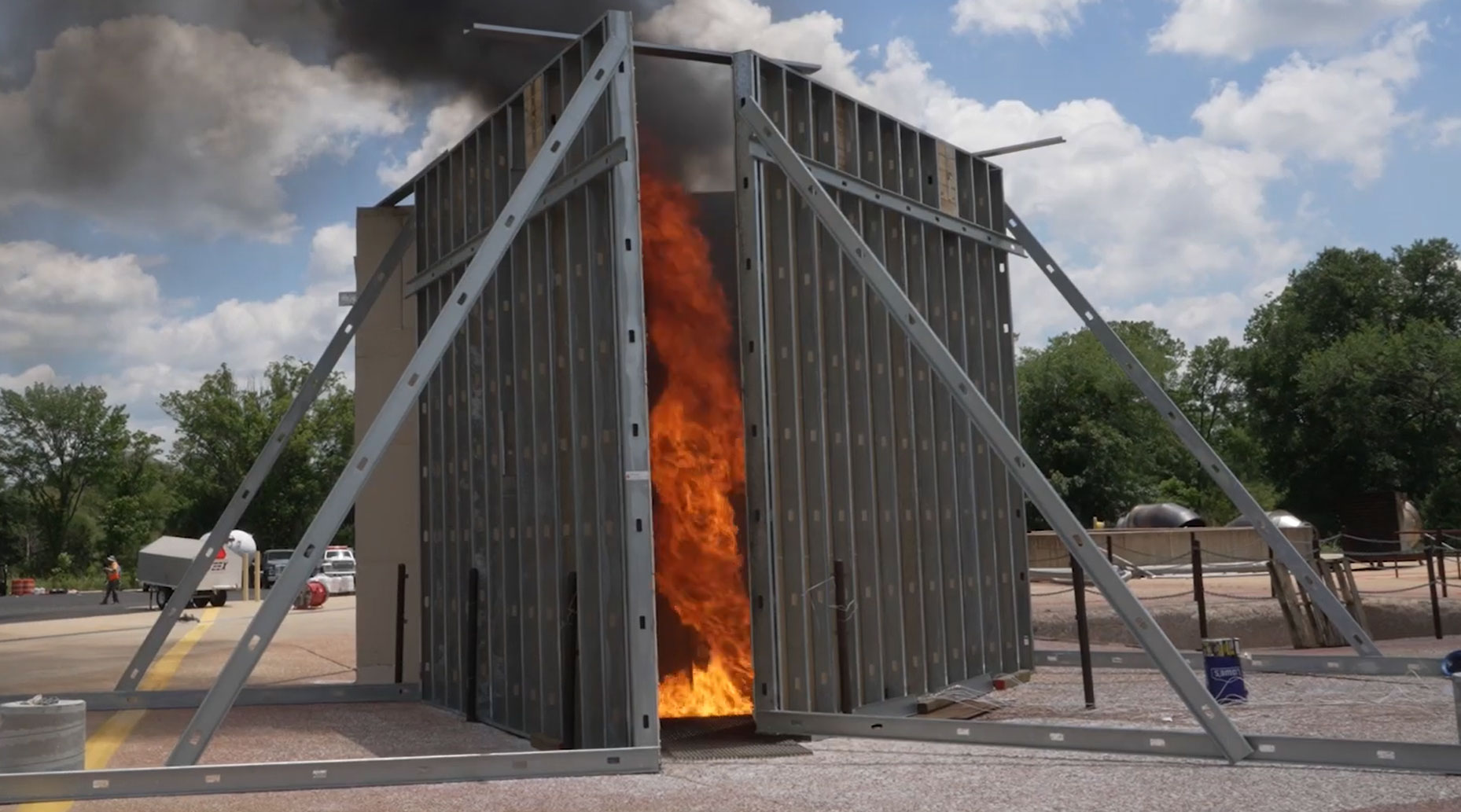
To achieve this large-scale experiment, the research team built a three-wall structure about 16 feet (about 4.9 meters) high. The three walls were arranged in a triangle to accurately guide the air flow. At the center of the structure, they laid a crude oil pool about 1.5 meters in diameter on the water and ignited it at the Texas A&M Engineering Extension Services (TEEX) Brayton Fire Training Field. As the airflow is twisted between the three walls and converged over the flames, a nearly 17-foot-tall flame tornado forms, demonstrating greater burning intensity, cleaner emissions, and near-complete fuel consumption than a regular fire pool.
This result has been published in the academic journal "Fuel". Data shows that the speed of fire tornado burning oil pollution is increased by about 40%, smoke emissions are reduced by about 40%, and the fuel burnout rate can reach up to 95%. Compared with traditional on-site combustion, it has achieved all-round improvements. Oran said that these results not only prove the huge potential of firespouts in maritime oil spill control, but also provide important physical basis for the design of efficient combustion systems, prediction and management of wildfire behavior and other broader fields.
However, the application of fire tornadoes also faces severe engineering challenges. Research points out that fire tornadoes are extremely sensitive to environmental conditions, and only in a "Goldilocks zone" (that is, a state of equilibrium where conditions are "just right") can they maintain efficient and stable rotating flames. When the wind speed is too high, the rotating fire column will be disturbed or even disintegrated; if the air flow organization is insufficient, the flame will degenerate into an ordinary fire pool; the thickness of the oil layer is also crucial. When the oil film is too thick, the fire tornado will extinguish prematurely.
In the future, the scientific research team envisions developing movable engineering devices that can be deployed at maritime accident sites to convert ordinary burning flames into efficient fire tornadoes. This type of device is expected to be transported and positioned above the oil spill area to guide the airflow through the structure and generate a controllable flame vortex to achieve rapid and relatively low-emission emergency combustion operations. Oran emphasized that this research is not only an experiment, but also a preview of a future in which humans can transform fire from a destructive natural force into a tool to protect the oceans and the earth.
At present, the successful generation and control of large-scale firespouts in the field has constituted an important scientific milestone. Research shows that many natural phenomena that seem extreme or even destructive can potentially be “tamed” by humans as long as their physical laws are deeply understood, and in turn used to address today’s pressing environmental challenges.