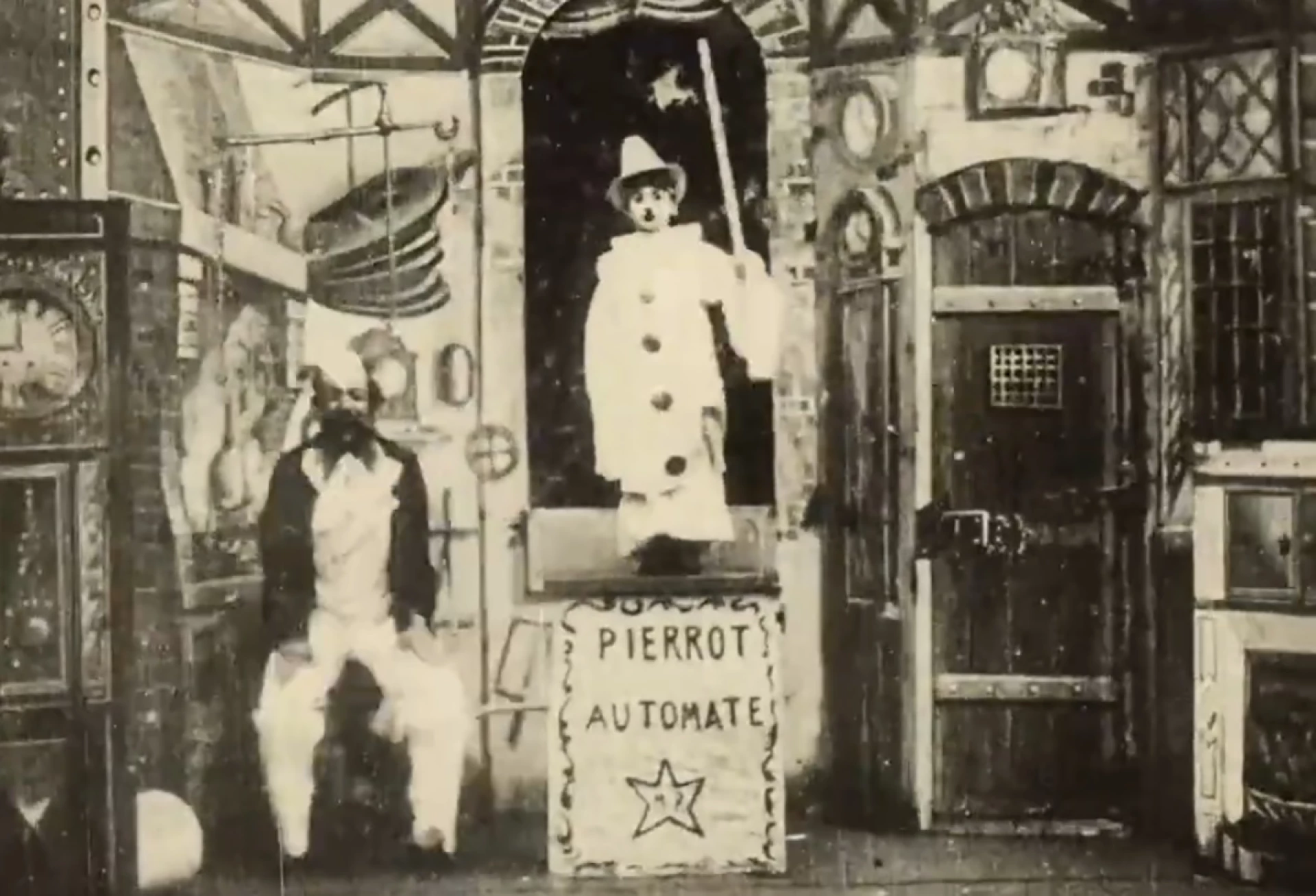
An image of the intertwining history of technology and film has recently been resurfaced. The U.S. Library of Congress has recently released a restored silent short video. This is the earliest film known to feature a "robot" on the screen - "Gugusse et l'Automate" (The Clown and the Automate), shot by French director Georges Méliès in 1897. This film was once considered lost forever.
Georges Méliès is regarded as one of the important pioneers in the history of film. He laid many foundations for film language and film technology. At that time, many film creators were still stuck at the simple recording level of shooting trains entering the station and people on the street. Méliès pioneered the concept of constructing a coherent story through "artificially arranged scenes" and created the "special effects film" as we know it today.
In 1896, while Méliès was filming on the Place de l'Opéra in Paris, the camera unexpectedly stalled, and the resulting image showed the effect of a public carriage "transforming" into a hearse. This accidental event inspired him to systematically explore lens techniques such as "jump cuts" and combine them with stage magic and illusion. He gradually developed a series of imaging techniques such as double exposure, frame dissolution, hand coloring, and matte synthesis. What's even more rare is that under the technological conditions at the time, most of these special effects needed to be completed directly in the camera before the film was developed, which was extremely technically difficult.
On this basis, Méliès successively filmed films such as "Le Manoir du Diable", "Cendrillon", "Le Voyage à travers l'impossible" and the well-known "Le Voyage dans la Lune", leaving a string of classics in film history. However, at that time, films were generally regarded as "one-time exhibition" consumables that only had commercial value for a limited screening period, and were often abandoned or destroyed afterwards. As a result, a large number of early works today have been lost forever.
"The Clown and the Automata" was once classified as a "lost film". For more than a century, the whereabouts of this work remained unknown until 2025, when ten severely rusted nitrate film copies were discovered in the William Dreyer Frisbie Collection of the Library of Congress in Culpeper, Virginia. The relevant films had been stored in basements and garages for a long time and entered the public collection after being donated by Bill McFarland of Michigan.
After being confirmed as Méliès's lost works, the National Audiovisual Conservation Center at the Library of Congress immediately started the restoration process, stabilizing and digitally scanning the fragile and fragmented films. The edited and restored image lasts less than one minute, but it has important significance in the history of film and technology.
The plot of the film is very simple: a clown named Gugusse shows the audience an automaton that looks like a boy. The clown cranks the crank in his hand, and the automaton swings a stick. Then, the puppet suddenly grew in size and continued to wave repeatedly; then it expanded to the size of an adult man and began to hit the clown on the head - whether it was for fun or "out of control", the camera did not give a clear explanation. In anger, the clown threw the puppet to the ground, and swung an exaggeratedly huge "clown hammer" to hit it repeatedly. The puppet's body shrank with each blow, and finally turned into a puppet. Finally, it was completely destroyed by the clown with a heavy blow.
From today's perspective, this is obviously not a science fiction blockbuster like "Terminator 2", but within the boundaries of technology and imagination in 1897, it was a bold visual attempt at "automatic machines" and "anthropomorphic devices". It also became one of the earliest movie clips in the existing images that uses the image of "robot" as its core selling point. The U.S. Library of Congress has now made the restored video publicly available for the public to watch this "robot debut" more than a century ago.