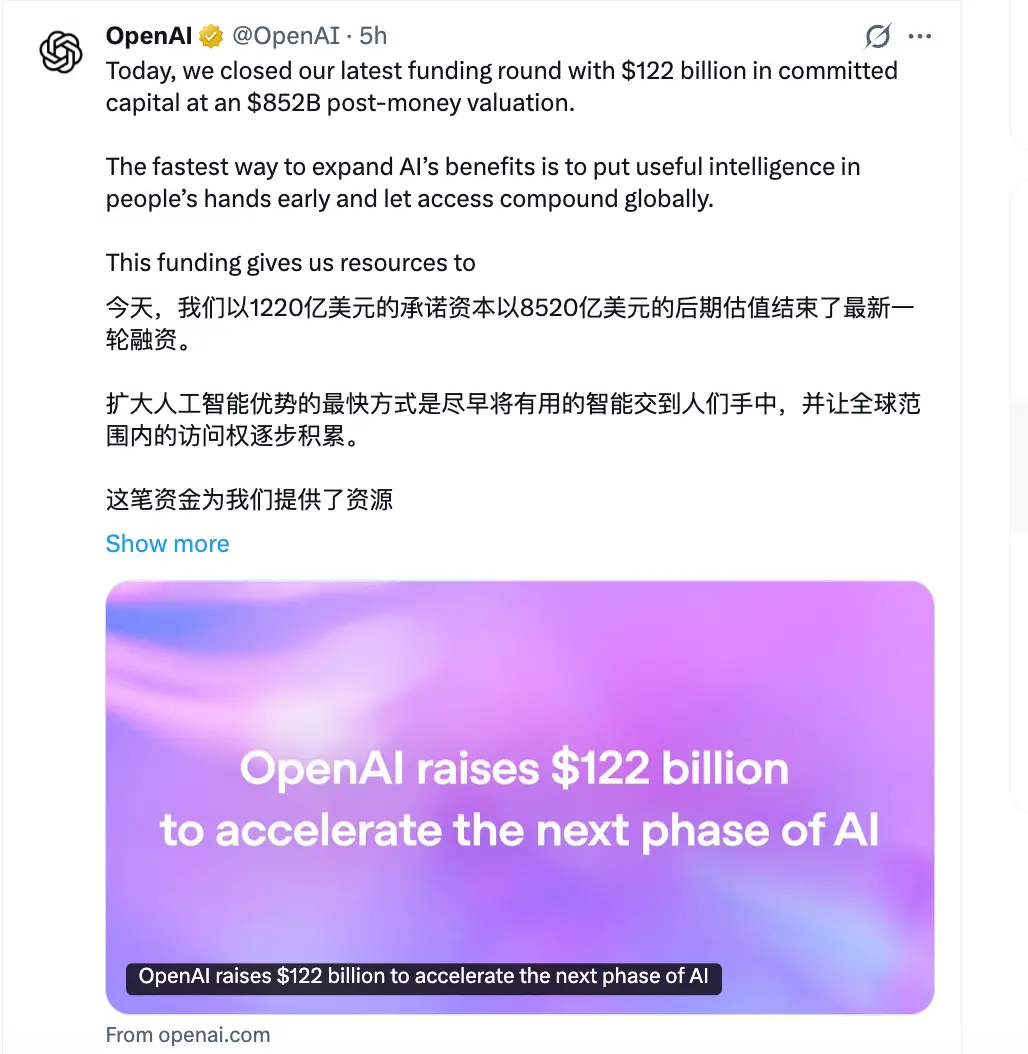
On April 1, OpenAI announced the completion of a new round of financing. The scale of this round of financing reached US$122 billion. It was led by Amazon, Nvidia and SoftBank. SoftBank and venture capital institution a16z (Andreessen Horowitz) served as the co-leads of this round of financing. The amount of this round of financing set a new high for a single round of financing for global start-ups, and also pushed OpenAI’s post-investment valuation to US$852 billion.
It is worth noting that this round of financing OpenAI is open to investors for the first time through bank channels, raising more than US$3 billion from individual investor groups. At the same time, OpenAI will be included in multiple exchange-traded funds managed by ARK Investment, which will further expand the shareholding group. The company also expanded its existing revolving credit line to approximately $4.7 billion, providing greater flexibility to continue large-scale investments, which is backed by a global syndicate of banks including JPMorgan Chase, Citigroup, Goldman Sachs, Morgan Stanley and others.
At the same time as the financing, OpenAI officially disclosed that the number of weekly active users (WAU) of ChatGPT has risen to 900 million and will soon reach 1 billion, of which there are more than 50 million paid subscribers, and the enterprise market already has 9 million enterprise paid seats. The company's annualized revenue (ARR) is close to US$25 billion, with its highest revenue in a single month exceeding US$2 billion, and its revenue growth rate is nearly four times that of Alphabet and Meta.
Although financial data has improved significantly, the company is still in the stage of burning cash and losing money. Previously, there was news in the market that OpenAI will launch an IPO in the fourth quarter of this year. The company has also recently adopted a radical stop-loss strategy, including shutting down the excessively high-cost video generation model Sora.
While OpenAI is financing, its largest competitor Anthropic is also accelerating capital actions, and the competition between the two parties has entered a fierce stage.
Anthropic completed a US$30 billion G round of financing on February 12, 2026, with a post-investment valuation of US$380 billion, annualized revenue of US$14 billion during the same period, and raised its 2026 revenue forecast to approximately US$18 billion. Anthropic is also simultaneously advancing its IPO plan, with the goal of being listed as early as October 2026. The market predicts that Anthropic will go public faster than OpenAI.
After this round of financing, OpenAI’s valuation is higher than Anthropic’s US$380 billion, and much higher than the market value levels of Zhipu and MiniMax of US$55.9 billion and US$46.3 billion. OpenAI's high valuation is mainly due to its "infrastructure-level" positioning. The funds from this round of financing will mainly be used to build an intelligent infrastructure layer, trying to transform AI from a simple dialog box into a "super agent" with the ability to act autonomously.
OpenAI claims that it has gradually become the core infrastructure of artificial intelligence, enabling users around the world to easily build various applications. In particular, continuous and stable computing resources are a strategic advantage throughout the entire system. OpenAI emphasized that NVIDIA remains the cornerstone of the company's infrastructure, and the company's training clusters and most of the inference stack continue to run on NVIDIA GPUs. Through this round of cooperation, both parties will further deepen this partnership to support scale expansion.