According to the latest report from US enterprise expense management platform Ramp, Anthropic is approaching OpenAI in the enterprise AI market.Anthropic's enterprise customer share surged from 24.4% to 30.6% in March, an increase of 6.3 percentage points in a single month, and the gap with OpenAI (35.2%) narrowed to only 4.6 percentage points. Ramp said,At the current growth rate, Anthropic is expected to overtake itself within two months.

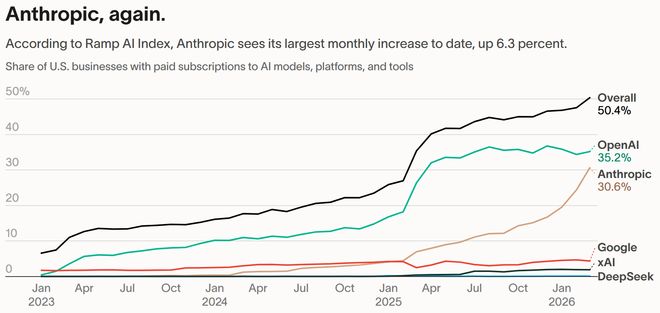
▲The proportion of US companies subscribing to AI from different companies (Source: Ramp)
In terms of annualized revenue (ARR), overtaking has already occurred. Anthropic's annual revenue has exceeded US$30 billion (approximately RMB 204.9 billion), exceeding OpenAI's US$25 billion (approximately RMB 170.8 billion) in the same period. This is the first time since the release of ChatGPT in 2022 that a competitor has surpassed OpenAI in terms of revenue scale.
At the same time, Ramp’s report also revealed a more macro trend:U.S. enterprise AI adoption rate crosses 50% mark for first time in March, reaching 50.4%, compared with only 35% a year ago. The report points out that the strongest predictor of whether a company adopts AI is not its industry or size, but the type of capital behind it.Enterprises with venture capital background have AI adoption rates as high as 80%, and more companies in this group choose Anthropic instead of OpenAI.
1. The share gap has narrowed by half in two months, and the three high-adoption industries have changed hands.
Ramp is a financial automation and corporate card issuer for enterprises. Its AI index is compiled based on the real expenditure data of enterprises on the platform, covering both corporate card and invoice payment transactions. It is an important reference indicator for observing the trend of AI adoption by American enterprises.
According to the report, Anthropic’s proportion of enterprise customers rose from 24.4% in February to 30.6% in March, a single-month increase of 6.3 percentage points.Refreshed the single-month growth record just set last month. The gap between Anthropic and OpenAI quickly narrowed from 11 percentage points in February to 4.6 percentage points, more than halved in two months.
From an industry perspective, Anthropic hasInformation industry, finance and insurance industry and professional services industryLeading the three industries with the highest AI adoption rates.
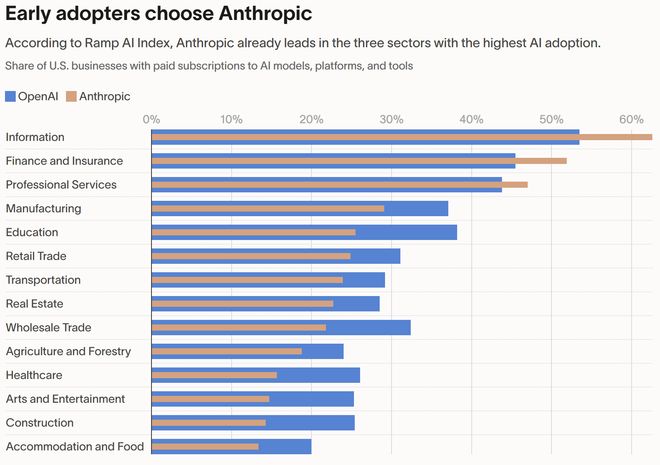
▲Comparison of AI selection by companies in different industries: Anthropic and OpenAI (Source: Ramp)
OpenAI currently leads the rest of the industry, but Ramp economist Ara Kharazian noted: “The pattern in our data is consistent.What early adopters choose now is what the market will choose a few months from now."This judgment implies that Anthropic's leading advantage in the head industry may spread to other industries.
It's worth noting that Anthropic's growth occurred in an unfavorable policy environment. In February this year, the U.S. Department of Defense classified Anthropic as a "supply chain risk," but enterprise customers were almost "indifferent" to this, and the adoption rate increased instead of decreasing. Harazian believes that corporate voting with their feet essentially undermines the credibility of this government threat.
2. Who is investing in you can better see your AI adoption rate?
There is another interesting finding in the Ramp report: the strongest predictor of whether a company adopts AI is not industry, size, or geography, butWhat kind of investors are standing behind this?.
There are obvious differences in the AI adoption rate among companies with different backgrounds. The AI adoption rate of venture capital-backed companies is as high as 80%, that of private equity-backed companies is 64%, and that of companies without institutional investors is only 45%. This set of figures holds true in every industry tracked by Ramp. Even in the construction and food industries, which have the lowest AI adoption rates, the AI adoption rates of companies with venture capital backgrounds have reached 77% and 67%, far exceeding the industry average. In other words, who invests in you can determine whether you use AI more than what business you do.
Ramp economist Harazian believes that venture capital institutions are actually playing the role of AI promoters. They push AI tools across their entire portfolio through unified purchasing agreements, management directives, and a culture of “you should use the latest tools.” Private equity institutions also have a similar driving effect, but the intensity is weaker than that of venture capital. Companies without institutional investors have to figure out whether to use AI or not.
Moreover, among venture capital-backed companies, the proportion choosing Anthropic has reached 66%, which is significantly higher than OpenAI’s 59%.
3. ARR has completed the overtake, growing 30 times in 15 months
It can be seen from the changing trend of enterprise customer share that the balance is tilting towards Anthropic, and in terms of revenue, Anthropic's lead has become a fact.
According to The AI Corner, Axios and other foreign media reported that Anthropic's ARR increased approximately 30 times in 15 months: approximately US$1 billion (approximately RMB 6.8 billion) in January 2025, and approximately US$1 billion (approximately RMB 6.8 billion) in December 2025. Reaching approximately US$9 billion (approximately RMB 61.5 billion), it exceeded US$30 billion (approximately RMB 204.9 billion) in April 2026, exceeding OpenAI’s US$25 billion (approximately RMB 170.8 billion).
About 80% of the revenue comes from corporate customers, and the number of large customers with annual consumption of more than 1 million US dollars (approximately RMB 6.83 million) has doubled to more than 1,000 in less than two months.
According to Business Insider, Claude Code is very popular among software engineers. This product alone has contributed approximately US$2.5 billion (approximately RMB 17.1 billion) in ARR and is the core engine driving the growth of corporate spending. In terms of profit prospects, OpenAI expects to lose approximately US$14 billion (approximately RMB 95.6 billion) in 2026, while Anthropic expects to achieve positive free cash flow in 2027.
Conclusion: Early adopters are already leaning toward Anthropic, and it may be just a matter of time before they overtake it.
The Ramp report shows the preference of enterprises for Anthropic. This trend of Anthropic approaching or even surpassing OpenAI is becoming increasingly clear: venture-backed enterprises will move first, and industries with high AI adoption rates will overtake it, and then spread to the wider market. When 66% of venture capital companies and the three leading industries have turned to Anthropic, OpenAI’s lead in total share may not last long.
For Anthropic, the next suspense is whether it can maintain its advantage after overtaking and gain more corporate recognition; for OpenAI, how to win back corporate customers while maintaining the developer ecosystem will become a key issue in the next stage.