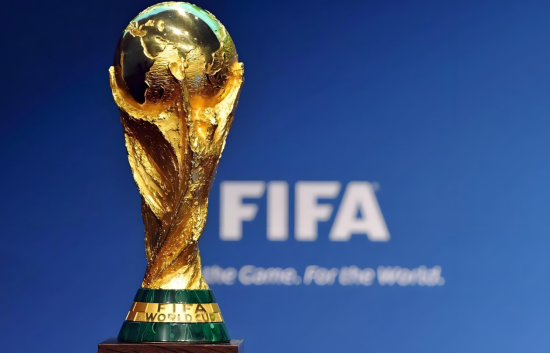
With less than five weeks left before the opening of the 2026 World Cup in the United States, Canada and Mexico, negotiations for the broadcast rights in the Chinese market for this world's top sports event have reached an unprecedented deadlock. It is reported that FIFA's initial bid for the broadcast rights of a single World Cup to CCTV is as high as US$250 million to US$300 million (about 1.8 billion to 2.1 billion yuan), while CCTV's budget may only be US$60 million to US$80 million; even if it is reduced to US$120 million to US$150 million after multiple rounds of negotiations, there is still a huge gap with CCTV's expected bid. More importantly, FIFA's bid for the two World Cup broadcasts in the Indian market was only US$35 million.
Text | "BUG" column Zhou Wenmeng
Today, FIFA responded to the sky-high price of World Cup copyright in China, saying that negotiations are still ongoing and details must be kept confidential.
Currently on social platforms, netizens are already quarreling over the sky-high copyright fees for World Cup broadcasts. Most netizens bluntly said that they "won't watch it" if they can't talk about it. Due to the time difference and work, they simply "can't watch it". They might as well watch the "Soviet Super League".
China's World Cup broadcast negotiations have reached a "deadlock"
Over the past 20 years, the increase in World Cup broadcasting rights fees has become an indisputable fact.
According to incomplete statistics from the "BUG" column, the packaged domestic copyright fees for the two World Cup broadcasts from 2002 to 2006 were only US$24 million (US$12 million for a single session); the packaged broadcast fees for the two events from 2010 to 2014 were 1.1 500 million U.S. dollars (about 60 million U.S. dollars for a single session); by 2018-2022, the packaged broadcast fee for the two sessions will be about 300 million U.S. dollars (a single session is 150 million U.S. dollars). This year, the single session will report a broadcast fee of 250 million to 300 million U.S. dollars. The price has increased more than 20 times in 20 years.
According to media reports, the current World Cup broadcast quotations are seriously out of touch with the reality of the Chinese market. First of all, since this World Cup will be held in North America, about 70% of the games will be played in the early morning to morning hours of Beijing time, which directly leads to the lack of prime viewing time, and the advertising value and ratings expectations are seriously weakened. In addition, the national football team's failure to qualify for the World Cup finals for six consecutive years has further reduced the Chinese people's enthusiasm and discussion for this event. More importantly, FIFA’s bid for the two World Cup broadcasts in the Indian market was only US$35 million.
With the World Cup broadcast negotiations reaching a "deadlock", two groups composed of mass consumer groups and World Cup broadcast-related interest groups are delivering two different voices.
On multiple social platforms, a large number of netizens shook their heads after seeing the "sky-high" quotation for the World Cup broadcast rights fee. They bluntly said that the quotation was too high, "then don't broadcast it", and thought that "it's not too expensive to buy it right" and "it's okay not to watch it." Some even bluntly said that due to the jet lag problem, "it's impossible to take care of work at the same time."
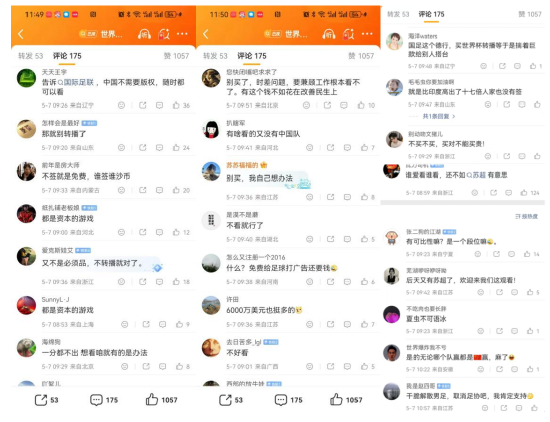
Due to the "widening" of the national football team in recent years, some netizens believe that buying World Cup broadcasts under such circumstances is "equal to spending huge sums of money to set up a platform for others."
Zhang Qing, founder of the Key Sports Consulting Company, pointed out that although the two sides are still in the game, the possibility of successful negotiations in the end still exists.
From the perspective of the World Cup, the first is the reduction in official revenue, and the second is the weakening of sponsor exposure and traffic returns. In addition, the influence of the World Cup itself will also be weakened. The Chinese market is so large and influential, and the World Cup also has many sponsors from China. FIFA is essentially a huge business empire. If the negotiations break down, the result will be unacceptable.
"2026 is considered a big year for sports. The first half to the middle of the year is the World Cup, and the second half is the Asian Games. Usually leading companies will make arrangements for these two major events. For FIFA, the longer the delay, the greater the pressure." Zhang Qing said bluntly.
The rise of the "Soviet Super League" brings more choices
Behind the 20-fold price increase in 20 years, why are the World Cup broadcast fees in the Chinese market becoming more and more expensive?
According to industry insiders, as the world's number one sport - football, the world's top event, there is no corresponding event to compete with the World Cup, which has become the main reason why FIFA continues to increase broadcast rights fees. Moreover, since this year’s World Cup has added 48 teams, covers a larger area and has a longer competition period, it has its own logic to hope to increase copyright fees. However, without the Chinese team's World Cup, the broadcast value in the domestic market itself has been depreciated to a certain extent. Added to various factors such as time differences, excessive copyright fees will also make broadcast platforms and advertisers shrink back.
"Although the World Cup is a global hit, its popularity has continued to decline in recent years, and the 'art of toe' is fading. In addition, various domestic football events in recent years, such as the Scottish Premiership and Village Super League, have made huge breakthroughs in the perspective of national sports and igniting derivative consumption. This has also allowed video platforms and merchants to participate, with more down-to-earth and consumption scenario expansion options." According to industry analyst Zhang Shule, the rise of events such as the Scottish Premiership is also changing Chinese people's viewing behavior of football events from single-choice questions in the past to multiple-choice questions.
Zhang Qing bluntly told the "BUG" column that although the World Cup is the highest level competition in the world, the Scottish Premiership is just a mass game. According to the competitive level, the Scottish Premiership is actually below the Chinese Second Division, or even the Chinese Championship (fourth tier). However, judging from the commercial value of the Scottish Super League this year, it has reached the second level and above. Whether it is England, the five major European leagues, or North America, the commercial value of the fourth tier amateur league in any country can reach this level.