Aging is a systemic process regulated by complex networks at multiple levels from molecules to the body. Microscopic perturbations cascade in the network, driving macroscopic decline and the progression of chronic diseases. Affected by the differences in health reserves between individuals and the asynchronous characteristics of organ aging, the aging rate of people of the same age shows significant differences. The development of biotechnology and artificial intelligence has promoted the transformation of aging research from descriptive correlation to quantifiable intervention, trying to answer questions such as "how old is a person", "where does one age first, why does one age, and how to intervene".
Recently, the Beijing Genome Institute of the Chinese Academy of Sciences (National Bioinformatics Center), in conjunction with the Institute of Zoology and other units, built an aging digital human holographic framework to map multi-dimensional aging data to an individualized digital twin model. In the proof-of-concept, the team analyzed a four-center standardized cohort of healthy volunteers, collected more than 240 parameters, built a multi-modal, multi-level, and interpretable aging clock system, and constructed an aging digital human body model that is quantifiable, simulated, and interventionable. This framework effectively expands the dimension of aging assessment and can accurately predict biological age, map organ aging asynchrony, and identify aging-driving molecules such as coagulation factors.
This framework follows the three-layer logic of “reading, calculation, and adjustment”. "Read" to obtain multi-dimensional aging data. "Calculation" relies on the multi-modal aging clock to convert data into biological age and organ aging rate. The core capability clock integrates more than 240 physiological indicators. The multi-modal clock integrates six levels of molecular data to reduce the age prediction error to 3.87 years. The organ clock relies on liquid-phase biopsy technology to independently assess the biological age of six organs and reveal the asynchronous characteristics of aging. "Tune", targeting targetable aging-driving molecules based on causal inference.
The study also constructed independent aging clocks for six major organs: brain, liver, lungs, muscles, blood vessels, and skin. Research has confirmed that there is significant asynchrony in organ aging, and the aging turning point of the liver is earlier than that of the brain. The team also identified two non-linear change windows between the ages of 40 and 50 and between the ages of 60 and 70. The significant activation of the coagulation pathway at the age of 60 to 70 is a critical stage for accelerated aging.
The study also found that coagulation factors derived from aging livers are synergistically upregulated. In vitro experiments have confirmed that key coagulation factors can induce endothelial cell aging; in vivo experiments in mice have shown that injection of F13B can induce accelerated aging of multiple tissues, confirming that coagulation factors are the core molecules driving the aging of blood vessels and multiple organs.
Clinical translation shows that the core clock can be approximately reconstructed using only a representative set of plasma proteins, suggesting that blood testing may become a feasible way to assess biological age. The organ-specific aging clock can identify prematurely aging organs in advance and provide differentiated intervention targets. For vascular aging driven by coagulation factors, it can target the coagulation pathway. The aging of other types of organs can be matched with different lifestyle or drug interventions.
This study marks a paradigm shift in aging science from descriptive to systematic and causal, and establishes quantifiable biological age as the core evaluation indicator for aging intervention. Currently, the research team is continuing to iterate the model, by introducing longitudinal data, covering different populations, developing low-cost detection technology, and gradually solving problems such as limitations of cross-sectional data and verification of coagulation factor inhibitors. This achievement is expected to build a dynamic health twin engine and provide a standardized and transformable new path for healthy aging.
Relevant research results were published in Cell (Cell)superior.
Paper link
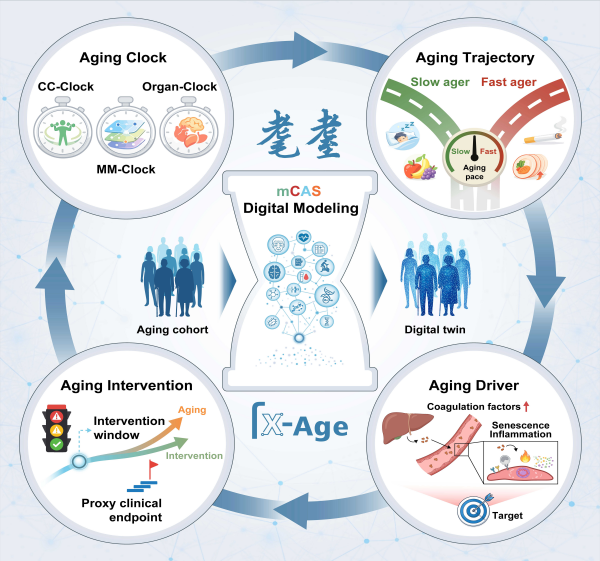
X-Age multidimensional aging assessment and digital modeling framework