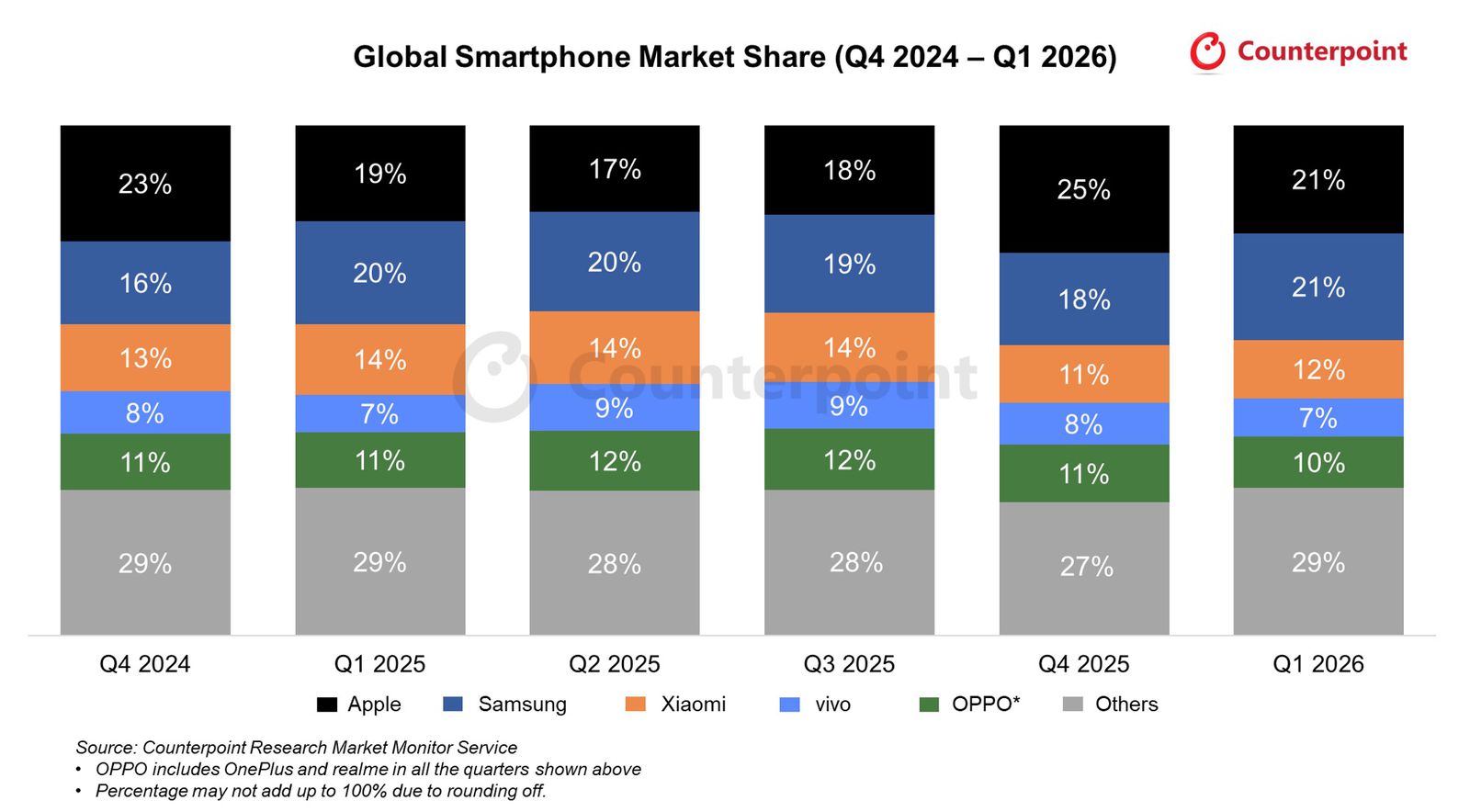
The latest data from Counterpoint Research shows that in the first quarter of 2026, Apple became the world's largest smartphone brand in terms of shipments. This is the first time that Apple has topped the global smartphone market in the first quarter. The report pointed out that in an environment where the overall smartphone market fell by 3% year-on-year, Apple still achieved 9% year-on-year growth, with global shipment share reaching 21%.
Samsung also ranked second with a market share of about 21%, but its shipments were basically the same; Xiaomi, OPPO and vivo followed, with market shares of 12%, 10% and 7% respectively. Among them, Xiaomi's shipments fell by 19% year-on-year, while OPPO and vivo fell by 4% and 2% respectively.
This new milestone at the brand level continues Counterpoint’s previous finding: In the first quarter of 2026, iPhone 17 was the best-selling single smartphone model in the world. In the agency's global mobile phone model sales tracking, the iPhone 17 series took the top three sales spots, iPhone 17 Pro Max ranked second, iPhone 17 Pro ranked third, and the previous generation iPhone 16 also continued to remain at the top of the list. During an earnings call on April 30, Apple CEO Tim Cook said that the iPhone 17 series is the most popular iPhone product line in Apple’s history.
Counterpoint believes that in addition to the continued strong demand for the iPhone 17 series, Apple’s proactive deployment in supply chain management and improved sales performance in the Chinese market are also important reasons for its leading position this quarter. The report pointed out that Apple's ability to maintain high-end pricing and defend profit margins has made it less impacted than its competitors in the current shortage of memory chips. Currently, supply shortages of DRAM and NAND flash memory are still dragging down the entire smartphone industry, with chip manufacturers prioritizing production capacity allocation to protect artificial intelligence data center customers rather than smartphone manufacturers.
Cook has said that the shortage of memory chips and related rising costs will have a more obvious impact on Apple later in 2026. Counterpoint expects that the rest of 2026 will put similar pressure on most smartphone brands, and this "memory crisis" may continue until the end of 2027.