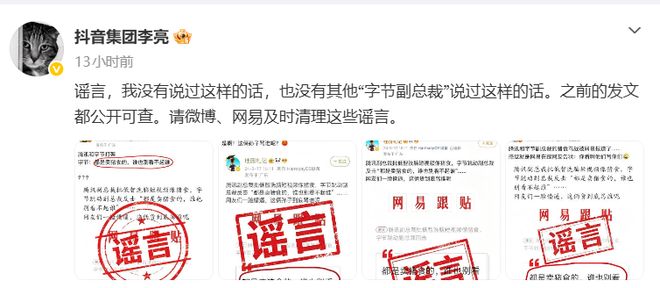
Recently, there were comments on the Internet saying: "The vice president of Tencent criticized the low-quality brainwashing short videos as being like pig food, and the vice president of ByteDance countered, 'We are all selling pig food, don't look down on anyone.'" On the evening of May 24, Li Liang, vice president of Douyin Group, wrote: "Rumors, I have never said such things, and no other 'Vice President of Byte' has said such things. Previous posts are all publicly available. Please Weibo and NetEase clear up these rumors in a timely manner."
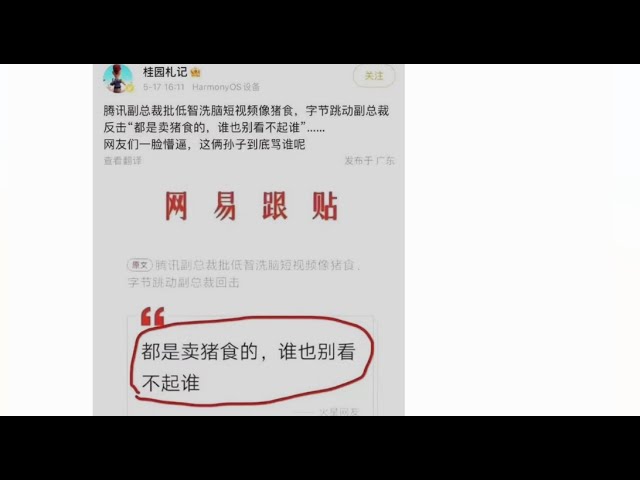
Jiemian News has learned that the spread of this rumor may be related to a "pig food theory" dispute that has attracted widespread attention in 2021.
According to a report by China Economic Weekly in June 2021, at the 9th China Online Audiovisual Conference, Sun Zhonghuai, Vice President of Tencent and CEO of Tencent Online Video, delivered a keynote speech titled "Stick to the Right Path and Set sail on a New Audiovisual Journey", in which he criticized some low-intellectual and vulgar short videos for their long-term impact on users' minds.
Sun Zhonghuai said at the time: "The personalized recommendations of short video platforms are so powerful now. If you like 'pig food,' all you see is 'pig food.'" He also mentioned that people who watch brainwashing short videos in public places "are like fools." He believes that such anti-intellectual and vulgar entertainment consumer products "very quickly bring down the aesthetic taste of a generation."
In addition, he also said that brainwashing and repetitive short videos will particularly have a negative impact on young people whose minds are not yet mature.
The short video platform’s counterattack soon followed. At the audio-visual conference, the relevant people in charge of Station B and Kuaishou were present, but they did not directly fight back. Douyin, who was not present, released a big move from a distance. Li Liang posted an article saying that Tencent is obviously vigorously developing short videos, but at the same time it has been attacking the short video industry. Li Liang pointed out that the WeChat video account, which claims to have hundreds of millions of users, is currently the only short video platform that has not launched an "underage mode" as required.
The war of words didn't end there. On the afternoon of June 4, 2021, ByteDance published "Major Events of ByteDance's Blocking and Banning by Tencent (2018-2021)" on its official WeChat. The article clearly stated at the beginning that "the 'pig food theory' of a Tencent executive is extremely arrogant and unfair." On the contrary, they believe that short videos, as a new form of communication, help countless ordinary people record and share their lives, allowing more people to see the larger world.
In fact, the competition between long video platforms and short video platforms has been around for a long time. The core contradiction lies in the competition for user time and the collision of content forms. As the mobile Internet traffic dividend peaks, the online video industry has entered an era of stock competition. Long-form video platforms are facing the dilemma of slowing membership growth and pressure on advertising revenue, while short-form video platforms are quickly seizing users' attention with their fragmented and highly interactive content forms, and the two parties have formed a direct substitution relationship in content consumption scenarios.
It is worth noting that as the industry landscape evolves, the boundaries between long videos and short videos are increasingly blurred. Tencent strongly supports WeChat video accounts to enter the field of short videos, while Douyin and Kuaishou continue to extend their reach to medium- and long-term videos and high-quality micro-short dramas. The two parties are gradually moving from "either/or" to "competition and cooperation" as they penetrate each other.
In addition, according to Metropolis Express, it was recently reported that the cooperation between Douyin and Tencent Video Platform has expired. At the same time, the official Douyin account of the Shaanxi Opera Research Institute was suddenly banned from playing the Qin Opera play "Dajiao Zan" in the live broadcast room. Some people said that "Dajiao Zan" is the same as the drama "Protagonist" currently being played by Tencent Video, which triggered heated discussions.
On May 20, “Douyin blocked the live broadcast room of Dajiao Zan” became the first trending topic on Weibo. On the evening of May 20, Li Liang posted on Weibo and said: Seeing that "Douyin blocked the live broadcast room of Da Jiao Zan" entered the hot search rankings, a large number of netizens were misled. Let me explain again that the "Qin Opera live broadcast (Da Jiao Zan) was blocked due to the promotion of the drama" is a rumor. The actual situation is that this account has repeatedly disguised "recorded broadcasts" as "live broadcasts" to deceive netizens, violated platform rules and was punished, and has nothing to do with the promotion of the TV series. Please don’t believe and spread rumors.
Regarding the discussion on whether "official TV drama accounts" can publish copyrighted content, Douyin explained from a legal perspective. Historically, there have been cases where "video platform copyright owners" have listed content released by their official Douyin account as evidence of infringement.
Therefore, due to compliance considerations, Douyin stipulates that even the official account of a TV series must obtain explicit authorization from the copyright owner of the video platform when publishing content containing full copyrights. At present, Douyin stated that it has not received valid authorization materials for the relevant series.