Against the backdrop of soaring NVMe solid-state drive prices, SanDisk has chosen to bet on an "old technology" and plans to launch a new SATA solid-state drive product line - Sandisk 320 and Sandisk 520 - in 2026 to provide a more cost-effective storage alternative for users who do not want to pay for high-speed M.2 NVMe.
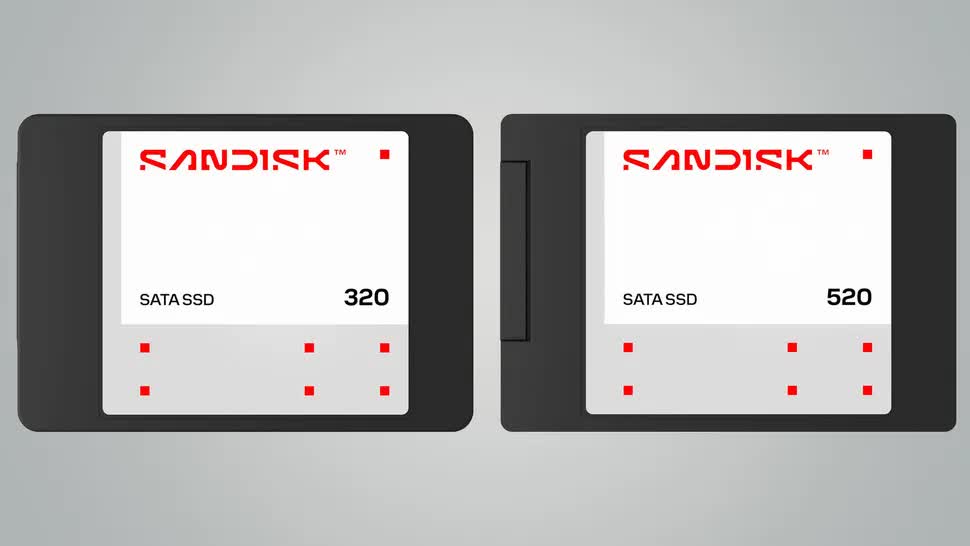
According to what hardware tipster momomo_us discovered on the UK Amazon page, both the Sandisk 320 and 520 use the traditional 2.5-inch, 7mm thickness specification, which means they are compatible with a large number of desktop and laptop models, especially those that still retain 2.5-inch hard drives. Sandisk 320 is positioned as a mainstream model, with capacities ranging from 250GB to 2TB, with sequential read speeds up to 545MB/s, and sequential write speeds up to 525MB/s; Sandisk 520 starts from 500GB, with a maximum capacity of 4TB, sequential read speeds up to 560MB/s, and write speeds of up to 525MB/s. The 4TB version has a nominal write life of 1000 TBW, but the model of the main control chip used has not yet been determined.
It needs to be emphasized that this is still a product based on the SATA interface after all. Even a SATA SSD that performs well has a performance upper limit limited by the interface itself, which is about 600MB/s. In contrast, typical PCIe 4.0 NVMe SSD sequential reads can often reach 5,000MB/s to 7400MB/s, and newer PCIe 5.0 products far exceed this level. Therefore, in high-end game console or workstation scenarios that emphasize extreme performance, the SATA solution itself is not attractive. In addition, SATA still requires data and power cables in desktop computers, as well as 2.5-inch hard drive bay support in the chassis, and many modern ultrabooks and game consoles that rely on M.2 slots simply cannot use such 2.5-inch products.
However, if the use scenario shifts from "system disk" to "mechanical hard drive replacement" or "expansion disk", the positioning of these two new SanDisk products will become more reasonable. For users who want to eliminate old mechanical hard drives, "rejuvenate" old notebooks, and make extra space for game libraries or large-capacity data, but do not particularly pursue NVMe-level speeds, SATA SSDs are still of practical significance. The key lies in whether SanDisk can offer a competitive enough price.
The current tense situation in the storage market is largely due to the chain reaction brought about by the AI hardware boom: the demand for NAND and SSD in data centers has increased sharply, resulting in tight overall supply, making storage equipment another "victim" of the AI wave. According to reports, even SATA SSD prices have increased by about 10% to 20% in the past year: 250GB products start at about US$42, 500GB models are about US$101, 1TB products are about US$204, and 4TB can even reach about US$329. These figures have further compressed the space of traditional "cost-effective storage".
As of now, SanDisk has not officially announced pricing information for the Sandisk 320 and 520 in the US market, and official news about these two products has not been further updated than when it was initially exposed. The report pointed out that the relevant page on Amazon in the UK seems to have been removed from the shelves, but a Dutch retailer is said to have given a timetable for the Sandisk 520 to arrive on June 3, indicating that the product launch process has entered the countdown stage.
In what is described as the "AI-driven memory/flash apocalypse", SanDisk chose to repackage the "old technology" based on SATA as the current "pragmatic choice", trying to make up for the gap left by the high-priced NVMe in the mass market through a more affordable price. If the Sandisk 320 and 520 can significantly outperform NVMe solid-state drives of the same capacity in price, they have the opportunity to become a "life-saving straw" for a large number of ordinary users; conversely, if the pricing is too close to the faster M.2 NVMe, these two new products may just become another footnote used by users to lament "how outrageous the storage market has become."