OpenAI officially announced its first self-developed artificial intelligence processor Jalapeño on Wednesday. This chip was jointly developed by OpenAI and Broadcom. It is mainly targeted at AI inference tasks, which is the core computing link that allows the model to respond to user requests, run agents such as Codex, and generate ChatGPT replies. This means that OpenAI is further bringing the computing infrastructure under its control in an attempt to reduce its dependence on Nvidia GPUs.
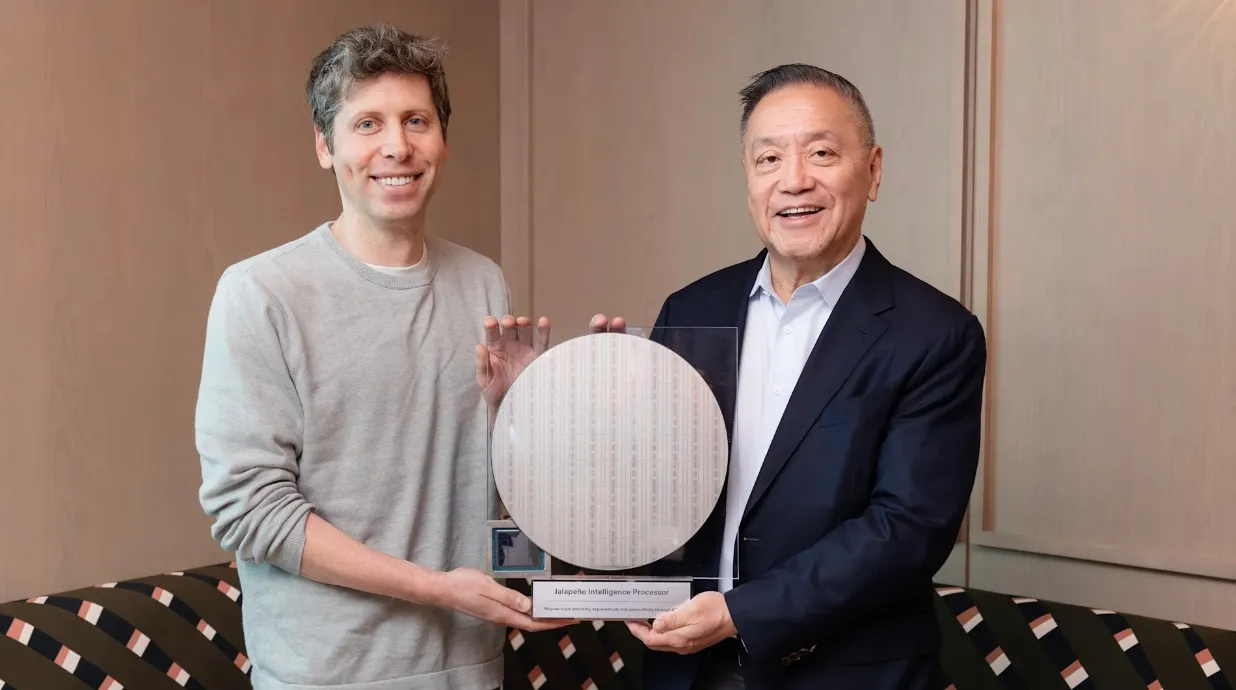
Jalapeño is classified as an ASIC, which is an application-specific integrated circuit. Unlike a general-purpose GPU, it is a chip tailored for specific purposes. OpenAI stated that this chip must not only support existing large language models, but also adapt to future new generation models, and is regarded as the first stage of its "multi-generation computing platform". The company expects the chip to begin deployment by the end of 2026.
According to a joint statement between OpenAI and Broadcom, Jalapeño only took about nine months from design to molding. During the development process, OpenAI engineers participated in chip design, and Broadcom was responsible for manufacturing and related network technology integration. OpenAI also mentioned that chip samples have been run in the laboratory and tested with its GPT-5.3-Codex-Spark model under target power consumption and performance conditions. The company said preliminary tests show the chip will significantly outperform current leading solutions in terms of performance per watt, but final performance metrics are still being evaluated.
From a positioning perspective, Jalapeño is not intended to replace general AI accelerators, but to specifically serve inference scenarios. Richard Ho, head of hardware at OpenAI, said that this chip will maintain good adaptability for future iterations of various large language models. Broadcom CEO Hock Tan said in an interview with Reuters that the performance of this chip is comparable to Nvidia Blackwell chips and Google TPU.
This cooperation is also an important step for OpenAI to promote the strategy of “building its own entire technology stack”. Greg Brockman, president of OpenAI, said that designing more underlying systems himself will help "provide more intelligence with higher efficiency" and promote the wider availability of advanced AI. Public information also shows that OpenAI hopes to reduce the cost of reasoning and improve the deployment efficiency of its AI products in ChatGPT, API and future agent products.
The outside world generally regards this release as an official signal that OpenAI has entered the AI chip competition. If subsequent mass production and deployment go smoothly, Jalapeño will not only help OpenAI gain greater initiative in an environment of tight computing power supply, but may also change its dependence structure on external chip suppliers in the long term.