The Digital Music Research Center of Queen Mary University of London recently released a large-scale lyric analysis study, pointing out that moral themes in pop music lyrics have changed significantly over the past 60 years. The frequency of content involving "vices" continues to increase, while expressions related to "virtue" have steadily decreased.
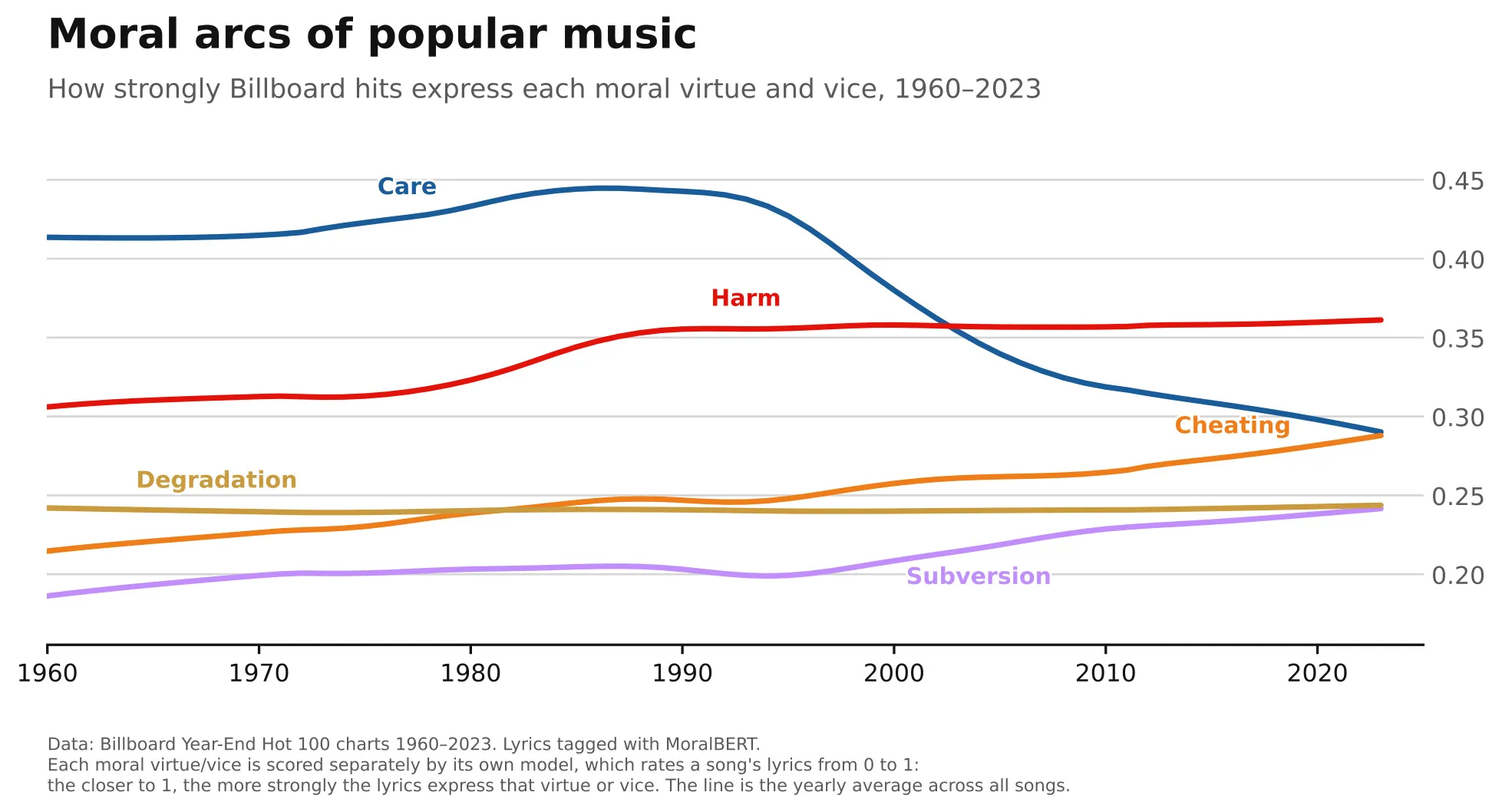
The research team analyzed the lyrics of more than 380,000 English pop songs from 1960 to 2023 and found that the overall emotional color is becoming increasingly negative, with a significant increase in words involving moral "vices" such as harm, deception, subversion, and degradation, and a significant decrease in language related to moral "virtues" such as care and decency. Researchers believe that this change may reflect the deep changes in emotional expression and values in contemporary society. Popular music is becoming an important "barometer" for observing cultural changes.
The research was led by the Digital Music Research Center at Queen Mary University of London and was mainly based on two large-scale lyrics data sets spanning more than 60 years. The researchers screened out about 377,000 English songs from the WASABI data set from 1960 to 2010, and added about 5,500 songs that were on the Billboard annual list from 1960 to 2023 to build a long-term corpus covering mainstream pop music. On this basis, the team used advanced artificial intelligence and language analysis technology to systematically track the emotional tendencies and moral themes in the lyrics.
The lead author of the study, Dr. Vjosa Preniqi of Queen Mary University of London, pointed out that music is far more than entertainment, it is one of the ways in which society tells its own story. By analyzing song lyrics across generations, it is possible to observe how emotional expressions and moral narratives evolve over time. She said research shows that language in lyrics related to virtues such as care and decency has gradually taken a back seat, while themes related to moral concerns such as conflict and harm have become more prominent. These changes are influenced by multiple factors within different music genres, including genre style, narrative traditions, and the creative tendency to attract attention through "impact," but the overall trend provides a window into the evolution of cultural values.
In a systematic analysis of the content of lyrics, the research team found that a variety of expressions related to moral "vices" continued to increase. For example, language involving harm, deception, subversion and degradation has gradually increased in pop songs of different eras, accompanied by an increase in emotional overtones such as negative emotions, anger and disgust. In contrast, expressions that reflect moral "virtues" such as care, decency, and loyalty account for a relatively lower proportion in lyrics, forming a long-term trend of "the rise of vices and the retreat of virtues" as a whole.
Research also shows that moral expression in lyrics varies significantly between different music genres. Some music genres tend to emphasize care and social connection, and themes such as mutual aid, support, and emotional attachment are common in songs; other genres more frequently display conflict, rebellion, and darker emotional narratives, highlighting gestures of confrontation, rejection, or breaking norms. This shows that the moral theme is not only related to the background of the times, but also closely connected with the narrative tradition, audience group and cultural positioning of various types of music.
At the artist group level, research has also found differences in patterns of moral expression between different gender categories. Under the premise of the binary gender classification used and the imbalanced gender ratio of the sample, the study observed that virtuous themes such as care and loyalty more often appear in the lyrics of female artists, while the works of men and mixed-gender combinations more frequently involve negative themes such as harm, subversion and degradation. The research team emphasizes that these findings need to be interpreted carefully in conjunction with the gender division in the data set and the imbalance in the gender distribution of artists to avoid oversimplifying complex creative and social factors.
Dr. Charalampos Saitis, senior author of the project, assistant professor of digital music processing at Queen Mary University of London and co-investigator of the joint doctoral training program in the field of AI and music, said that popular music provides a unique perspective for understanding cultural changes. Because music is such a broad and influential form of expression, analyzing lyrics at a large scale can help identify long-term trends that are not easily detectable in everyday perception. He pointed out that music not only mirrors social reality, but also shapes the way people understand the world. Therefore, tracking the evolution of moral narratives in lyrics can help us better understand the deep changes surrounding identity, social issues and collective values.
The research team combined computational linguistics, artificial intelligence technology, and theoretical frameworks on morality and human behavior in its approach. It used algorithms to extract and quantify emotional and moral-related words in lyrics, and then cross-analyzed them with dimensions such as time, genre, and artist characteristics. This interdisciplinary approach allows researchers to unearth hidden cultural signals from a large number of songs over decades, providing data support for how music reflects and even participates in shaping the social and emotional climate.
In the current context of increasingly heated public discussions about mental health, social cohesion and cultural change, researchers believe that pop music provides a precious "notebook" for observing social emotions and values. By examining the evolution of emotional and moral language in lyrics, we can see more clearly how different generations have expressed concerns, vented emotions, constructed meaning, and talked about justice and injustice through music. The research team stated that similar methods can be expanded to multilingual and multicultural contexts in the future to further understand the complex interaction between music and social changes on a global scale.
It is reported that the complete paper of this research has been published online, and readers can view detailed data and method instructions through the link provided by Queen Mary University of London.