According to the latest research published in Nature Astronomy by the University of Sydney in Australia and a related research team, astronomers may have found the key clue to deciphering a rare type of cosmic repetitive radio burst signal: a pair of star systems that tightly orbit each other and exchange matter. The new discovery points to a radio source called ASKAP J1745, which emits long-period radio transients thought to come from an interacting binary system consisting of a white dwarf star and a companion star.
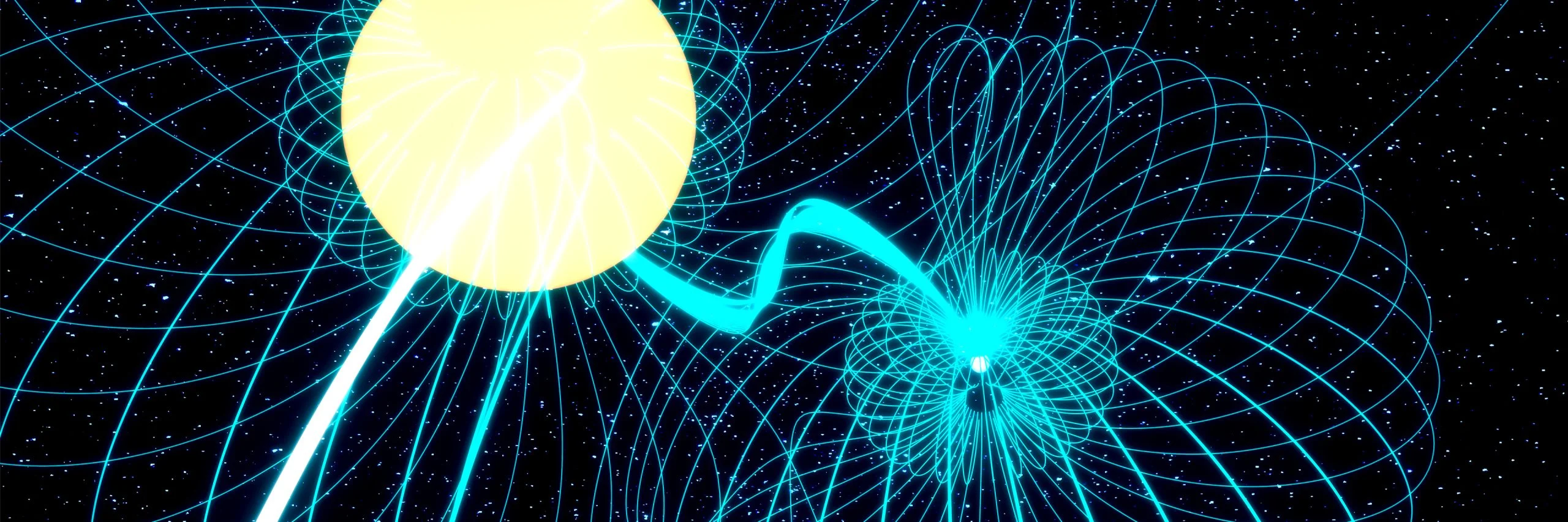
The so-called long-period radio transients refer to celestial objects that produce bright, repeated bursts in the radio band, with burst intervals ranging from minutes to hours. In recent years, astronomers have accidentally discovered this type of "slow pulse" signal during large-field surveys, and only a dozen sources have been confirmed so far. Many of them are located in the dense dust region of the Milky Way, making it difficult for optical telescopes to directly image them, which also poses a challenge to revealing their physical nature. Observations have shown that some long-period transient sources can continue to emit radio pulses regularly for up to 30 years, while others will suddenly "lose their voice" for several days or even become permanently silent.
Initially, researchers attributed the signals to extremely slowly spinning neutron star pulsars, the dense cores left behind after massive stars explode as supernovae. However, it is known that the radio emission of pulsars usually goes out as their rotation slows down. If the rotation period slows down to tens of minutes or even longer, traditional theory holds that they should no longer produce strong radio emission. As more observational data accumulated, the research team began to consider other possibilities such as white dwarfs, and found in some sources that they belonged to a binary star system: a compact object orbiting closely with a lower-mass red dwarf star.
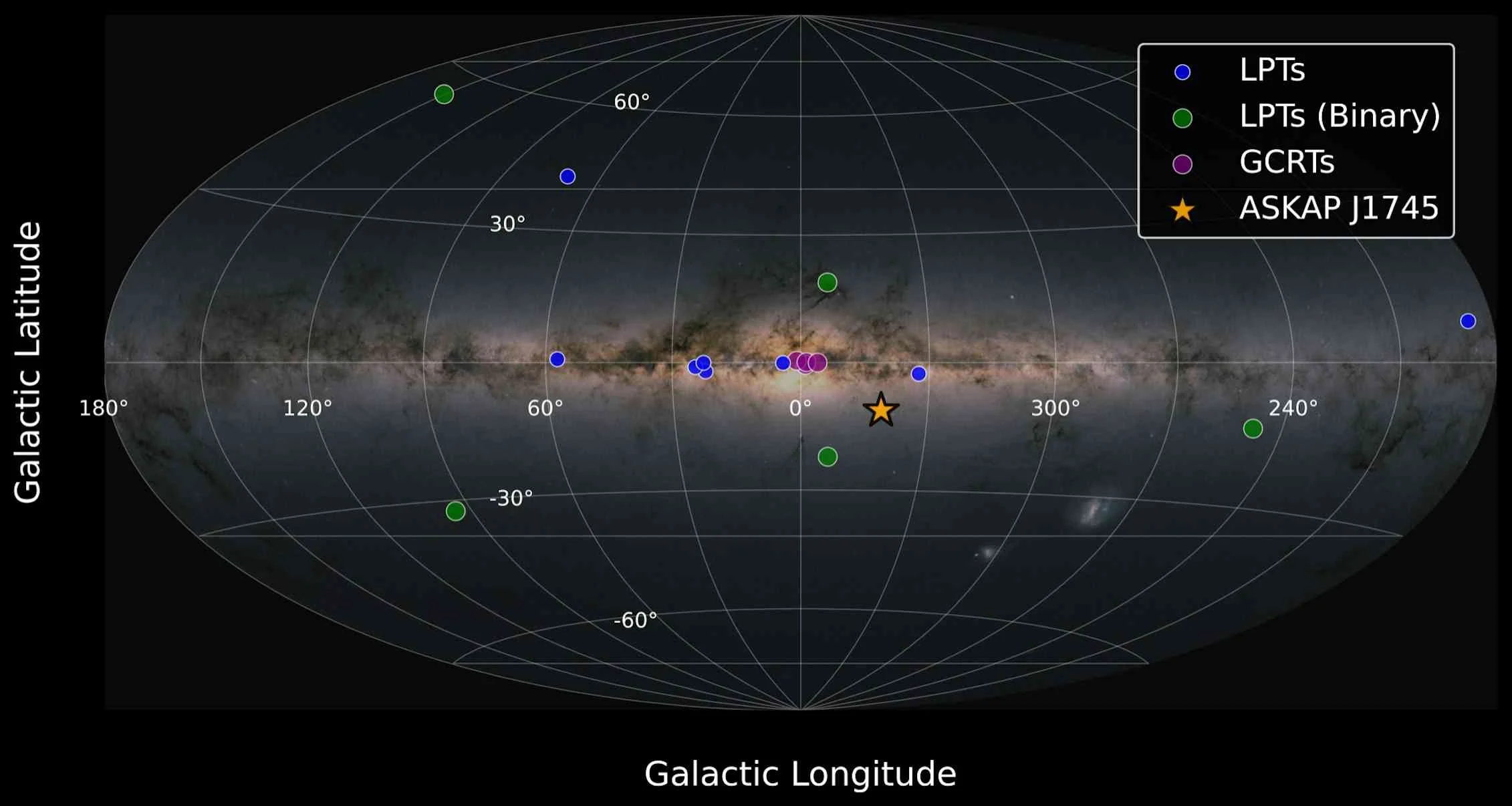
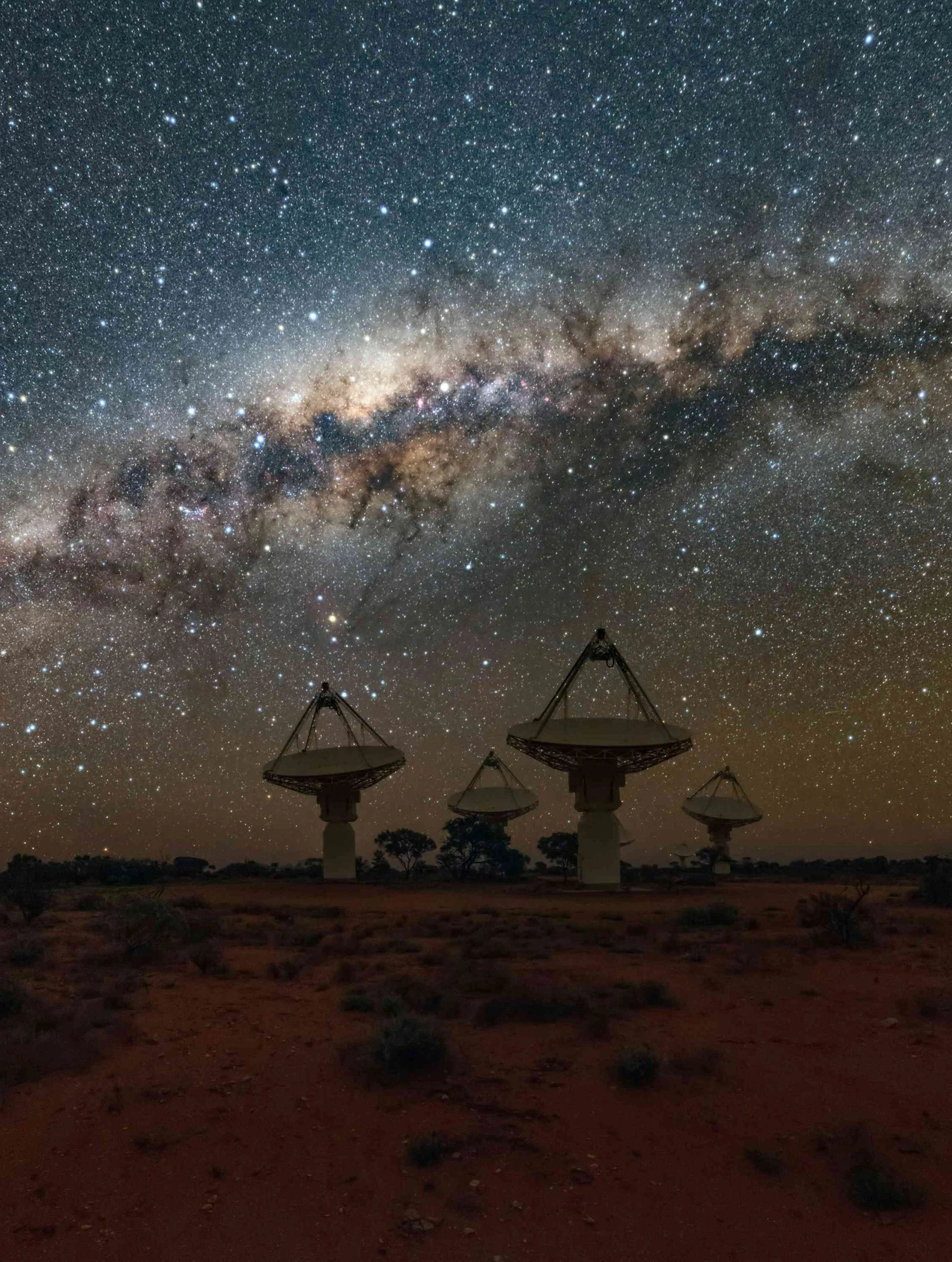
The latest discovery, ASKAP J1745, was detected by the ASKAP radio telescope operated by Australia's national science agency CSIRO and was confirmed to be a type of "cataclysmic variable". This type of system consists of a white dwarf star and a companion star. The two are close enough that the white dwarf can accrete matter from the companion star through gravity, so it is also called an "accretion white dwarf binary." Different from previous cases, researchers have for the first time matched the source's radio and X-ray bursts with the orbital motion of the binary star, and combined with optical observations to confirm that corresponding radio and X-ray burst signals will appear during each orbital cycle of the binary star.
In such rapidly rotating systems, X-ray radiation is thought to come primarily from material accreted by the white dwarf that is extremely heated as it falls toward its surface. Previously, the physical mechanism of radio bursts in long-period transient sources remained a mystery. Only one similar case has been found to have both radio and X-ray periodic signals, but the specific correspondence between the two is not clear. This time, through multi-band joint observations, the team inferred that the pulsed radio radiation of ASKAP J1745 mainly originated from the interaction between high-energy charged particles and strong magnetic fields. Both stars in this system have extremely strong magnetic fields, which are described as "generally thousands of times stronger than those of nuclear magnetic resonance imaging." The companion star continuously delivers charged material to the white dwarf, providing an ideal environment for the generation of radio bursts.
Researchers likened this breakthrough discovery of multiple bands and multiple information sources to the "Rosetta Stone" of deciphering ancient Egyptian hieroglyphics. Just as the Rosetta Stone records the same content in three languages to help scholars decipher ancient texts, ASKAP J1745 provides a unified and corresponding signal in the three bands of radio, X-rays and visible light, providing an important reference for understanding other long-period transient sources that are only visible in the radio band and have limited information. Currently, ASKAP J1745 is the first long-period transient source that exhibits accretion characteristics across the entire spectrum from radio to optical to X-rays, and its charged matter flow process is regarded as a key condition for the generation of radio radiation.
The scientific community believes that this discovery will not only help clarify the origin of long-period radio bursts, but also provide a rare "laboratory" for studying extreme physical processes. Through in-depth study of the interaction mechanism between charged particle flow and strong magnetic fields in such systems, astronomers can test and develop theoretical models about high-energy plasmas, magnetic field structures, and radiation mechanisms in environments that far exceed experimental conditions on Earth. The research paper is titled "Periodic radio and X-ray emission from an accreting white dwarf binary" and was officially published in Nature Astronomy in June 2026.