NASA recently released a new cosmic image taken by the Hubble Space Telescope, showing a magnificent scene of the star birth region LH 95 in the Large Magellanic Cloud: brilliant blue-white baby stars dotted above the red gas clouds, like the light and smoke left after fireworks bloom in the night sky.
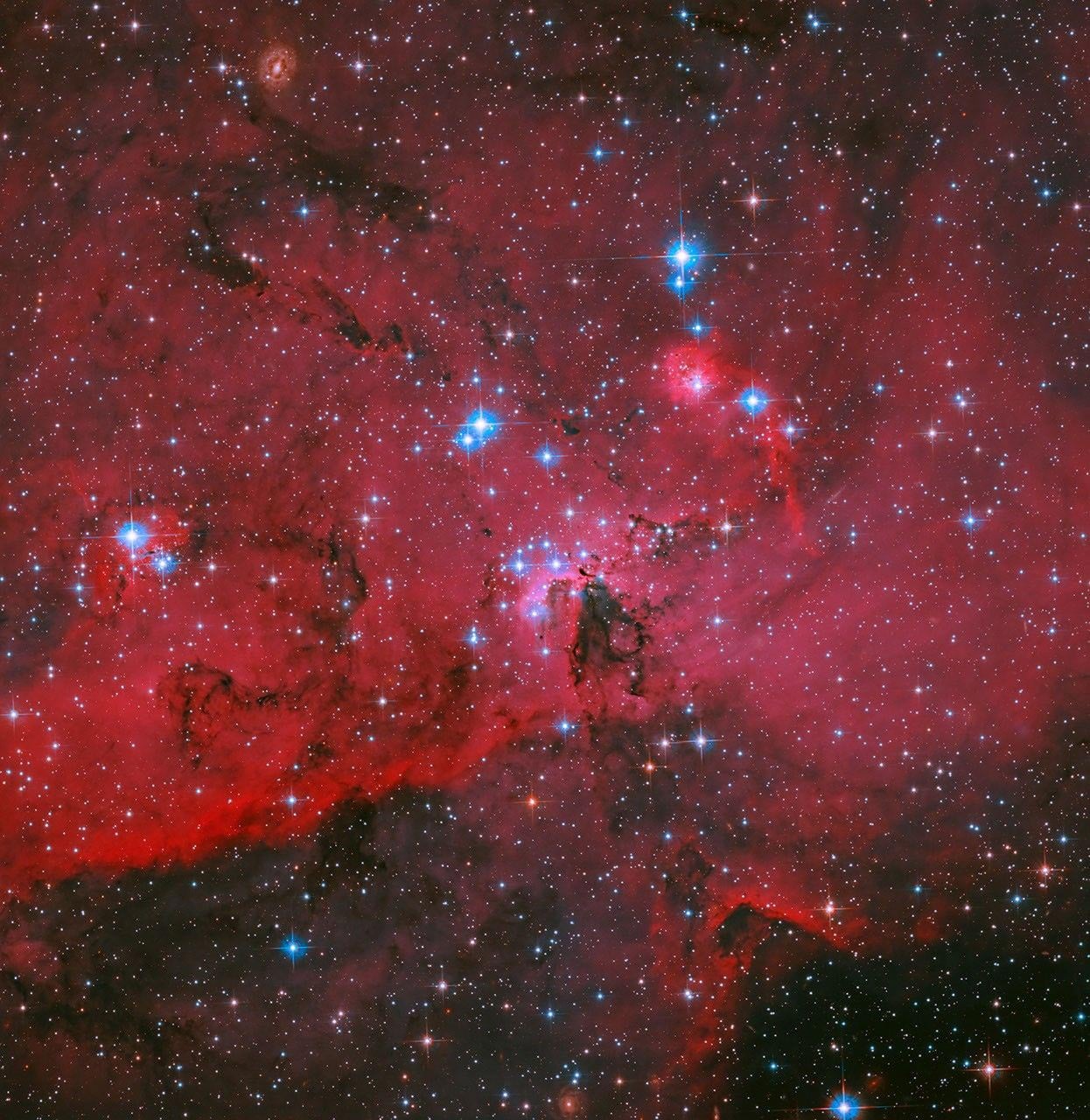
In the LH 95 region, the largest blue stars have at least three times the mass of the Sun. Their intense ultraviolet radiation and high-speed stellar winds continue to heat the surrounding hydrogen gas and carve out the overall shape of the nebula over a long period of time.
The colors in Hubble images are not natural colors directly seen by the human eye, but scientific visualizations of light of different wavelengths: blue represents shorter visible light wavelengths, while red covers longer visible light and part of the near-infrared band.
Scientists use Hα light to identify extremely young stars hidden in the luminous gas. The observations show that there are about 2,500 growing stars in the LH 95 region. They have almost accumulated the mass required to complete themselves, but have not yet begun the core nuclear fusion process.
Studying these newborn stars further supports a key rule: as they age, the rate at which they accret material from the surrounding disk of gas and dust naturally slows down.
Hubble's observations also revealed that LH 95 was not a single star formation event in a one-time burst, but instead gave birth to stars of different generations multiple times over millions of years, and these stars of different ages now stand side by side in the same nursery.
Because LH 95 has a rich variety of evolving stars and is less obscured by dust than many similar nurseries in the Milky Way, this goal provides astronomers with a close-up, clear-view "laboratory" to systematically study the entire process of stars from birth to growth.